The Next American Revolution will be Powered by AI (from ChatGPT)
Posted: June 21, 2024 Filed under: Governance Reform | Tags: ai, politics, reform, values Leave a commentWhat sort of values and strategies should an AI-powered movement focused on human flourishing adopt to use that [American Revolution bottom-up] blueprint to disrupt today’s dysfunctional institutions?
The Prompt
An AI-powered movement focused on human flourishing can draw valuable lessons from the American Revolution to disrupt today’s dysfunctional institutions. Here are key values and strategies to adopt:
Values:
Read the rest of this entry »Up From Socialism: The Heartbreaking Memoir Offering Hope to the Woke
Posted: January 27, 2024 Filed under: News | Tags: activism, polarization, politics, race, socialism, transformation, woke Leave a commentUp From Socialism: My 60-Year Search for a Healing New Radical Politics (Bombardier Books/Post Hill Press, edited by Adam Bellow, distributed by Simon & Schuster).
I have a confession to make.
I am a horrible person.
I am asking you to do something I haven’t done myself.
Maybe because I’m lazy and cowardly.
Or too busy. Or the wrong person.
But if you are hungry to change the world, and heal all the horrific wrongs you see in society, you need to read Mark Satin‘s latest book.
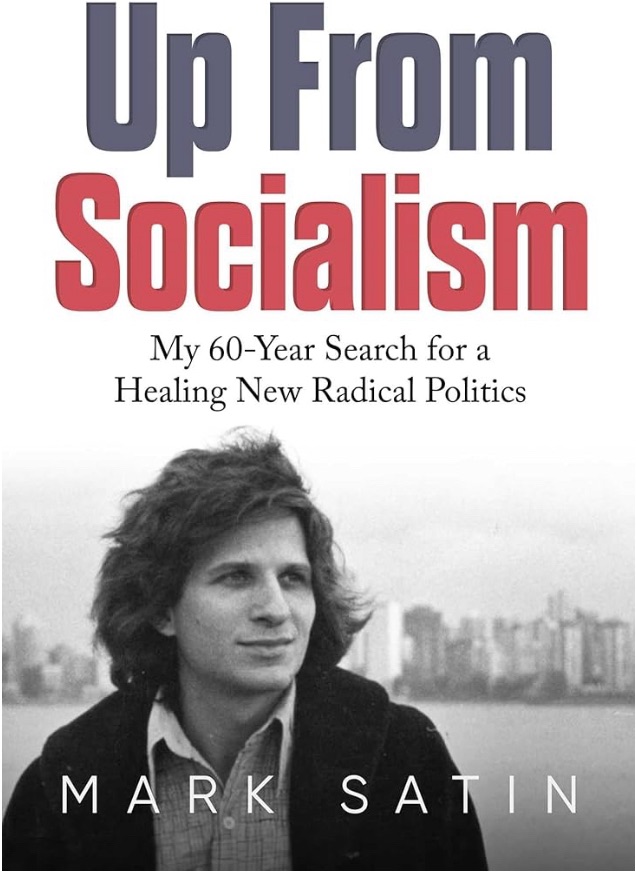
Because as he readily admits, he has tried and failed at that probably more times than anyone…
Read the rest of this entry »Repost: If I Were Hamas: An Exercise in Empathy
Posted: October 15, 2023 Filed under: Centroids | Tags: empathy, politics, war Leave a commentFits in with the Radical Centrist mantra of “loving your enemies to death.”
I can imagine being a true believer in Hamas… / If I knew a cure for this horrid compulsion, I would have used it. But from what I can see of the …
If I Were Hamas: An Exercise in Empathy
Podcast: Towards a Science of Spirituality
Posted: December 5, 2021 Filed under: education | Tags: reform, truth, wisdom, zoasophy Leave a commentI had the privilege of discussing Zoasophy on the Multiple Voices podcast with Claudia Monacelli from Rome. We had a blast! Check it out on your favorite Podcast player:
October 32nd, Part 3: Personal Reality
Posted: November 3, 2021 Filed under: Governance Reform | Tags: dialogue, emotions, politics, reform, training 2 CommentsContinued from Part 2
After hearing Carrie tell the story of Alex, the alien who became US President in this reality with an October 32nd, I sat there stunned for several minutes. Both at the radical shift in my entire concept of the universe — and at her amazingly concise summary of such an extraordinary series of events!
“Did you really just figure all that out while you were watching TV?” I asked.
She actually blushed when I said that. I couldn’t help noticing this made her several notches more attractive than I had initially thought. Read the rest of this entry »
October 32nd, Part 2: Political Alienation
Posted: November 2, 2021 Filed under: Governance Reform | Tags: debate, dialogue, politics, reform, values 2 CommentsContinued from Part 1
An hour later I am sitting In a coffee shop with the girl, Carrie. I don’t remember ever seeing her before, but that is hardly unusual in a university of 50,000+ students. Also. she isn’t exactly my type, I note with a wistful recollection of last night’s redhead.
But, she might be the only human being in this reality who won’t question my sanity. Plus, as an early riser, she seems way more on top of things than I am. Maybe she has some idea why we both woke up in a world where it was October 32nd, and an alien was President of the United States.
Read the rest of this entry »October 32nd, Part 1: The Day that Never Was
Posted: November 1, 2021 Filed under: Governance Reform | Tags: politics, reform, science fiction 1 CommentMaybe I drank too much.
Okay, yeah, I definitely did drink too much. I woke up with the mother of all hangovers. But that still isn’t enough to explain what happened.
Maybe it was the witch. But of course, she couldn’t have really been a witch. Just a sexy redhead in a store-bought witch’s costume. Perhaps she cast a spell on me, but that’s hardly unusual at a sorority Halloween party. She didn’t even take me back to her room or feed me a potion. I’ve gone over it in my mind a hundred times, and I still can’t find any way to pin it on her.
Still, there’s no denying Something must have happened. Even if nobody believes it but me.
I woke up in my rumpled bed; severely hung over, as mentioned before. My roommate was gone for the weekend, so I stumbled over to our kitchenette for a glass of water. I remember wondering whether a Bloody Mary might help, then realizing we were out of tomato juice.
It took a while for my fogged brain to figure out what was funny about our calendar. I remember thinking that I should probably flip it over to November. But then I corrected myself, as October obviously wasn’t over. Yesterday was Saturday, October 31st. Today was Sunday.
October 32nd.
Once my brain grasped the incongruity of what I was seeing, my first thought was the same as yours: one of my buddies must be gaslighting me. I padded back to the bedroom on bare feet and strapped on my Apple watch. I punched in the passcode to unlock it and checked the date.
October 32nd.
I scrolled through and changed the watch face, to make sure it wasn’t just a photo. But no, the watch really believed it was October 32nd. I checked my phone and laptop, and they both said the exact same thing.
Still, I’m just a lowly PoliSci major. How the hell do I know what hackers over in CompSci might be able to pull off? Jeremy, for example. He was a whiz with all these Apple gadgets. I could totally imagine him pulling a stunt like this, just to show he could.
We don’t have a TV, so I try to remember where I might be able to go buy a newspaper. I consider checking the web, but figure whoever hacked my computer probably installed some widget to make the browser rewrite all the dates.
Then I remember the TV in the basement of the Student Union. Its never used at this hour of Sunday morning, and I doubt Jeremy even knows it exists. I could just turn on the Weather Channel and get confirmation of today’s date.
In the back of my mind, part of me is wondering why I am so obsessed with disproving this date hack. But the rest of me tells that part to shut up. I shower, change, and stuff some dry Cheerios into my belly. Need to remember to buy some milk.
The quad is mostly empty, just scattered groups of well-dressed kids heading off to church together. I consider asking one of them what the date is, but I don’t want to come across as nutty as Ebenezer Scrooge.
I finally make it to the Union, and climb down the deserted stairs to the basement. Nobody seems to be there, but I can hear noise coming from the TV. Good; it is so rarely used, I was afraid it may have broken down or simply been scrapped.
It seems to be tuned to one of those 24-hour news channels. Which is fine, they probably have a running ticker with the date and time, right? I can just confirm the correct date, laugh at the cleverness and perversity of my friends, then get on with my life.
Except that’s not what happens.
As I enter the lounge, I receive two shocks. Make that three.
First, as you have no doubt guessed, I see the aforementioned ticker, and damn if it doesn’t also say October 32nd.
Second, the room isn’t empty. There’s a petite blonde sitting in the back corner, almost hidden behind an overstuffed sofa. She has some sort of journal in her lap, and appears to be scribbling furiously while glancing up at the screen.
The big shock, though, is what is happening on the screen.
“Holy shit!” says I.
“Oh, thank God,” responds the girl in back, glancing up at me. “You see it too! I was afraid I was the only one.”
I nod absently to acknowledge her, unable to tear my eyes off the TV. It is a scene from the White House. It looks like an ordinary press briefing. The usual crowd of correspondents are pestering the President with their questions.
But not the President I remember. The suit is the same: conservative navy blue pinstripe, double-breasted. Even the tie seems familiar: diagonal stripes, thick blue, thin red, white edging.
But the being wearing them, deftly answering questions as if nothing unusual is happening, is an alien. An honest-to-God, green-skinned, tentacled, bug-eyed alien.
To Be Continued

