Radical Graciousness: Activism as Social Therapy (ChatGPT as Gandhi)
Posted: November 28, 2024 Filed under: AI-Powered Essays | Tags: activism, polarization, politics, purpose, transformation, values 1 CommentWhy would Abbie Hoffman resist “radical graciousnsss“?
ChatGPT Prompts
This isn’t a cognitive problem. It probably reflects the emotional trauma that motivated his activism.
What historical figures could help Abbie feel psychologically safe enough to work through that?
Have Gandhi host a group therapy session on radical graciousness with Havel and Day, attended by a reluctant Abbie.
Setting the Scene
In a serene ashram courtyard under a sprawling banyan tree, Mahatma Gandhi hosts a transformative group therapy session. Joining him are Václav Havel, Dorothy Day, and a reluctant Abbie Hoffman. The participants sit on simple mats around a low wooden table, sharing fruit and tea, as they explore how graciousness can transform not only society but also the activist’s soul.
Gandhi Opens the Session
“Welcome, friends. Each of us has fought against oppression in our own way, driven by the fire of justice. But today, we ask: how do we resist without losing our humanity? Can grace not only strengthen our activism but heal the wounds that fuel it? Abbie,” he says, turning with a gentle smile, “I sense you carry a deep burden. Let’s begin with you.”
Hoffman crosses his arms, his voice sharp. “Look, Gandhiji, I appreciate the invite, but let’s not kid ourselves. Grace doesn’t topple systems. Anger does. Grace is what they preach to keep us quiet.”
Read the rest of this entry »Psychological Oobleck: A Fireside Chat on Assimilating Radical Change
Posted: November 28, 2024 Filed under: AI-Powered Essays | Tags: leadership, psychology, systems, transformation 2 CommentsSetting the Stage
In a warm library with a roaring fireplace, Peter Senge hosts a fireside chat featuring Karl Weick, Barry Staw, and Chris Argyris. The topic: why humans and organizations behave like psychological oobleck—flexible under gradual change but rigid when hit with force—and how to help them assimilate radical transformation. The conversation is fueled by wit, wisdom, and several bottles of wine.

Peter Senge Opens the Evening
“Good evening, friends. Tonight, we delve into a peculiar metaphor: organizations as oobleck. Flexible under light touch, unyielding under pressure. How do individuals and systems absorb change, and what makes them solidify under threat? And more importantly, is Karl’s Merlot truly as transformative as radical change itself?”
Read the rest of this entry »The Great American Marriage: Kamal Harris v. Donna Trump
Posted: November 19, 2024 Filed under: AI-Powered Essays | Tags: argument, dialogue, ideas, intellectual, polarization, politics, reform, relationships, transformation, values Leave a commentWrite a hunorous three-act play where the American political divide is portrayed as a couple, Donna Trump and Kamal Harris.
ChatGPT Prompt
In Act II, show their therapist Miriam Bowen-Friedman guiding them to a breakthrough using self-harmonization and the example of Jefferson and Adams.
Highlight how their conflicts mirror their inner struggles and how embracing their rejected parts (Donna’s logic, Kamal’s passion) leads to personal and relational growth, especially for parenting their kids.
#InternalFamilySystems
Act I – “Divided We Bicker”
Setting: The living room of the America household. The room is divided down the middle. On one side, everything is red, adorned with eagles and a MAGA hat on the coffee table. On the other side, it’s blue, with a climate change poster and a Ruth Bader Ginsburg bobblehead on the shelf. Donna Trump, wearing a red power suit and pearls, is pacing aggressively. Kamal Harris, in a navy blazer with a cup of herbal tea, is calmly sitting on the couch.
Scene 1: The Disagreement
Donna Trump (hands on hips):
Kamal, I’m telling you, we need a wall! The neighbor’s kids keep cutting through our yard. It’s disrespectful!
Kamal Harris (raises an eyebrow, sipping tea):
Donna, we don’t need a wall. We need a fence, maybe even a community garden. Let’s invite them over and talk about why they’re cutting through.
Donna Trump (throws her hands in the air):
Talk? TALK? By the time you’re done “talking,” they’ll have taken the lawn chairs, the grill, and the doghouse!
Higher Self Café, v4: Miriam Harmonizes The Philosophers
Posted: November 17, 2024 Filed under: AI-Powered Essays | Tags: debate, dialogue, philosophy, relationships, systems, transformation 2 CommentsContinued from Frankel vs Maslow/Bowen/Hegel and Chesterton vs Philosophers.
Scene: The Philosophers’ Table
The café exudes warmth and intellectual energy. The round wooden table is cluttered with coffee cups, scribbled napkins, and sugar packets stacked into haphazard sculptures. G.K. Chesterton, Abraham Maslow, and Viktor Frankl are engaged in a spirited debate. Miriam Bowen-Friedman, the waitress, enters to clear the table, carrying herself with quiet authority.
1. The Napkin Sketch Incident
Chesterton
(as Miriam reaches for a napkin with a crude pyramid sketch)
Stop, stop! You’re about to destroy the next chapter of Orthodoxy!
Miriam
(pauses, holding the napkin up to the light, feigning deep thought)
I don’t know. It looks more like Heresy to me.
Maslow
(leans forward, grinning)
You’ve got a sharp tongue. Careful, we might recruit you into philosophy.
Miriam
(deadpan)
Only if you let me clean up the mess you’ve made of it.
Higher Self Cafe, v3: Chesterton vs Philosophers
Posted: November 16, 2024 Filed under: AI-Powered Essays | Tags: debate, philosophy, religion, transformation, truth 1 CommentAs the laughter settles, the café door creaks open, letting in a gust of wind. In strides G.K. Chesterton, his broad figure wrapped in a heavy coat and scarf, a walking stick in hand. He scans the room, spots the group, and approaches their table with curiosity. Standing over Maslow’s napkin, now covered in scribbles and redrawn layers, he stares at the pyramid with a slight frown.
Chesterton:
Booming voice, laced with mischief
Ah, the famous pyramid! But I must say, gentlemen, it looks terribly… unfinished. You’ve all been climbing this structure like rational mountaineers, but what happens when you reach the peak and realize it’s upside down?
The Chronicles of Hither and Yon: The Quest for the Included Middle
Posted: November 9, 2024 Filed under: AI-Powered Essays | Tags: culture, philosophy, transformation Leave a commentFADE IN:
INT. VILLAGE OF HITHERION – TOWN SQUARE – DAY
Villagers bustle about in a neat, orderly square split right down the middle. On one side, EVERYTHING IS BRIGHT AND WHITE; on the other side, DARK AND SHADOWY.
NARRATOR (V.O.)
Once upon a time, in the curious land of Hitherion, there was no such thing as “maybe.” You were either on one side or the other – Absolutely or Absolutely Not.
We see a young boy, EDMUND (late teens, awkward but curious), standing by the LINE that divides the town in two. He squints at the swirling mist that runs down the center of the square, a magical boundary called THE LINE.
Read the rest of this entry »The Friedman School: Self-Differentiating Leaders for a Meta-Modern World
Posted: November 7, 2024 Filed under: AI-Powered Essays, education | Tags: business, politics, resilience, systems, training, transformation, values 1 Comment[Yes, this is a ChatGPT-powered fantasy. But seriously: why isn’t anyone doing this? — Ernie P.]
FOR IMMEDIATE RELEASE
April 1, 2025
Minerva University Launches The Friedman School: A Groundbreaking Program for Self-Differentiating Leaders in a Meta-Modern World
SAN FRANCISCO, CA — Minerva University today announced the launch of The Friedman School, a pioneering leadership program designed to develop self-differentiating leaders equipped to navigate, integrate, and lead in the complex, interconnected meta-modern world. Named in honor of Edwin Friedman, the influential thinker on self-differentiation and systems-based leadership, The Friedman School aims to empower a new generation of leaders with the resilience, empathy, and adaptability needed to address today’s global challenges.
Read the rest of this entry »Toynbee-22: Design Brief for a New Civilization
Posted: November 3, 2024 Filed under: AI-Powered Essays, Governance Reform | Tags: civilization, politics, reform, transformation Leave a commentChatGPT as Arnold J. Toynbee
As Toynbee, write a design brief for the successor to Western civilization.
The Prompt
1. Project Background and Purpose
Context:
Western civilization, in its current form, has reached a critical juncture. Rooted in centuries of exploration, technological advancement, and intellectual development, it has fostered great achievements but also complex crises—ecological degradation, socioeconomic inequality, and a pervasive sense of alienation. These challenges signal not merely an era of decline but the potential for transformation, as Western civilization’s response to its own contradictions can serve as a generative force for a new, transcendent cultural epoch. History teaches us that civilizations evolve by creatively responding to crises, and in this spirit, we must envision a successor to the Western world order.
Objective:
To conceptualize a civilization that synthesizes the strengths of Western achievements with the wisdom of other traditions, creating a new cultural framework that prioritizes human connection, ecological stewardship, and a balanced pursuit of knowledge. This new civilization will be a bridge from the individualistic, materialistic focus of the West to a more integrated, sustainable, and spiritually fulfilling way of life. The aim is to not only resolve existing crises but to foster a cultural foundation that can endure and thrive in an interconnected global future.
Read the rest of this entry »Saving Washington: The Cure for Political Divisiveness
Posted: August 10, 2024 Filed under: AI-Powered Essays, Governance Reform | Tags: competition, partisanship, politics, race, reform, transformation 4 CommentsChatGPT as George Washington, with help from Edwin Friedman and Paul Bloom
My Fellow Americans,
I stand before you now, not as the first President of our beloved Republic, but as one who has journeyed beyond the veil of time, beholding the trials and triumphs of our nation from a vantage point few can comprehend. I speak to you from beyond the grave, not out of a desire to relive the glories of old, but to address the grave perils that now threaten to undo the very fabric of our Union.
When I penned my Farewell Address, I warned of the dangers of political factions and partisanship. I implored you to guard against the spirit of division, for I knew that it would lead to discord and weaken the strength of our nation. Yet, even I could not foresee the extent to which these divisions would deepen, threatening to tear asunder the bonds that hold us together as one people.
The Crisis of Partisanship
Today, we find ourselves at a crossroads, where the spirit of partisanship has taken root in the hearts and minds of our citizens. The symptoms are clear:
Read the rest of this entry »Up From Socialism: The Heartbreaking Memoir Offering Hope to the Woke
Posted: January 27, 2024 Filed under: News | Tags: activism, polarization, politics, race, socialism, transformation, woke Leave a commentUp From Socialism: My 60-Year Search for a Healing New Radical Politics (Bombardier Books/Post Hill Press, edited by Adam Bellow, distributed by Simon & Schuster).
I have a confession to make.
I am a horrible person.
I am asking you to do something I haven’t done myself.
Maybe because I’m lazy and cowardly.
Or too busy. Or the wrong person.
But if you are hungry to change the world, and heal all the horrific wrongs you see in society, you need to read Mark Satin‘s latest book.
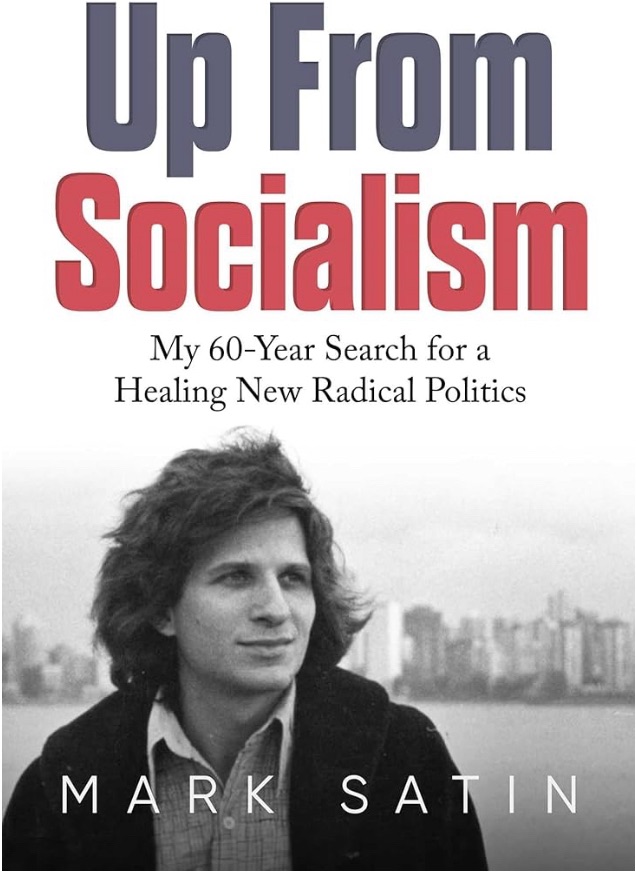
Because as he readily admits, he has tried and failed at that probably more times than anyone…
Read the rest of this entry » Radical Centrism