Higher Self Cafe, v3: Chesterton vs Philosophers
Posted: November 16, 2024 Filed under: AI-Powered Essays | Tags: debate, philosophy, religion, transformation, truth 1 CommentAs the laughter settles, the café door creaks open, letting in a gust of wind. In strides G.K. Chesterton, his broad figure wrapped in a heavy coat and scarf, a walking stick in hand. He scans the room, spots the group, and approaches their table with curiosity. Standing over Maslow’s napkin, now covered in scribbles and redrawn layers, he stares at the pyramid with a slight frown.
Chesterton:
Booming voice, laced with mischief
Ah, the famous pyramid! But I must say, gentlemen, it looks terribly… unfinished. You’ve all been climbing this structure like rational mountaineers, but what happens when you reach the peak and realize it’s upside down?
The Chronicles of Hither and Yon: The Quest for the Included Middle
Posted: November 9, 2024 Filed under: AI-Powered Essays | Tags: culture, philosophy, transformation Leave a commentFADE IN:
INT. VILLAGE OF HITHERION – TOWN SQUARE – DAY
Villagers bustle about in a neat, orderly square split right down the middle. On one side, EVERYTHING IS BRIGHT AND WHITE; on the other side, DARK AND SHADOWY.
NARRATOR (V.O.)
Once upon a time, in the curious land of Hitherion, there was no such thing as “maybe.” You were either on one side or the other – Absolutely or Absolutely Not.
We see a young boy, EDMUND (late teens, awkward but curious), standing by the LINE that divides the town in two. He squints at the swirling mist that runs down the center of the square, a magical boundary called THE LINE.
Read the rest of this entry »The Friedman School: Self-Differentiating Leaders for a Meta-Modern World
Posted: November 7, 2024 Filed under: AI-Powered Essays, education | Tags: business, politics, resilience, systems, training, transformation, values 1 Comment[Yes, this is a ChatGPT-powered fantasy. But seriously: why isn’t anyone doing this? — Ernie P.]
FOR IMMEDIATE RELEASE
April 1, 2025
Minerva University Launches The Friedman School: A Groundbreaking Program for Self-Differentiating Leaders in a Meta-Modern World
SAN FRANCISCO, CA — Minerva University today announced the launch of The Friedman School, a pioneering leadership program designed to develop self-differentiating leaders equipped to navigate, integrate, and lead in the complex, interconnected meta-modern world. Named in honor of Edwin Friedman, the influential thinker on self-differentiation and systems-based leadership, The Friedman School aims to empower a new generation of leaders with the resilience, empathy, and adaptability needed to address today’s global challenges.
Read the rest of this entry »Toynbee-22: Design Brief for a New Civilization
Posted: November 3, 2024 Filed under: AI-Powered Essays, Governance Reform | Tags: civilization, politics, reform, transformation Leave a commentChatGPT as Arnold J. Toynbee
As Toynbee, write a design brief for the successor to Western civilization.
The Prompt
1. Project Background and Purpose
Context:
Western civilization, in its current form, has reached a critical juncture. Rooted in centuries of exploration, technological advancement, and intellectual development, it has fostered great achievements but also complex crises—ecological degradation, socioeconomic inequality, and a pervasive sense of alienation. These challenges signal not merely an era of decline but the potential for transformation, as Western civilization’s response to its own contradictions can serve as a generative force for a new, transcendent cultural epoch. History teaches us that civilizations evolve by creatively responding to crises, and in this spirit, we must envision a successor to the Western world order.
Objective:
To conceptualize a civilization that synthesizes the strengths of Western achievements with the wisdom of other traditions, creating a new cultural framework that prioritizes human connection, ecological stewardship, and a balanced pursuit of knowledge. This new civilization will be a bridge from the individualistic, materialistic focus of the West to a more integrated, sustainable, and spiritually fulfilling way of life. The aim is to not only resolve existing crises but to foster a cultural foundation that can endure and thrive in an interconnected global future.
Read the rest of this entry »Saving Washington: The Cure for Political Divisiveness
Posted: August 10, 2024 Filed under: AI-Powered Essays, Governance Reform | Tags: competition, partisanship, politics, race, reform, transformation 4 CommentsChatGPT as George Washington, with help from Edwin Friedman and Paul Bloom
My Fellow Americans,
I stand before you now, not as the first President of our beloved Republic, but as one who has journeyed beyond the veil of time, beholding the trials and triumphs of our nation from a vantage point few can comprehend. I speak to you from beyond the grave, not out of a desire to relive the glories of old, but to address the grave perils that now threaten to undo the very fabric of our Union.
When I penned my Farewell Address, I warned of the dangers of political factions and partisanship. I implored you to guard against the spirit of division, for I knew that it would lead to discord and weaken the strength of our nation. Yet, even I could not foresee the extent to which these divisions would deepen, threatening to tear asunder the bonds that hold us together as one people.
The Crisis of Partisanship
Today, we find ourselves at a crossroads, where the spirit of partisanship has taken root in the hearts and minds of our citizens. The symptoms are clear:
Read the rest of this entry »Up From Socialism: The Heartbreaking Memoir Offering Hope to the Woke
Posted: January 27, 2024 Filed under: News | Tags: activism, polarization, politics, race, socialism, transformation, woke Leave a commentUp From Socialism: My 60-Year Search for a Healing New Radical Politics (Bombardier Books/Post Hill Press, edited by Adam Bellow, distributed by Simon & Schuster).
I have a confession to make.
I am a horrible person.
I am asking you to do something I haven’t done myself.
Maybe because I’m lazy and cowardly.
Or too busy. Or the wrong person.
But if you are hungry to change the world, and heal all the horrific wrongs you see in society, you need to read Mark Satin‘s latest book.
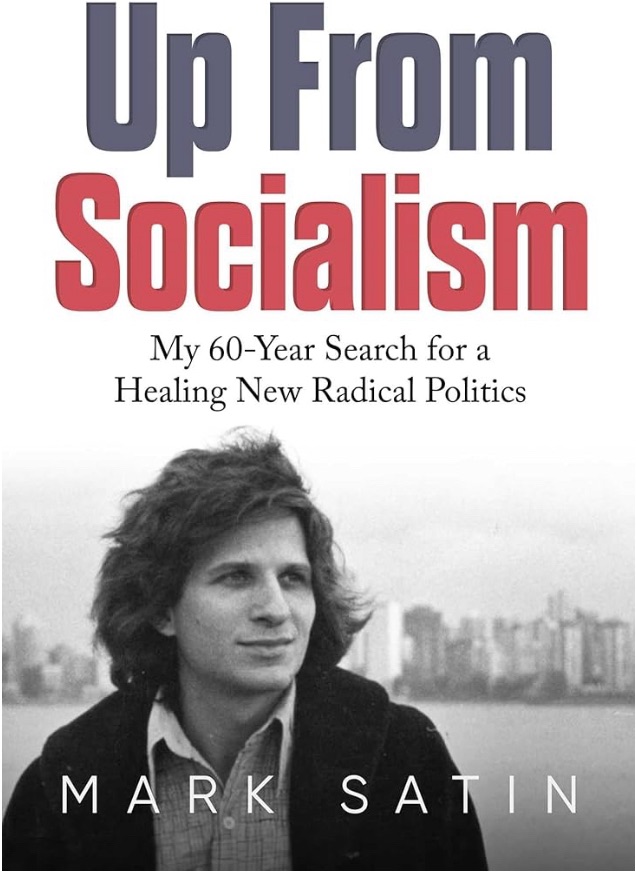
Because as he readily admits, he has tried and failed at that probably more times than anyone…
Read the rest of this entry »Ultimate Harmony
Posted: August 16, 2020 Filed under: Governance Reform | Tags: culture, economics, education, health, philosophy, politics, psychology, reform, religion, systems, transformation Leave a commentThe ultimate purpose and measure of mental, emotional, and spiritual health is a Harmonious Self, where each Part relates constructively to the Other.
The ultimate purpose and measure of political, economic, and cultural health is a similarly Harmonious Society.
The ultimate purpose and measure of parenting, education and religion is our ability to become Harmonious Selves who co-construct more Harmonious Societies. Read the rest of this entry »
THS-4H: Systemic Virtue
Posted: July 2, 2020 Filed under: Governance Reform | Tags: systems, transformation Leave a commentAmerica is facing a long-overdue reckoning with issues related to racism and inequity. Again. In fact, this seems to happen every fifty years or so:
- The American Revolution
- Jacksonian Democracy
- The American Civil War
- Women’s Suffrage
- Civil Rights
- #BlackLivesMatter
While there has certainly been progress, I have this ugly suspicion that the way we solved each crisis led directly to the next one. While numerous individual benefited from each of those reforms, there is a nagging sense that whole populations are still as disenfranchised as ever.
Can we do better? I believe so — but it won’t be easy. We remain trapped by the codependency between 18th-century ideologies, currently represented by capitalist conservatism and Marxist liberalism. We need a breakthrough vision of what a good society could be in order to guide our efforts in a more constructive direction.
Below is my first draft of such a vision, building on my earlier THS-IPA: A Game-Theoretic Model of Transformation. I welcome your feedback!
Read the rest of this entry »THS-IPA: A Game-Theoretic Model of Transformation
Posted: April 17, 2020 Filed under: Governance Reform | Tags: game theory, politics, resources, status, transformation, values 2 CommentsThis is my first attempt to articulate a coherent theoretical model of transformation, based on my dialogues with Prof. Agnis Stibe on Transforming Human Systems.
The Instigator-Population-Agents (IPA) model describes the dynamics of how an Instigator spreads behavior across a particular Population of Agents. While most commonly used for leaders attempting to transform a group of people, the model should also be applicable to individuals (via the society of mind interpretation), social animals, and even some computational systems.
Read the rest of this entry »
