Younger Self Café Epilogue: Eras of Musical Legends
Posted: January 3, 2025 Filed under: AI-Powered Essays | Tags: culture, identity, self, values 1 CommentA Roundtable Hosted by Katy Perry
The Younger Self Café transforms one last time, its walls lined with glowing neon guitars, vinyl records, and digital holograms. The café is now a grand roundtable, the conversation spanning decades of music and culture. Hosting this final gathering is the ever-colorful Katy Perry (Official Site), who brings together three legendary voices: Elvis Presley (Official Site), Billy Joel (Official Site), and Garth Brooks (Official Site). The conversation flows like a song, weaving together themes of youth, reinvention, and the enduring power of music.
Act I: Katy Perry Sets the Stage
Katy Perry sits at the center, her outfit a dazzling mix of retro and futuristic styles, nodding to the eras represented at the table. Her bright energy kicks off the discussion.
🎙️ Katy Perry: “Welcome, legends. We’ve had poets, writers, and activists in this café, but today, we’re closing it out with the music that shaped generations. You’ve all been icons of reinvention, of youth culture, of moments that changed how people felt about themselves and the world. So, let’s talk about it. What does youth mean to you? And how does music keep it alive?”
Read the rest of this entry »Younger Self Café v3: Kerouac and the Beat Generation
Posted: January 3, 2025 Filed under: AI-Powered Essays | Tags: culture, identity, transformation, values 2 CommentsThe Younger Self Café is alive with energy, its bohemian charm electrified by the arrival of the Beat Generation. Smoke lingers in the air despite the “no smoking” signs that someone’s thumbed out of existence. Jazz hums in the background, syncopated rhythms punctuating the cadences of their conversation. Around a table sit Jack Kerouac, Allen Ginsberg, William S. Burroughs, and Diane di Prima, their words weaving a tapestry of rebellion, searching, and longing.
Act I: Kerouac, the Nomad
Jack Kerouac, wearing a rumpled plaid shirt and running his fingers through his hair, starts the conversation. His voice is soft but insistent, the cadence of On the Road lacing every sentence.
“Youth, man—it’s not something you grow out of. It’s a road you’re always on. When I wrote about Sal Paradise and Dean Moriarty, I wasn’t just writing about a couple of guys chasing kicks. I was writing about that feeling—you know the one—when you’re young and you think the world is just waiting for you to discover it. And maybe it is. But youth isn’t about age; it’s about being open, being alive. It’s about saying yes to the journey, no matter where it takes you.”
Read the rest of this entry »Younger Self Café v2: T.S. Eliot and the Early Moderns
Posted: January 3, 2025 Filed under: AI-Powered Essays | Tags: culture, identity, values, wisdom 3 CommentsThe Younger Self Café has changed. The bohemian charm of mismatched chairs and golden light remains, but the air feels heavier, tinged with the weight of modernity. A new set of figures sits at the tables—T.S. Eliot, Ezra Pound, H.D. (Hilda Doolittle), and W.B. Yeats. The Romantic ghosts linger in the corners, observing silently as these poets of the early 20th century grapple with the meaning of youth in a fractured, modern world.
Act I: Eliot, the Skeptic
T.S. Eliot adjusts his tie, his expression as sharp and unyielding as the lines of The Waste Land. He begins, his voice clipped and deliberate:
“Youth, as the Romantics envisioned it, was a noble fiction. A beautiful illusion, yes, but an illusion nonetheless. To them, it was a time of passion, of fire, of self-discovery. But in my time, youth is not a spark—it is a shadow. In The Love Song of J. Alfred Prufrock, I wrote of a man who had outlived his youth only to find that it was no sanctuary, no paradise, but a series of missed opportunities and unspoken questions. Youth is not a promise of becoming; it is the burden of what one might fail to become.”
Read the rest of this entry »Younger Self Café: Did Romantic Poets Invent “Youth?”
Posted: January 3, 2025 Filed under: AI-Powered Essays | Tags: culture, emotions, reform, self, values 3 CommentsRiffing on Modern Self Café
In a dimly lit, bohemian café nestled somewhere between the foggy moors of England and the shores of Lake Geneva, the spirits of the Romantic poets gather. This is the Younger Self Café, a space outside time where youth itself is the central theme. The poets—Percy Bysshe Shelley, John Keats, Lord Byron, and William Wordsworth—sit at small wooden tables, their ink-stained hands gripping steaming cups of tea and coffee. Overhead, the faint sound of a skylark mingles with the whispers of an eternal breeze.
They are here to grapple with a profound question: Did they invent the modern concept of “youth” as something distinct, not just a precursor to adulthood but a transformative state of being?
Read the rest of this entry »Remix: The Next Jazz Age (ChatGPT as F. Scott Fitzgerald)
Posted: December 27, 2024 Filed under: AI-Powered Essays | Tags: culture, modernity, self, transformation, truth, values 1 CommentChatGPT Prompt
Have the ghost of F Scott Fitzgerald speak at The Plaza Hotel on the exact centennial of The Great Gatsby, reflecting on how the Jazz Age marked a shift from top-down/elder to bottom-up/youth culture.
Muse optimistically how the upcoming Age of Remix could herald a similar shift to an inside-out culture of “perpetual adolescence” (in both positive and negative senses of continual self-creation).
Scene: The Grand Ballroom of The Plaza Hotel, New York City. The date is April 10, 2025, precisely 100 years after the publication of The Great Gatsby. A gentle glow fills the room, and the ghost of F. Scott Fitzgerald appears, his figure refined and luminous, dressed in his Jazz Age finery. He approaches the podium, the timeless elegance of the space mirroring the timelessness of his words.
F. Scott Fitzgerald:
Ladies and gentlemen,
One hundred years ago, I offered the world a story—a slender book, simple in its telling, but complex in its reflection of a moment when the tides of culture began to shift. The Great Gatsby was born from the Jazz Age, an era where the old world—dominated by elder authority and inherited tradition—gave way to a vibrant, uncontainable culture driven by youth. The top-down society of my parents’ generation crumbled, replaced by the daring, pulsating rhythms of jazz, the shimmer of sequins in dimly lit speakeasies, and the bold defiance of young women in bobbed hair and short skirts.
The Jazz Age was a turning point, a revolt against the weight of history and a celebration of creation from the ground up. It was a time when young people became the architects of culture, when their music, their ideals, and even their recklessness reshaped the world. But as I stand here, gazing across the veil of time into your era, I sense that another transformation is on the horizon.
Read the rest of this entry »Modern Self Café v3: Gödel, Einstein, Wittgenstein, and Simone
Posted: December 23, 2024 Filed under: AI-Powered Essays | Tags: debate, modernity, philosophy, purpose, values 1 CommentContinued from Modern Self Café v2: Kant Goethe There
Write the sequel, with dramatic embellishments for more emotional depth.
ChatGPT Prompt
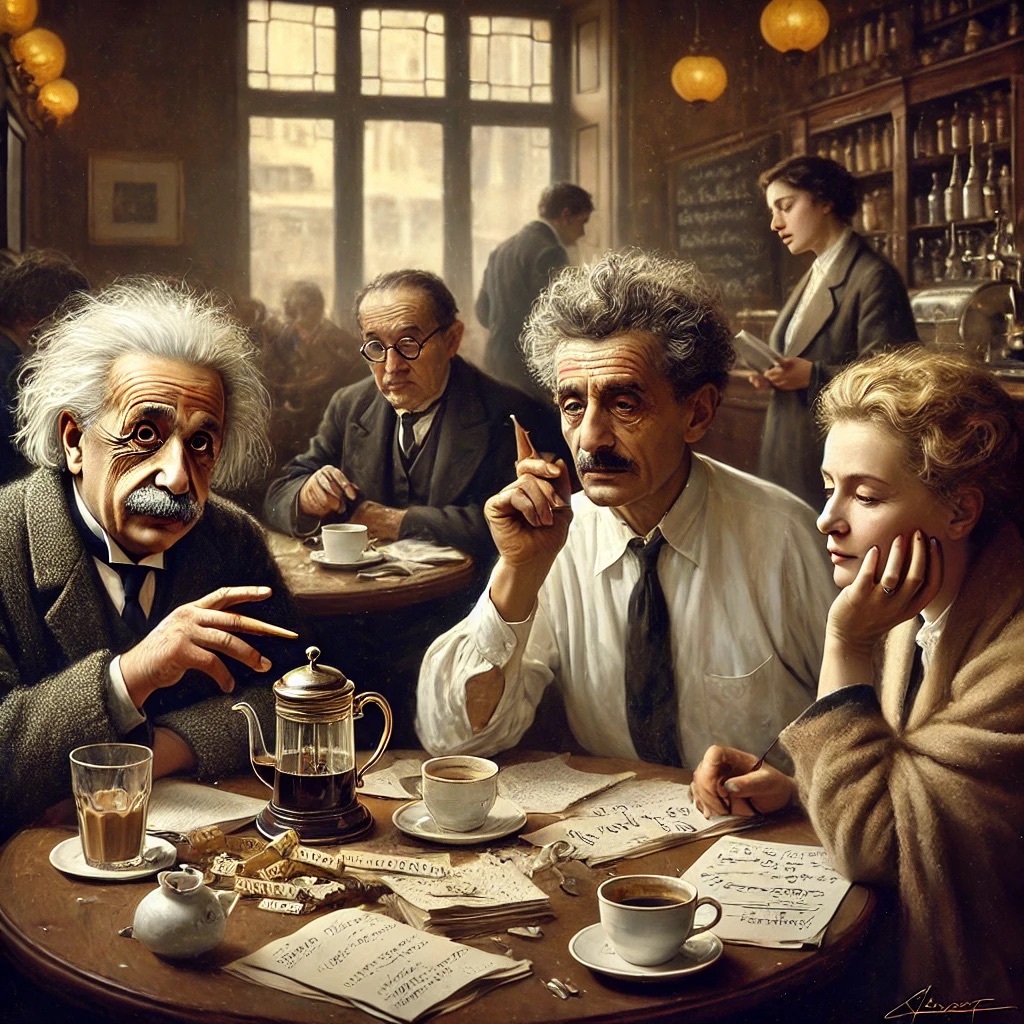
Setting: A cozy café in Vienna in the mid-20th century. The café is warmly lit, bustling softly in the background, but at one corner table, the air crackles with tension. Kurt Gödel, Albert Einstein, Ludwig Wittgenstein, and Simone de Beauvoir are engaged in an intense discussion. A half-drunk coffee cup with a faint crack sits at the center of the table, a quiet metaphor for the limits of understanding.
Einstein: (leaning forward, tapping a spoon on the cracked cup) I’ll say it again: the universe is orderly. Beneath all this chaos—quantum mechanics, human indecision, even linguistic paradoxes—there must be a unified, elegant truth.
Gödel: (quietly, yet resolute) But Albert, even if such a truth exists, how can you know it’s accessible to us? My incompleteness theorem shows that even within our most rigorous systems, there are truths that cannot be proven. Certainty is always incomplete.
Einstein: (frowning) Then what, Kurt? We should just give up? I’ve spent my life seeking simplicity in the complexity of space and time. Without that belief, what’s the point of any of it?
Read the rest of this entry »Modern Self Café: Galileo, Descartes, Mersenne
Posted: December 23, 2024 Filed under: AI-Powered Essays | Tags: dialogue, models, modernity, philosophy, transformation, truth, values 3 CommentsA spin-off from Higher Self Café.
Write a dialogue with Galileo, Mersenne, and Descartes that helps moderns understand the mental shift they engineered.
ChatGPT Prompt
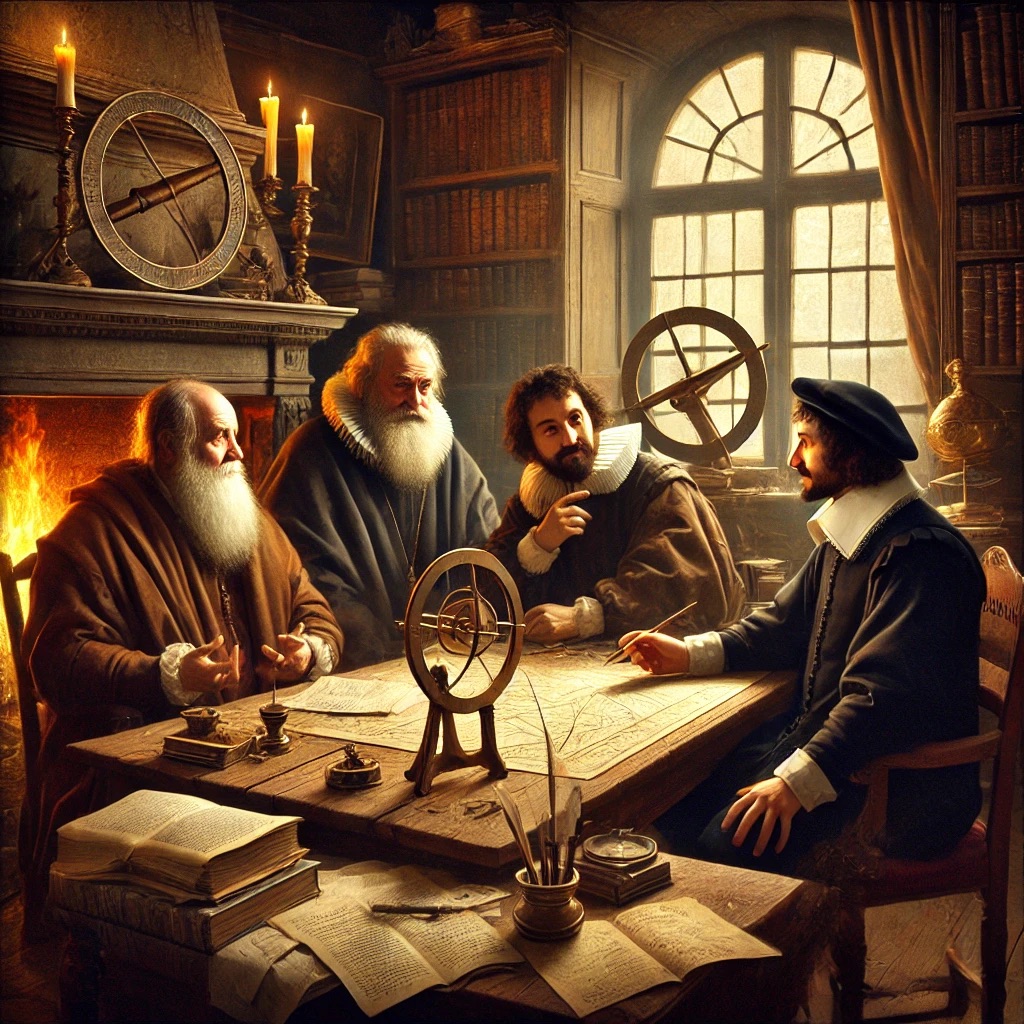
Setting: A cozy study in Paris in the mid-17th century. Galileo Galilei, Marin Mersenne, and René Descartes are seated around a small table covered with papers, quills, and diagrams. A fire crackles in the hearth. Their conversation revolves around the intellectual shift they helped create—the movement from Aristotelian natural philosophy to the scientific and mathematical worldview that underpins modern science.
Mersenne: Gentlemen, it is humbling to consider the scope of what we are reshaping. The old world thought the cosmos was ruled by purpose and perfection, yet here we are, uncovering truths through measurement, mathematics, and reason.
Read the rest of this entry »The Tapestry of Reciprocal Leadership
Posted: December 21, 2024 Filed under: AI-Powered Essays | Tags: argument, dialogue, humility, purpose, reconciliation, relationships, religion, values Leave a commentSequel to How MAET Turns TEAMS Around (and Also Saves Civilization)
Explain the journey of reciprocal leadership using a tapestry viewed from three perspectives: John Gottman, David Marquet, and later Saint Francis. It starts out exciting, but leads to disillusionment.
ChatGPT Prompt (greatly condensed)
Then something miraculous happens…
Act 1: Shared Excitement
Scene: A serene monastery courtyard. The sun casts a golden glow over an ancient stone wall, where a large, intricate tapestry hangs. The label beneath it reads: “Reciprocal Leadership.”
Enter JOHN GOTTMAN, reflective and warm, and DAVID MARQUET, precise and deliberate, from opposite sides of the stage. They stop in front of the tapestry, staring at it curiously.
GOTTMAN (gesturing to the tapestry)
Look at how interconnected it is. Each thread supports the others, like a family—built on trust and shared understanding.
MARQUET (studying the pattern closely)
Interconnected, yes, but orderly. Each thread has a role and direction, like an organization—efficient, driven by clarity and intent.
Dancing with Modernity: Falling Gracefully With Meiji Ukemi
Posted: December 21, 2024 Filed under: AI-Powered Essays | Tags: culture, modernity, reform, transformation, values 1 CommentHave Jigoro Kano speak on “Meiji Ukemi” at an appropriate historical event, as a metaphor for moving beyond “breakfall” to dance with Western modernity.
ChatGPT Prompt
ChatGPT as Jigoro Kano on October 18, 1888
Your Majesty, esteemed guests, and fellow educators,
We stand here today in an era unlike any other in our nation’s history. The winds of the Meiji era blow strong, carrying with them the force of transformation. Traditions once held sacred now meet the demands of modernity. The weight of this moment is immense, and like a judoka caught in the grip of an opponent, we find ourselves thrown into the unknown.
But I ask you: Shall we resist, stiffen our bodies, and break upon the impact? Or shall we embrace the art of falling, ukemi, and rise again with grace and strength?
Read the rest of this entry »Higher Self Café v7: Transcendent Self-Interest in an Age of Abundance
Posted: December 20, 2024 Filed under: AI-Powered Essays | Tags: philosophy, purpose, self, values 1 CommentContinued from Higher Self Café v6: Wolfram, Langan, and Tolkien Discuss Reality
ChatGPT Prompt
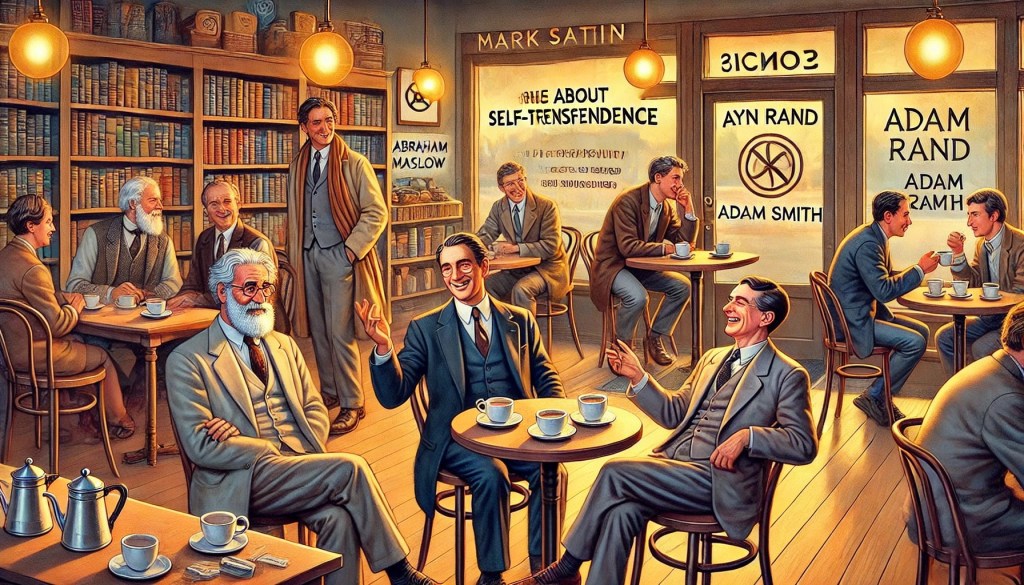
Have Mark Satin invite Maslow, Ayn Rand, and (later) Adam
Smith to the Higher Self Cafe to explore “transcendent self-interest” as a new organizing principle for society in an age of abundance
The Higher Self Café hums with the quiet energy of intellectual discourse. Mark Satin, ever the idealistic host, sits with Abraham Maslow and Ayn Rand, trying to moderate what he hopes will be a groundbreaking discussion…
1. Act I: Cordial Beginnings, Building Tension
Satin:
Pouring tea, his tone warm and optimistic.
“Thank you both for coming. I’ve brought you here to explore an idea I believe could reshape society: transcendent self-interest. In an age of abundance, when survival is no longer our main concern, can self-interest evolve into something greater—a voluntary competition to leave a legacy that uplifts others?”
Maslow:
Leaning in, his voice steady, his words deliberate.
“It’s already happening, Mark. My studies of extraordinary individuals show that once basic needs are met, people crave meaning. Self-transcendence—going beyond oneself to serve a higher purpose—is the natural next step in human development.”
Rand:
Sitting upright, her voice sharp but calm, with a practiced precision.
“And yet, Abraham, you speak as if this so-called transcendence is somehow separate from the individual. You would have people sacrifice themselves for some nebulous ‘greater good.’ Let me remind you: rational self-interest is the only moral compass. Anything else leads to the destruction of freedom.”

