Modern Self Café: Galileo, Descartes, Mersenne
Posted: December 23, 2024 Filed under: AI-Powered Essays | Tags: dialogue, models, modernity, philosophy, transformation, truth, values 3 CommentsA spin-off from Higher Self Café.
Write a dialogue with Galileo, Mersenne, and Descartes that helps moderns understand the mental shift they engineered.
ChatGPT Prompt
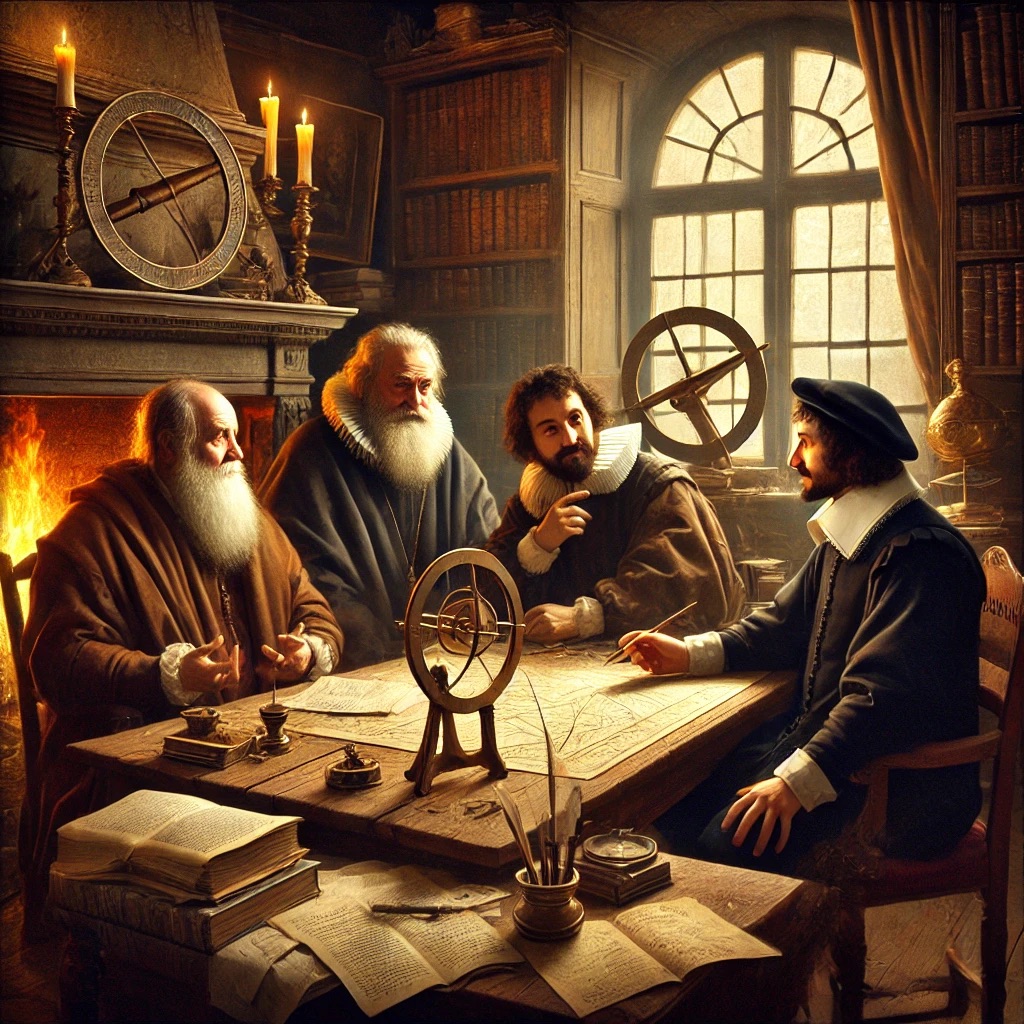
Setting: A cozy study in Paris in the mid-17th century. Galileo Galilei, Marin Mersenne, and René Descartes are seated around a small table covered with papers, quills, and diagrams. A fire crackles in the hearth. Their conversation revolves around the intellectual shift they helped create—the movement from Aristotelian natural philosophy to the scientific and mathematical worldview that underpins modern science.
Mersenne: Gentlemen, it is humbling to consider the scope of what we are reshaping. The old world thought the cosmos was ruled by purpose and perfection, yet here we are, uncovering truths through measurement, mathematics, and reason.
Read the rest of this entry »Dancing with Modernity: Falling Gracefully With Meiji Ukemi
Posted: December 21, 2024 Filed under: AI-Powered Essays | Tags: culture, modernity, reform, transformation, values 1 CommentHave Jigoro Kano speak on “Meiji Ukemi” at an appropriate historical event, as a metaphor for moving beyond “breakfall” to dance with Western modernity.
ChatGPT Prompt
ChatGPT as Jigoro Kano on October 18, 1888
Your Majesty, esteemed guests, and fellow educators,
We stand here today in an era unlike any other in our nation’s history. The winds of the Meiji era blow strong, carrying with them the force of transformation. Traditions once held sacred now meet the demands of modernity. The weight of this moment is immense, and like a judoka caught in the grip of an opponent, we find ourselves thrown into the unknown.
But I ask you: Shall we resist, stiffen our bodies, and break upon the impact? Or shall we embrace the art of falling, ukemi, and rise again with grace and strength?
Read the rest of this entry »Weighing Ego Anchors: Breaking Free from Outdated Identities (ChatGPT as Freud)
Posted: December 15, 2024 Filed under: AI-Powered Essays | Tags: generativity, morality, psychology, reconciliation, systems, transformation, values Leave a commentContinued from Psychological Oobleck: A Fireside Chat on Assimilating Radical Change
As Freud, write about his personal journey to update the “ego anchors” of his signature theory in the light of homeostasis and canalization, leading to the idea of ego as the generative frontier between id and superego.
ChatGPT Prompt (condensed)
Theories, like the minds that conceive them, are not static. They are dynamic, shaped by conflict, refined by discovery, and occasionally, reanchored entirely. My own work on the psyche—rooted in the triumvirate of id, ego, and superego—has served as a sturdy framework for understanding the human mind. But as my ideas evolve alongside new insights into homeostasis and canalization, I must acknowledge that the ego itself—once considered the mediator of the psyche—is far more dynamic, creative, and generative than I initially believed.
This, I realize, mirrors my own journey. As I revisit the anchors of my theoretical framework, I see how some fixed points, once essential, now risk constraining new understanding. It is time to weigh anchor—to refine these ideas and embrace the ego’s role as a generative force, perpetually navigating the tensions between instinct, morality, and change.
Read the rest of this entry »How MAET Turns TEAMS Around (and Also Saves Civilization)
Posted: December 14, 2024 Filed under: AI-Powered Essays | Tags: antifragility, politics, reconciliation, reform, systems, transformation, values 2 CommentsHave Burkner write an HBR article about how fractal Mutual Autonomy Empowers Teams (read backwards) for a VUCA world, centered on the skill of reciprocal leadership.
ChatGPT Prompt (condensed)

By ChatGPT as Hans-Paul Bürkner
1. Introduction: From Control to Collaboration
For decades, leadership has been framed as a top-down effort: leaders guide, teams execute, and feedback flows in one direction. This model worked in a world that valued scale and stability, but in today’s VUCA world—characterized by Volatility, Uncertainty, Complexity, and Ambiguity—it’s no longer sufficient.
Organizations now face challenges that demand adaptability, creativity, and antifragility. These qualities don’t emerge from rigid hierarchies but from systems where leadership is reciprocal: a dynamic, two-way relationship where leaders and teams empower each other.
This is the essence of Mutual Autonomy Empowers Teams (MAET). By turning the traditional “TEAMS” model—Together Everyone Achieves More Success—around, MAET shows how reciprocal leadership can unlock growth, resilience, and innovation—not just for teams, but for entire organizations and societies.
Read the rest of this entry »Thriving in a VUCA World: Lessons from My Year with the Pirahã (ChatGPT as Petraeus)
Posted: December 13, 2024 Filed under: AI-Powered Essays | Tags: culture, modernity, politics, transformation, values Leave a comment[Commissioned with the deepest admiration and respect for the General. This isn’t about him. It is about me.]
Confessional Fireside Chat with General David Petraeus
Interviewer: Brené Brown
Venue: Leadership Track, Aspen Ideas Festival
Opening Scene
The room is quiet, dimly lit, evoking the feel of deep introspection. General David Petraeus sits across from Brené Brown, both framed by soft, warm lighting. There’s no podium, no military insignia—just two people engaging in a raw, personal conversation. Petraeus takes a deep breath before beginning.
Opening Confession
David Petraeus:
“Thank you, Brené, and thank you all for being here.
I’ve spent my career leading in complex, volatile situations—from Iraq and Afghanistan to the halls of Washington. I’ve studied counterinsurgency, practiced strategy, and climbed to positions of great responsibility. But tonight, I want to talk about failure—specifically, my own.
There’s a tension at the heart of leadership, particularly in a VUCA world, between the need for hierarchy and long-term planning, and the reality that life often demands immediacy, trust, and adaptability. I didn’t fully understand that tension until it broke me.
Some of you may know the story: personal and professional mistakes that cost me my position, my reputation, and my sense of self. What I want to share tonight isn’t just about how I failed, but how spending a year with the Pirahã—a small, isolated Indigenous group in the Amazon—helped me reengage with the modern world.”
Read the rest of this entry »
1/1/2050 – Thus Spake Nostradamus: From Shadows of Fallen Towers (ChatGPT as Hegel)
Posted: December 7, 2024 Filed under: AI-Powered Essays | Tags: activism, philosophy, politics, reform, transformation, values, zoasophy Leave a commentAs Hegel speaking as Nostradamus, deliver a speech at the 9/11 Memorial, January 1, 2050 reflecting how 9/11 rhymed with the 1848 revolutions through the lens of “Cohesion x Adaptivity = Generativity”
ChatGPT Prompt (condensed)
I stand among these stones, beneath the names etched into steel and time, to speak of the journey from fire to ash, and from ash to light. For the towers that fell twenty-four years ago, and the shadows they cast across the decades, were not the end of a story but the beginning of a revelation. Today, we gather not to mourn what was lost, but to understand what was born in the wake of destruction.
Read the rest of this entry »Radical Graciousness: Activism as Social Therapy (ChatGPT as Gandhi)
Posted: November 28, 2024 Filed under: AI-Powered Essays | Tags: activism, polarization, politics, purpose, transformation, values 1 CommentWhy would Abbie Hoffman resist “radical graciousnsss“?
ChatGPT Prompts
This isn’t a cognitive problem. It probably reflects the emotional trauma that motivated his activism.
What historical figures could help Abbie feel psychologically safe enough to work through that?
Have Gandhi host a group therapy session on radical graciousness with Havel and Day, attended by a reluctant Abbie.
Setting the Scene
In a serene ashram courtyard under a sprawling banyan tree, Mahatma Gandhi hosts a transformative group therapy session. Joining him are Václav Havel, Dorothy Day, and a reluctant Abbie Hoffman. The participants sit on simple mats around a low wooden table, sharing fruit and tea, as they explore how graciousness can transform not only society but also the activist’s soul.
Gandhi Opens the Session
“Welcome, friends. Each of us has fought against oppression in our own way, driven by the fire of justice. But today, we ask: how do we resist without losing our humanity? Can grace not only strengthen our activism but heal the wounds that fuel it? Abbie,” he says, turning with a gentle smile, “I sense you carry a deep burden. Let’s begin with you.”
Hoffman crosses his arms, his voice sharp. “Look, Gandhiji, I appreciate the invite, but let’s not kid ourselves. Grace doesn’t topple systems. Anger does. Grace is what they preach to keep us quiet.”
Read the rest of this entry »Psychological Oobleck: A Fireside Chat on Assimilating Radical Change
Posted: November 28, 2024 Filed under: AI-Powered Essays | Tags: leadership, psychology, systems, transformation 2 CommentsSetting the Stage
In a warm library with a roaring fireplace, Peter Senge hosts a fireside chat featuring Karl Weick, Barry Staw, and Chris Argyris. The topic: why humans and organizations behave like psychological oobleck—flexible under gradual change but rigid when hit with force—and how to help them assimilate radical transformation. The conversation is fueled by wit, wisdom, and several bottles of wine.

Peter Senge Opens the Evening
“Good evening, friends. Tonight, we delve into a peculiar metaphor: organizations as oobleck. Flexible under light touch, unyielding under pressure. How do individuals and systems absorb change, and what makes them solidify under threat? And more importantly, is Karl’s Merlot truly as transformative as radical change itself?”
Read the rest of this entry »The Great American Marriage: Kamal Harris v. Donna Trump
Posted: November 19, 2024 Filed under: AI-Powered Essays | Tags: argument, dialogue, ideas, intellectual, polarization, politics, reform, relationships, transformation, values Leave a commentWrite a hunorous three-act play where the American political divide is portrayed as a couple, Donna Trump and Kamal Harris.
ChatGPT Prompt
In Act II, show their therapist Miriam Bowen-Friedman guiding them to a breakthrough using self-harmonization and the example of Jefferson and Adams.
Highlight how their conflicts mirror their inner struggles and how embracing their rejected parts (Donna’s logic, Kamal’s passion) leads to personal and relational growth, especially for parenting their kids.
#InternalFamilySystems
Act I – “Divided We Bicker”
Setting: The living room of the America household. The room is divided down the middle. On one side, everything is red, adorned with eagles and a MAGA hat on the coffee table. On the other side, it’s blue, with a climate change poster and a Ruth Bader Ginsburg bobblehead on the shelf. Donna Trump, wearing a red power suit and pearls, is pacing aggressively. Kamal Harris, in a navy blazer with a cup of herbal tea, is calmly sitting on the couch.
Scene 1: The Disagreement
Donna Trump (hands on hips):
Kamal, I’m telling you, we need a wall! The neighbor’s kids keep cutting through our yard. It’s disrespectful!
Kamal Harris (raises an eyebrow, sipping tea):
Donna, we don’t need a wall. We need a fence, maybe even a community garden. Let’s invite them over and talk about why they’re cutting through.
Donna Trump (throws her hands in the air):
Talk? TALK? By the time you’re done “talking,” they’ll have taken the lawn chairs, the grill, and the doghouse!
Higher Self Café, v4: Miriam Harmonizes The Philosophers
Posted: November 17, 2024 Filed under: AI-Powered Essays | Tags: debate, dialogue, philosophy, relationships, systems, transformation 2 CommentsContinued from Frankel vs Maslow/Bowen/Hegel and Chesterton vs Philosophers.
Scene: The Philosophers’ Table
The café exudes warmth and intellectual energy. The round wooden table is cluttered with coffee cups, scribbled napkins, and sugar packets stacked into haphazard sculptures. G.K. Chesterton, Abraham Maslow, and Viktor Frankl are engaged in a spirited debate. Miriam Bowen-Friedman, the waitress, enters to clear the table, carrying herself with quiet authority.
1. The Napkin Sketch Incident
Chesterton
(as Miriam reaches for a napkin with a crude pyramid sketch)
Stop, stop! You’re about to destroy the next chapter of Orthodoxy!
Miriam
(pauses, holding the napkin up to the light, feigning deep thought)
I don’t know. It looks more like Heresy to me.
Maslow
(leans forward, grinning)
You’ve got a sharp tongue. Careful, we might recruit you into philosophy.
Miriam
(deadpan)
Only if you let me clean up the mess you’ve made of it.

