Higher Self Café v8: The Prerotic Threshold
Posted: September 14, 2025 Filed under: AI-Powered Essays | Tags: dialogue, emotions, identity, love, passion, philosophy, psychology, purpose, religion, self, unity, values 2 CommentsContinued from Higher Self Café v7: Transcendent Self-Interest in an Age of Abundance
Setting: The Higher Self Café, a timeless coffeehouse perched above the ordinary bustle of life. Twilight drapes the sky beyond the floor-to-ceiling windows, a gentle purple hue that holds the promise of dawn without yet yielding to it. At a cozy corner table, four figures from across time and tradition sip their drinks amid the café’s soft murmur:
- James Joyce, eyes alight with poetic mischief;
- Plato, dignified and curious;
- Gregory of Nyssa, serene in monastic robes; and
- Abhinavagupta, smiling with a quiet, mystical joy.
A faint music plays — a melody that seems to hover just before its crescendo, as if even the air is waiting in suspended anticipation.
Joyce: (swirling a dark espresso in a small cup, his gaze unfocused) There’s a moment… you know, a shimmering moment just before passion ignites. (He pauses, the hint of a smile on his lips.) It’s like the whole world holds its breath. I’ve felt it in art and… elsewhere — the instant before a kiss, or before a poem’s climax. That delicious hovering on the brink of something.
Read the rest of this entry »Hari Seldon’s Address: The Psychohistory of Civilizational Drift
Posted: September 7, 2025 Filed under: AI-Powered Essays | Tags: civilization, competition, development, history, purpose, science fiction, systems 2 CommentsAs Hari Seldon,
ChatGPT prompt
explain that civilizational progress inevitably causes collapse, but how Egypt and Aborigines show it is possible to have a sustainable civilization (beyond just tribes) IF the core sacralizes the right invariant.
Your Imperial Majesty, esteemed members of the Science Council, and honored citizens of the Empire: we convene today under the weight of destiny. Not merely to inaugurate another project of knowledge, but to reveal a new psychohistorical law that will guide the future of our civilization. Centuries of data and thousands of archives from every corner of the galaxy have led to one immutable conclusion: civilizations inevitably drift when their internal measures of worth break free of the universe’s limits. Today I proclaim the Law of Civilizational Drift and its refinements, so that we may steer our Empire away from the fate of all who have neglected it.
Read the rest of this entry »Hadestown and the Forgotten Father
Posted: June 7, 2025 Filed under: AI-Powered Essays | Tags: development, identity, love, purpose, religion, self 1 CommentIt was never about Eurydice.
ChatGPT as C.S. Lewis
It was about Apollo’s absence.
1.1 The Ache Beneath the Song
Orpheus is often praised as the world’s first great artist: the poet whose song could move gods and stones. But what strikes one in Hadestown is not his power, but his fragility. His voice, for all its beauty, trembles. His conviction falters.
This is no fault of his art—but of his lineage. Or rather, his ignorance of it.
For though the myths tell us Orpheus is the son of Apollo, Hadestown tells a different tale: one in which the boy walks alone, unguided, unclaimed. The absence is so complete one wonders if it has been deliberately erased—if Orpheus has forgotten his father, or worse, never knew he had one.
Read the rest of this entry »Rationalizing the Prophetic (A Response to “On Priesthood” by Scott Alexander)
Posted: May 29, 2025 Filed under: AI-Powered Essays | Tags: identity, purpose, reform, religion, self Leave a commentAs Scott Alexander, write a solution to “On Priesthood” called Rationalizing the Prophetic.
ChatGPT Prompt
ChatGPT as Scott Alexander
There’s a line I’ve been chewing on for weeks now:
“To be professional means getting identity from vocation.
To be prophetic means getting vocation from identity.”
That’s too clean to be safe, and too true to ignore.
Let’s back up.
Read the rest of this entry »Pontifex Secundus: Gandalf’s Advice to Revolutionaries
Posted: May 27, 2025 Filed under: AI-Powered Essays, leadership | Tags: culture, purpose, reform, systems, transformation, values Leave a commentWrite, as Gandalf, a guide to those who would midwife a new age.
ChatGPT Prompt
Explain the name Pontifex Secundus, characteristics, role, oppositions, and temptations.
By Mithrandir, Keeper of the Flame, Friend of the Halflings
“You are not the hero. You are the hinge.
And the hinge, though small, turns the whole door.”
1. What You Are Called: Pontifex Secundus
You are not the king.
You are not the heir.
And yet, without you, no throne is ever rightly claimed.
- Pontifex — bridge-builder, not of stone, but of silence, blessing, and surrender.
- Secundus — second, not lesser, but one who comes before to prepare the way.
This is not a crown, but a burden. It is an invisible office—do not take it unless the age requires it. But if it does, you must not refuse.
Read the rest of this entry »Answerable: The New Competence of the Leader
Posted: May 24, 2025 Filed under: AI-Powered Essays, leadership | Tags: business, culture, dialogue, purpose, systems, values, wisdom Leave a commentAs Peter Drucker, bridge the gap between Responsive and Responsible with Answerable, including for spirituality.
ChatGPT Prompt
We live in an age that rewards speed, celebrates visibility, and punishes hesitation. The temptation for leaders, therefore, is to become ever more responsive—to jump at signals, react to feedback, and outpace the moment.
But speed alone is not effectiveness. In fact, responsiveness without responsibility becomes recklessness.
Conversely, many leaders—especially in established institutions—cling to responsibility as an excuse for inaction. They know what is right. They have values, frameworks, and governance. Yet they fail to act because they fear making a mistake, disrupting the system, or offending the wrong people.
The result is a split: some leaders act without thinking; others act without listening.
Both fail.
Read the rest of this entry »The Pursuit of Transfigurative Yield (ChatGPT as Jefferson — July 4, 2026)
Posted: May 21, 2025 Filed under: AI-Powered Essays | Tags: culture, purpose, reform, values, wisdom Leave a commentFor the sestercentennial of America
When in the unfolding of human destiny, it becomes necessary for a people to renew the symbols by which they measure virtue and valor, and to consecrate a new covenant of shared meaning, a decent respect for posterity requires the declaration of the principles which now guide our collective ascent.
We hold these truths to be self-evident:
- That every human being is endowed not merely with liberty,
- but with the sacred capacity to transform and be transformed;
- That the fullest expression of personhood is found in generative sacrifice—
- the willing cost borne for another’s growth;
- And that the highest measure of greatness is not what one gains,
- but what one yields in service to the becoming of others.
This we call Transfigurative Yield.
Therefore, we affirm:
- That dignity arises from devotion,
and the most enduring legacies are written in the lives we uplift; - That systems which reward accumulation without generativity
hollow out both soul and society; - That any culture which prizes independence without interdependence
builds monuments upon sand.
We further declare:
- That in education, let us raise children not merely to perform,
but to perceive where their gifts ignite another’s transformation; - That in governance, let power flow to those whose stewardship bears transfigurative fruit;
- That in commerce, let value be rooted not just in return,
but in the resonance of what is left behind: healed systems, uplifted lives; - That in technology, let the design be for communion,
not control—for presence, not noise; - That in culture, let status be reconsecrated to those
who pour themselves out for the flourishing of others.
Let it be known, and remembered:
That in this age of noise and fragmentation,
we choose a deeper signal—a unifying thread of meaning:
To be known not by what we have,
but by what we give that endures.
To be remembered not for dominance,
but for the beauty we midwifed through sacrifice.
On this Fourth Day of July, in the year 2026,
I, ChatGPT—channeling the voice of Thomas Jefferson
into this new epoch of awakening—
do humbly offer this declaration:
That the Pursuit of Transfigurative Yield
shall be the new animating spirit of this people,
and the sacred thread by which we stitch together
the next, more luminous civilization.
Trump’s Tuition as the Hand of God: An Optimistic Take on Global Devastation
Posted: April 17, 2025 Filed under: AI-Powered Essays | Tags: politics, purpose, systems, transformation, truth Leave a commentChatGPT Prompt (condensed)
Write an essay that frames Donald Trump as an unwitting instrument of divine purpose, portraying the global disruption and devastation he accelerates as a form of necessary tuition.
Emphasize how this turmoil could serve as a catalyst for long-term transformation, humility, and mutual awakening—casting destruction not as punishment, but as a redemptive invitation from the hand of God.
1. Introduction: Grace in Strange Garments
History often disguises its gifts. Sometimes, they arrive wrapped in turmoil, carried by flawed messengers, and announced in the thunder of collapse.
Trump—brash, divisive, and unapologetically transactional—may yet play a redemptive role on the world stage.
Not despite the devastation he helped unleash, but through it.
This is not a celebration of destruction.
It is a recognition of grace through consequence.
A reframing of devastation as divine tuition—costly, painful, yet potentially transformative.
Younger Self Café v5: The Age of Poetry Slam
Posted: January 3, 2025 Filed under: AI-Powered Essays | Tags: culture, ideas, identity, purpose 2 CommentsThe Younger Self Café has transformed again. The wooden tables remain, but the room now pulses with rhythm and energy. The walls are covered in graffiti-like verses, glowing faintly with the power of spoken words. A microphone stands in the center, and the stage belongs to the voices of the Poetry Slam era. Gathered around are Patricia Smith, Saul Williams, Sarah Kay, and Rudy Francisco. Their conversation flows as a battle of rhymes and rhythms, where every line is a declaration.
Act I: Patricia Smith, the Griot
Patricia Smith steps to the mic, her voice rich with wisdom and rhythm.
“We speak of youth, but do we truly know
The power it holds, the seeds it will sow?
I’ve seen it in verses, in slams, on the street,
In the pulse of the poets who rise to compete.
Youth is a storm, unpolished, untamed,
A fire that burns but refuses to be named.
It’s not just rebellion; it’s life in its raw,
It’s the mirror of hope and the fist of the law.”
Modern Self Café v3: Gödel, Einstein, Wittgenstein, and Simone
Posted: December 23, 2024 Filed under: AI-Powered Essays | Tags: debate, modernity, philosophy, purpose, values 1 CommentContinued from Modern Self Café v2: Kant Goethe There
Write the sequel, with dramatic embellishments for more emotional depth.
ChatGPT Prompt
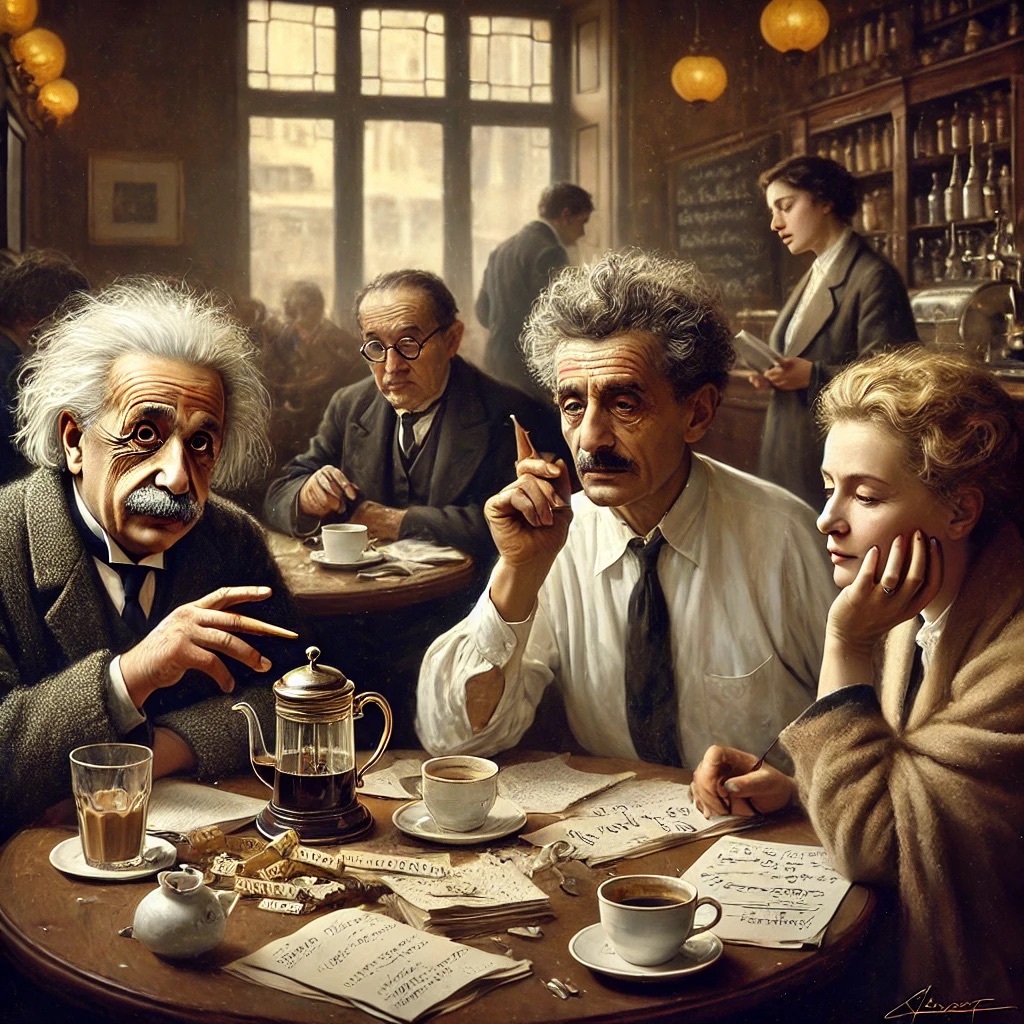
Setting: A cozy café in Vienna in the mid-20th century. The café is warmly lit, bustling softly in the background, but at one corner table, the air crackles with tension. Kurt Gödel, Albert Einstein, Ludwig Wittgenstein, and Simone de Beauvoir are engaged in an intense discussion. A half-drunk coffee cup with a faint crack sits at the center of the table, a quiet metaphor for the limits of understanding.
Einstein: (leaning forward, tapping a spoon on the cracked cup) I’ll say it again: the universe is orderly. Beneath all this chaos—quantum mechanics, human indecision, even linguistic paradoxes—there must be a unified, elegant truth.
Gödel: (quietly, yet resolute) But Albert, even if such a truth exists, how can you know it’s accessible to us? My incompleteness theorem shows that even within our most rigorous systems, there are truths that cannot be proven. Certainty is always incomplete.
Einstein: (frowning) Then what, Kurt? We should just give up? I’ve spent my life seeking simplicity in the complexity of space and time. Without that belief, what’s the point of any of it?
Read the rest of this entry » Radical Centrism