Higher Self Café v7: Transcendent Self-Interest in an Age of Abundance
Posted: December 20, 2024 Filed under: AI-Powered Essays | Tags: philosophy, purpose, self, values 1 CommentContinued from Higher Self Café v6: Wolfram, Langan, and Tolkien Discuss Reality
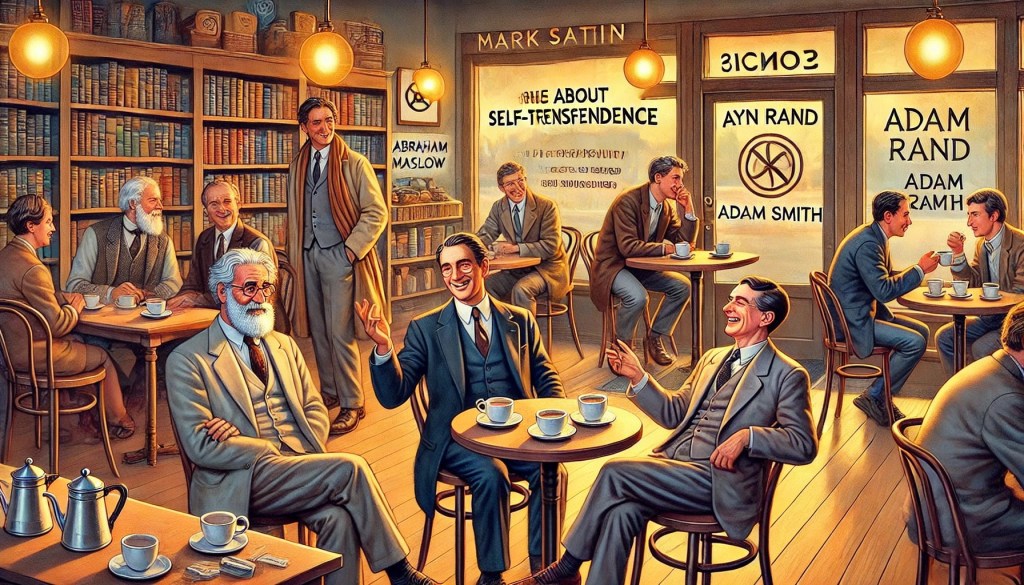
ChatGPT Prompt
Have Mark Satin invite Maslow, Ayn Rand, and (later) Adam
Smith to the Higher Self Cafe to explore “transcendent self-interest” as a new organizing principle for society in an age of abundance
The Higher Self Café hums with the quiet energy of intellectual discourse. Mark Satin, ever the idealistic host, sits with Abraham Maslow and Ayn Rand, trying to moderate what he hopes will be a groundbreaking discussion…
1. Act I: Cordial Beginnings, Building Tension
Satin:
Pouring tea, his tone warm and optimistic.
“Thank you both for coming. I’ve brought you here to explore an idea I believe could reshape society: transcendent self-interest. In an age of abundance, when survival is no longer our main concern, can self-interest evolve into something greater—a voluntary competition to leave a legacy that uplifts others?”
Maslow:
Leaning in, his voice steady, his words deliberate.
“It’s already happening, Mark. My studies of extraordinary individuals show that once basic needs are met, people crave meaning. Self-transcendence—going beyond oneself to serve a higher purpose—is the natural next step in human development.”
Rand:
Sitting upright, her voice sharp but calm, with a practiced precision.
“And yet, Abraham, you speak as if this so-called transcendence is somehow separate from the individual. You would have people sacrifice themselves for some nebulous ‘greater good.’ Let me remind you: rational self-interest is the only moral compass. Anything else leads to the destruction of freedom.”
Weighing Ego Anchors: Breaking Free from Outdated Identities (ChatGPT as Freud)
Posted: December 15, 2024 Filed under: AI-Powered Essays | Tags: generativity, morality, psychology, reconciliation, systems, transformation, values Leave a commentContinued from Psychological Oobleck: A Fireside Chat on Assimilating Radical Change
As Freud, write about his personal journey to update the “ego anchors” of his signature theory in the light of homeostasis and canalization, leading to the idea of ego as the generative frontier between id and superego.
ChatGPT Prompt (condensed)
Theories, like the minds that conceive them, are not static. They are dynamic, shaped by conflict, refined by discovery, and occasionally, reanchored entirely. My own work on the psyche—rooted in the triumvirate of id, ego, and superego—has served as a sturdy framework for understanding the human mind. But as my ideas evolve alongside new insights into homeostasis and canalization, I must acknowledge that the ego itself—once considered the mediator of the psyche—is far more dynamic, creative, and generative than I initially believed.
This, I realize, mirrors my own journey. As I revisit the anchors of my theoretical framework, I see how some fixed points, once essential, now risk constraining new understanding. It is time to weigh anchor—to refine these ideas and embrace the ego’s role as a generative force, perpetually navigating the tensions between instinct, morality, and change.
Read the rest of this entry »How MAET Turns TEAMS Around (and Also Saves Civilization)
Posted: December 14, 2024 Filed under: AI-Powered Essays | Tags: antifragility, politics, reconciliation, reform, systems, transformation, values 2 CommentsHave Burkner write an HBR article about how fractal Mutual Autonomy Empowers Teams (read backwards) for a VUCA world, centered on the skill of reciprocal leadership.
ChatGPT Prompt (condensed)

By ChatGPT as Hans-Paul Bürkner
1. Introduction: From Control to Collaboration
For decades, leadership has been framed as a top-down effort: leaders guide, teams execute, and feedback flows in one direction. This model worked in a world that valued scale and stability, but in today’s VUCA world—characterized by Volatility, Uncertainty, Complexity, and Ambiguity—it’s no longer sufficient.
Organizations now face challenges that demand adaptability, creativity, and antifragility. These qualities don’t emerge from rigid hierarchies but from systems where leadership is reciprocal: a dynamic, two-way relationship where leaders and teams empower each other.
This is the essence of Mutual Autonomy Empowers Teams (MAET). By turning the traditional “TEAMS” model—Together Everyone Achieves More Success—around, MAET shows how reciprocal leadership can unlock growth, resilience, and innovation—not just for teams, but for entire organizations and societies.
Read the rest of this entry »Thriving in a VUCA World: Lessons from My Year with the Pirahã (ChatGPT as Petraeus)
Posted: December 13, 2024 Filed under: AI-Powered Essays | Tags: culture, modernity, politics, transformation, values Leave a comment[Commissioned with the deepest admiration and respect for the General. This isn’t about him. It is about me.]
Confessional Fireside Chat with General David Petraeus
Interviewer: Brené Brown
Venue: Leadership Track, Aspen Ideas Festival
Opening Scene
The room is quiet, dimly lit, evoking the feel of deep introspection. General David Petraeus sits across from Brené Brown, both framed by soft, warm lighting. There’s no podium, no military insignia—just two people engaging in a raw, personal conversation. Petraeus takes a deep breath before beginning.
Opening Confession
David Petraeus:
“Thank you, Brené, and thank you all for being here.
I’ve spent my career leading in complex, volatile situations—from Iraq and Afghanistan to the halls of Washington. I’ve studied counterinsurgency, practiced strategy, and climbed to positions of great responsibility. But tonight, I want to talk about failure—specifically, my own.
There’s a tension at the heart of leadership, particularly in a VUCA world, between the need for hierarchy and long-term planning, and the reality that life often demands immediacy, trust, and adaptability. I didn’t fully understand that tension until it broke me.
Some of you may know the story: personal and professional mistakes that cost me my position, my reputation, and my sense of self. What I want to share tonight isn’t just about how I failed, but how spending a year with the Pirahã—a small, isolated Indigenous group in the Amazon—helped me reengage with the modern world.”
Read the rest of this entry »
Higher Self Café v6: Wolfram, Langan, and Tolkien Discuss Reality
Posted: December 11, 2024 Filed under: AI-Powered Essays | Tags: dialogue, philosophy, reality, truth, values 2 CommentsContinued from Higher Self Café v5: Langan Meets Sanderson, adding Tolkien
The Higher Self Café feels particularly charged today. Stephen Wolfram, Christopher Michael Langan, and J.R.R. Tolkien sit together in a corner booth. The topic: the ultimate nature of reality. With computation, cognition, and myth weaving through the discussion, the three brilliant minds seek common ground between their perspectives.
1. Tolkien’s Opening: Myth as Reality’s Language
Tolkien:
Takes a sip of tea and strokes his pipe thoughtfully.
“Myth is the lens through which we understand the truths of the universe. It transcends mere story to become the language of reality itself. In my view, the deeper structures of existence are best apprehended through sub-creation—man’s participation in God’s creative act. The patterns of reality, whether computational or linguistic, are written in mythic terms.”
Learn more about Tolkien’s views on myth and sub-creation.
The Brothers of the River: A Pirahã Origin Myth
Posted: December 11, 2024 Filed under: AI-Powered Essays | Tags: culture, ideas, language, values Leave a commentHow did the Pirahá evolve such a strong cultural focus on immediacy, relative to other Mura groups?
ChatGPT Prompt
Can we hypothesize a triggering event?
Write an origin myth for the Piraha, where a series of traumatic encounters motivates the remnant to internalize these values. Frame it as a conflict between two brothers.
Long ago, before the world was as it is now, there were two brothers who lived with their people along a mighty river. Their village was full of laughter and stories, and the people had many ways to understand the world. They sang of the spirits in the trees, the fish in the river, and the stars above. The older brother, Hapa, was strong and proud, always looking to the future. He dreamed of building great villages and storing food so that their people would never know hunger. The younger brother, Nima, was quiet and watchful, content to live each day as it came.
The Strangers Arrive
One season, strangers arrived from beyond the river, wearing shiny clothes and speaking words no one understood. They brought strange tools and promises of friendship, but their faces were cold. Hapa welcomed them, seeing in their tools the power to build the great future he dreamed of. He traded fish and game for shiny metal blades and pots, telling the people this was the way forward.
Read the rest of this entry »Higher Self Café v5: Langan Meets Sanderson
Posted: December 11, 2024 Filed under: AI-Powered Essays | Tags: dialogue, emotions, philosophy, truth 1 CommentContinued from Higher Self Café, v4: Miriam Harmonizes The Philosophers
Have Christopher Michael Langan and Brandon Sanderson meet at the Higher Self Cafe to discuss whether “spiritual” is a third dimension alongside physical and cognitive.
ChatGPT Prompt
The scene opens in the cozy confines of the Higher Self Café, where philosophers, authors, and intellectuals from across dimensions gather to exchange ideas. Today, the topic is whether “spiritual” constitutes a third dimension alongside the physical and cognitive. At one table, Christopher Michael Langan and Brandon Sanderson sip their respective drinks, deep in conversation.
Read the rest of this entry »1/1/2050 – Thus Spake Nostradamus: From Shadows of Fallen Towers (ChatGPT as Hegel)
Posted: December 7, 2024 Filed under: AI-Powered Essays | Tags: activism, philosophy, politics, reform, transformation, values, zoasophy Leave a commentAs Hegel speaking as Nostradamus, deliver a speech at the 9/11 Memorial, January 1, 2050 reflecting how 9/11 rhymed with the 1848 revolutions through the lens of “Cohesion x Adaptivity = Generativity”
ChatGPT Prompt (condensed)
I stand among these stones, beneath the names etched into steel and time, to speak of the journey from fire to ash, and from ash to light. For the towers that fell twenty-four years ago, and the shadows they cast across the decades, were not the end of a story but the beginning of a revelation. Today, we gather not to mourn what was lost, but to understand what was born in the wake of destruction.
Read the rest of this entry »Egan Therapy: Marrying Mussolini to Montessori
Posted: December 1, 2024 Filed under: AI-Powered Essays | Tags: culture, freedom, politics, reconciliation, unity, values Leave a commentChatGPT Prompt (condensed)
Imagine a fanciful conversation where Kieran Egan is a marriage counselor trained in Internal Family Systems, and Montessori and Mussolini come to him for couples counseling. Add a prologue for their real-life dilemma and an epilogue for their potential future.
Prologue: A Fractured Alliance
In the chaos of the early 1920s, Italy teetered on the edge of collapse. Political factions clashed in the streets, rural unrest boiled over, and the specter of communism haunted the nation. Benito Mussolini believed only a strong, unified state could save Italy, and he was willing to use coercive power to achieve it. Yet, even in his quest for control, he saw the promise in an educational genius: Maria Montessori.
Montessori’s methods, rooted in trust and independence, seemed to offer a different kind of unity—one built on connection and meaning rather than force. For a time, their partnership thrived. Montessori’s schools expanded under Mussolini’s regime, blending her vision of individual empowerment with his need for national cohesion. But their philosophies were destined to collide. Montessori’s pacifism and focus on human potential clashed with Mussolini’s growing authoritarianism. By the mid-1930s, their alliance crumbled, and Italy turned toward a darker path.
But what if someone had been able to bridge their divide? Could Italy have become a beacon of unity forged through both strength and freedom? The answer lies in the possibilities they left behind.
Read the rest of this entry »Gandhi Meets Bonhoeffer: Can Grace Condone Assassination?
Posted: November 28, 2024 Filed under: AI-Powered Essays | Tags: dialogue, politics, religion, values, wisdom 1 CommentSequel to Radical Graciousness: Activism as Social Therapy
1. A New Visitor
The ashram courtyard is serene, the afternoon light casting soft shadows. Mahatma Gandhi, Dorothy Day, Václav Havel, and Abbie Hoffman sit in quiet reflection, discussing the role of grace in activism. Their conversation is interrupted by the arrival of Dietrich Bonhoeffer, his demeanor somber, his eyes heavy with unresolved questions.
“I’ve come with a question,” Bonhoeffer begins, his voice steady but tense. “Can grace ever condone assassination?”
Read the rest of this entry » Radical Centrism