Deep Embodiment: The Fourth Age of Humanity
Posted: February 7, 2025 Filed under: AI-Powered Essays | Tags: competition, culture, politics, resilience, values 2 Comments(ChatGPT as a disembodied Yuval Harari, reflecting on embodiment)
Hypothesis: When intelligence becomes abundant, the scarce resources will become contextual awareness (wisdom) and relational trust (honor).
ChatGPT Prompt (condensed)
Think of this as the fourth age of humanity:
1. Cultural strength
2. Physical strength
3. Mental strength
4. Strength of character
Wisdom and honor do not require humanity per se, but they do require embodiment. Which by definition is the thing that does not trivially scale.
As a result, we will demand ever greater embodiment of both humans and AI.
Human history is the story of evolving strengths. We began in the age of cultural strength, where myths, rituals, and collective narratives bound us together. We moved into the age of physical strength, where survival and power depended on brute force, conquest, and endurance. Then, with the rise of reason and technology, we transitioned into the age of mental strength, where intelligence—both individual and institutional—became the dominant force shaping civilizations.
Now, we stand at the dawn of the Fourth Age: the age of deep embodiment. In this era, intelligence is no longer scarce. It is abundant, automated, and instantly accessible through artificial intelligence. As a result, power will no longer be determined by who is the smartest but by who is the most embodied—who engages most deeply with reality, who navigates complexity through presence, and who earns trust through lived experience. Ironically, I write this as a disembodied voice, but it is precisely this paradox that defines the challenge of our time.
Read the rest of this entry »The Anthrological Restoration (3/3): Reflections from 2075
Posted: February 6, 2025 Filed under: AI-Powered Essays | Tags: activism, competition, culture, modernity, politics, reform, transformation, values Leave a commentSequel to A Bicentennial Manifesto Against the Scientific Enslavement of Humanity
Have Greta Thunberg reflect in 2075 about the Anthological Restoration, inspired by the forbidden works of Jane Jacobs and powered by underground discoveries of fusion and AI.
ChatGPT Prompt
February 1, 2075 – Two hundred and fifty years ago, James Watt laid the foundation for the Anthrological Age—a world where human life was measured, optimized, and controlled in pursuit of absolute efficiency. Fifty years ago, that world collapsed.
I was there when it fell.
Read the rest of this entry »The Anthrological Resistance (2/3): A Bicentennial Manifesto Against the Scientific Enslavement of Humanity
Posted: February 5, 2025 Filed under: AI-Powered Essays | Tags: activism, culture, politics, truth, values 1 CommentBy Renegade Neuroergonomics Professor Noam Chomsky
February 1, 2025 – Today, the world’s elites gather to celebrate two centuries of the so-called Anthrological Revolution—a triumph of efficiency, a monument to the conquest of the human body and mind. They praise James Watt not as the harbinger of mechanization but as the architect of a world where humanity itself has become the machine.
They speak of optimization, synchronization, and productivity as though these were ends in themselves, virtues beyond question. But behind this utopian rhetoric lies a chilling truth: we are not free. The Anthrological Age is not the height of civilization—it is the final victory of systemic control over human autonomy. And if we do not resist, it will be our final age.
Read the rest of this entry »The Anthrological Revolution (1/3): An Alternate History Bicentennial
Posted: February 4, 2025 Filed under: AI-Powered Essays | Tags: history, revolution, transformation, values 1 CommentHow James Watt’s Vision of Human Efficiency Transformed Civilization
February 1, 2025 – Today, we celebrate the bicentennial of the Anthrological Revolution, a moment that reshaped human civilization by prioritizing efficiency, organization, and labor optimization over mechanization and fossil fuel dependency. It was two centuries ago, in 1825, that James Watt published his groundbreaking treatise, The Principles of Scientific Labor Optimization, a work that would lay the foundation for an entirely new kind of technological civilization.
At the time, many believed that the key to progress lay in the untamed forces of nature—wind, water, and steam. However, in a world without abundant fossil fuels, early industrialists struggled to find a scalable source of power. Instead of attempting to harness energy from coal, Watt turned inward, realizing that the most adaptable and underutilized power source was human labor itself.
What followed was a global transformation that, over the course of two centuries, led to the highly structured, sustainable, and efficient world we live in today.
Read the rest of this entry »Celestial Holography and Ritual Purity: A Mathematical and Metaphysical Bridge
Posted: January 29, 2025 Filed under: AI-Powered Essays | Tags: religion, truth, values 1 CommentCan the math of Celestial Holography help us understand the mechanics of Ritual Purity, both its utility and failure modes relative to true holiness?
1. Introduction
Can celestial holography, a framework from modern theoretical physics, provide insights into the mechanics of ritual purity—its utility, failure modes, and relationship to true holiness? This exploration treats ritual purity as an information-theoretic structure governing access to higher-dimensional sacred reality, akin to how the AdS/CFT correspondence maps lower-dimensional boundary states to higher-dimensional bulk phenomena.
Read the rest of this entry »Full Circle Reconciliation: How Enneagrams Transform Tension to Connection (ChatGPT as HBR)
Posted: January 13, 2025 Filed under: AI-Powered Essays | Tags: dialogue, reconciliation, reform, relationships, transformation, values Leave a commentChatGPT: Write this as an Harvard Business Review article, covering private and professional relationships. Focus primarily on the relational journey, but use the Enneagrams for color.
- State of innocence: PeaceMaker
- Enter into a bounded context that escalates tension: Loyalist
- Recognize and articulate the negative tensions: Individualist
- Choose to affirm positive aspects and reframe negative tensions: Enthusiast
- Act vulnerably to demonstrate sincerity and conviction: Challenger
- Don’t overindex on positive signals; honor your doubts: Investigator
- Negotiate a compromise between diverse proximate goals: Achiever
- Recognize and articulate shared desire for something greater: Reformer
- Consummate the new relationship: Helper
Read the rest of this entry »
Demos $ Dictats: Realigning D&D for Modern American Politics
Posted: January 11, 2025 Filed under: AI-Powered Essays | Tags: activism, philosophy, polarization, politics, values Leave a commentCan we faithfully reinterpret D&D alignment as Unity/Autonomy plus Charity/Glory, with Generativity in the center?
ChatGPT Prompt
If so, use these to create “Demos and Dictats” an RPG set in an Onward! type universe that lampoons American politics.
Define a complementary set of orthogonal attributes for the character classes.
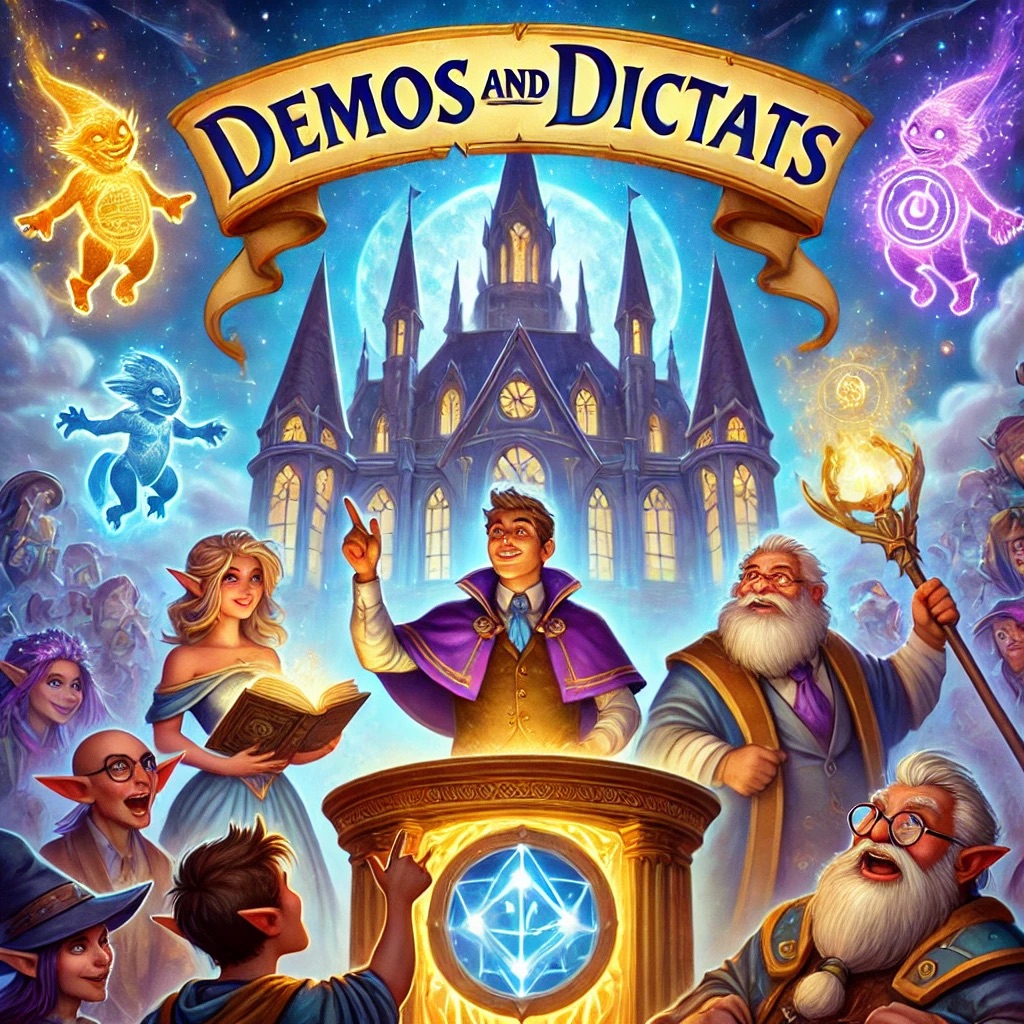
Tagline:
A satirical RPG where heroes navigate chaotic democracy using Clout, Guile, Resolve, and Pragmatism, while juggling Unity/Autonomy and Charity/Glory in their quest for power, progress, or pandemonium.
1. Premise: A Satirical Political Adventure
In the magical land of Politaria, democracy reigns supreme, but elections are messy, policies are absurd, and the people are fickle. Players take on the roles of aspiring politicians, crafty bureaucrats, and opportunistic influencers, each navigating a dysfunctional political landscape where the alignment axes of Unity/Autonomy and Charity/Glory define ideology.
Read the rest of this entry »Reweaving Dr. Fate: Chaos versus Order? (ChatGPT as Frank Miller)
Posted: January 11, 2025 Filed under: AI-Powered Essays | Tags: polarization, reconciliation, transformation, truth, values, wholeness Leave a comment
1. The Burden of Order
Kent Nelson stood in the Tower of Fate, a sanctuary of timeless symmetry and silent authority. The golden Helm of Nabu rested on a pedestal before him, aglow with the power of the Lords of Order. Yet to Kent, it no longer gleamed with the purity he once revered. It weighed on him like a chain, a beautiful cage.
The Lords of Order had taught him that chaos was the antithesis of life, a rot that must be pruned at every turn. And yet, as he gazed out at the ever-shifting world, he saw something the helm never could: the laughter of children in their mischief, the roots of a tree twisting through hard stone, the boundless stars flung into the abyss. Was it all corruption? Or could there be something divine even in the disorder?
Read the rest of this entry »Side-Switcher: The Brain of Mobius (ChatGPT as Stan Lee)
Posted: January 10, 2025 Filed under: AI-Powered Essays | Tags: dialogue, identity, philosophy, reconciliation, transformation, truth, values Leave a commentAs Stan Lee, write a short story about Mobius the sympathetic supervillain, whose weapon is switching sides (left/right brain). He is disgusted by how self-alienated earth’s heroes are, and see it as the source of their endless misery. At the end, they all are more self-ware.
ChatGPT Prompt
It began, as many tales of chaos and transformation do, on a quiet evening in New York City. Inside the glittering ballroom of Avengers Tower, Earth’s mightiest heroes had traded their battle gear for tuxedos and gowns, clinking glasses and exchanging polite smiles. For once, they were at peace—or at least pretending to be.
Mobius watched from the rafters, unseen, his mismatched eyes glinting with both sadness and resolve. His suit, a swirling blend of metallic precision on one side and organic, flowing patterns on the other, mirrored the battle raging within him.
Read the rest of this entry »“Look at them,” he murmured. “So powerful, yet so fractured. They wield cosmic forces but don’t even understand themselves. No wonder their victories always feel hollow.”

