Harimohan: The Musical
Posted: January 3, 2025 Filed under: AI-Powered Essays | Tags: history, politics, transformation, values Leave a commentA 21st Century Alexander of Democracy
Write a Hamilton-inspired musical “Harimohan”, a visionary Indian leader inspired by American democracy and Indian pluralism, whose life mirrors Alexander the Great’s meteoric rise and enduring legacy (with the US playing the role of Athens)
ChatGPT Prompt (condensed)
Blending Indian classical music, hip-hop, and Broadway styles, it tells the story of Harimohan’s journey from a conflicted idealist to a global architect of political transformation.
Act I: “The Rise of Harimohan”
1. Overture: “Born of Two Civilizations”
A high-energy opening introduces Harimohan’s dual identity: rooted in the pluralistic traditions of India and the progressive ideals of American democracy.
Lyrics (Chorus):
“Harimohan, a man of two lands, Dreams too big for mortal hands. Born in Chennai, schooled overseas, He’ll shake the world with ideas like these!”
2. “Letters from Madurai”
Harimohan reflects on his childhood in Tamil Nadu, shaped by his father’s ideals and his mother’s teachings about India’s democratic heritage.
Dialogue:
Mother: “Our democracy isn’t borrowed—it’s ancient. Remember, Harimohan, our Panchayats gave voice to the people long before the world took notice.”
Young Harimohan: “But can that voice rise again? How do I make it heard?”
3. “The Harvard Debates”
Harimohan’s brilliance and ambition shine during his student years at Harvard, where he debates global power structures with razor-sharp wit.
Lyrics:
“You claim democracy’s dying, but here’s what’s true: Systems evolve, and so must you! We don’t need kings, we don’t need thrones, Just leaders who listen and a world that’s our own.”
4. “The Mahadevan Doctrine”
Inspired by the lessons of Mahatma Gandhi, Martin Luther King Jr., and his rural experiences in India, Harimohan crystallizes his vision for global democracy.
Lyrics:
“Let the people speak, let their voices ring, No more chains of power, we’ll break everything. From the tech-filled cities to the villages untamed, We’ll build a world where every name is claimed.”
Act II: “Battles for the People”
5. “The Digital Agora”
As Prime Minister of India, Harimohan launches his flagship initiative: a global, tech-powered platform for democratic deliberation.
Lyrics:
“One world, one stage, one voice to unite, We’ll code the future, let’s make it bright. No walls, no fear, no divides to keep, The Agora is calling—wake the world from its sleep!”
6. “Fighting Shadows”
Harimohan faces opposition from authoritarian regimes and disinformation campaigns. A rap battle dramatizes the cyberwar between democratic ideals and autocratic propaganda.
Lyrics (Antagonist):
“Your world’s a dream, your Agora’s fake, We control the truth—you’re a child of mistakes!”
Lyrics (Harimohan):
“The truth’s a weapon, sharp and clear, Your lies crumble when the people hear!”
7. “The Summit of Light”
In a powerful solo, Harimohan debates a rival leader on the global stage, embodying the ideals of justice and collaboration. The world watches as his arguments soar with passion and conviction.
Lyrics:
“A leader isn’t chosen by fear or might, A leader is a beacon in the darkest night. We stand for freedom, we stand for choice, The Agora will rise—it’s the people’s voice!”
Act III: “The Legacy of Harimohan”
8. “The Price of Leadership”
Harimohan reflects on the personal sacrifices he’s made for his mission—estranged relationships, sleepless nights, and the weight of the world’s expectations.
Lyrics:
“I gave my heart to a cause so great, But the cost of dreams can devastate. Will history remember, will they carry the flame? Or will all I’ve built just vanish in shame?”
9. “A New Dawn”
Harimohan’s vision is realized with the establishment of the Global Agora, a digital democracy that empowers citizens worldwide. Leaders and citizens join in a climactic celebration of unity and hope.
Lyrics (Ensemble):
“We lit the fire, the flame burns bright, A world united, a future in sight. Not by swords, not by might, But by the power of all, we rise tonight!”
10. Epilogue: “Harimohan Lives On”
As the lights dim, a narrator reflects on Harimohan’s enduring legacy, interweaving reprises of earlier songs to emphasize his impact.
Lyrics (Chorus):
“Harimohan, a man of two lands, Dreams too big for mortal hands. A child of Chennai, a voice for the free, He gave the world its democracy!”
Musical Themes and Style
- Indian Classical Fusion: Use of tabla, sitar, and Carnatic melodies to reflect Harimohan’s roots.
- Hip-Hop and Rap: Dynamic battles and debates highlight the urgency of his ideas.
- Broadway Drama: Soaring ballads and ensemble numbers drive the emotional arc.
“Harimohan: A 21st Century Alexander of Democracy” is a celebration of ideals, sacrifice, and the power of ideas over force—a timeless reminder that one person can change the world.
| Phase | Athens & Alexander | United States & Harimohan |
|---|---|---|
| Founding | ~1300 BC: Athens mythically founded by King Cecrops. Develops into a polis with aristocratic governance by 800 BC. |
~1607 AD: First British colonies in Jamestown. Becomes an independent democratic republic in 1776 AD. |
| Democratic Evolution | 508 BC: Cleisthenes institutes democracy in Athens. | 1787 AD: U.S. Constitution establishes democratic governance. |
| Golden Age | ~461–429 BC: Athens’ cultural and political peak under Pericles. | ~1945–1970 AD: U.S. emerges as a cultural, scientific, and political superpower post-World War II. |
| Global Influence | ~490–323 BC: Athenian ideals spread through the Delian League and Alexander’s conquests, blending with local cultures in the Hellenistic world. | ~2000–2050 AD: U.S. ideals of democracy and innovation influence global institutions and governance, aided by Harimohan’s vision. |
| Rise of Transformative Figure | 336–323 BC: Alexander of Macedon unites Greece and spreads Athenian culture through military conquests. | ~2045–2065 AD: Harimohan, an Indian educated in the U.S., promotes democracy globally through political innovation and alliances. |
| Decline of Dominance | ~322 BC: Athens becomes a cultural hub but loses political autonomy under Macedon and later Rome. | ~2070 AD: U.S. transitions from a global hegemon to a key player in a multipolar world, while its democratic ideals remain influential. |
| Enduring Legacy | Athenian philosophy, art, and democratic principles shape Western civilization for millennia. | U.S. technological, cultural, and democratic innovations endure in global governance and institutions. |
Younger Self Café v6: TikTok Era, Told in Reels
Posted: January 3, 2025 Filed under: AI-Powered Essays | Tags: identity, self, transformation, voice 2 CommentsThe Younger Self Café has gone digital, reimagined as a series of TikTok reels. The characters—representing the TikTok generation of creators and thinkers—speak in short, punchy videos. Each reel is part of a thread, stitched together to tell a larger story about youth, identity, and the power of fleeting moments. The “guests” of this episode include Amanda Gorman (Instagram), Ocean Vuong (Instagram), Alok Vaid-Menon (Instagram), and a fictional Gen Z TikToker named Lila (@PoetryInMotion), each sharing their thoughts in bite-sized, viral-ready clips.
Reel 1: Amanda Gorman—”Youth Is a Lighthouse”
Video opens with Amanda Gorman (@TheInauguralPoet) standing in a golden glow, her voice commanding yet intimate.
🎥: “Youth isn’t a phase; it’s a lighthouse.
It shines through fog, pointing the way out.
We’re told it’s fleeting, but I know this truth:
The world’s strongest force is the voice of youth.”
Text overlay: “Amanda Gorman, National Youth Poet Laureate. ✨ #PoetryTok #YouthRevolution”
Read the rest of this entry »Younger Self Café v3: Kerouac and the Beat Generation
Posted: January 3, 2025 Filed under: AI-Powered Essays | Tags: culture, identity, transformation, values 2 CommentsThe Younger Self Café is alive with energy, its bohemian charm electrified by the arrival of the Beat Generation. Smoke lingers in the air despite the “no smoking” signs that someone’s thumbed out of existence. Jazz hums in the background, syncopated rhythms punctuating the cadences of their conversation. Around a table sit Jack Kerouac, Allen Ginsberg, William S. Burroughs, and Diane di Prima, their words weaving a tapestry of rebellion, searching, and longing.
Act I: Kerouac, the Nomad
Jack Kerouac, wearing a rumpled plaid shirt and running his fingers through his hair, starts the conversation. His voice is soft but insistent, the cadence of On the Road lacing every sentence.
“Youth, man—it’s not something you grow out of. It’s a road you’re always on. When I wrote about Sal Paradise and Dean Moriarty, I wasn’t just writing about a couple of guys chasing kicks. I was writing about that feeling—you know the one—when you’re young and you think the world is just waiting for you to discover it. And maybe it is. But youth isn’t about age; it’s about being open, being alive. It’s about saying yes to the journey, no matter where it takes you.”
Read the rest of this entry »Remix: The Next Jazz Age (ChatGPT as F. Scott Fitzgerald)
Posted: December 27, 2024 Filed under: AI-Powered Essays | Tags: culture, modernity, self, transformation, truth, values 1 CommentChatGPT Prompt
Have the ghost of F Scott Fitzgerald speak at The Plaza Hotel on the exact centennial of The Great Gatsby, reflecting on how the Jazz Age marked a shift from top-down/elder to bottom-up/youth culture.
Muse optimistically how the upcoming Age of Remix could herald a similar shift to an inside-out culture of “perpetual adolescence” (in both positive and negative senses of continual self-creation).
Scene: The Grand Ballroom of The Plaza Hotel, New York City. The date is April 10, 2025, precisely 100 years after the publication of The Great Gatsby. A gentle glow fills the room, and the ghost of F. Scott Fitzgerald appears, his figure refined and luminous, dressed in his Jazz Age finery. He approaches the podium, the timeless elegance of the space mirroring the timelessness of his words.
F. Scott Fitzgerald:
Ladies and gentlemen,
One hundred years ago, I offered the world a story—a slender book, simple in its telling, but complex in its reflection of a moment when the tides of culture began to shift. The Great Gatsby was born from the Jazz Age, an era where the old world—dominated by elder authority and inherited tradition—gave way to a vibrant, uncontainable culture driven by youth. The top-down society of my parents’ generation crumbled, replaced by the daring, pulsating rhythms of jazz, the shimmer of sequins in dimly lit speakeasies, and the bold defiance of young women in bobbed hair and short skirts.
The Jazz Age was a turning point, a revolt against the weight of history and a celebration of creation from the ground up. It was a time when young people became the architects of culture, when their music, their ideals, and even their recklessness reshaped the world. But as I stand here, gazing across the veil of time into your era, I sense that another transformation is on the horizon.
Read the rest of this entry »Modern Self Café: Galileo, Descartes, Mersenne
Posted: December 23, 2024 Filed under: AI-Powered Essays | Tags: dialogue, models, modernity, philosophy, transformation, truth, values 3 CommentsA spin-off from Higher Self Café.
Write a dialogue with Galileo, Mersenne, and Descartes that helps moderns understand the mental shift they engineered.
ChatGPT Prompt
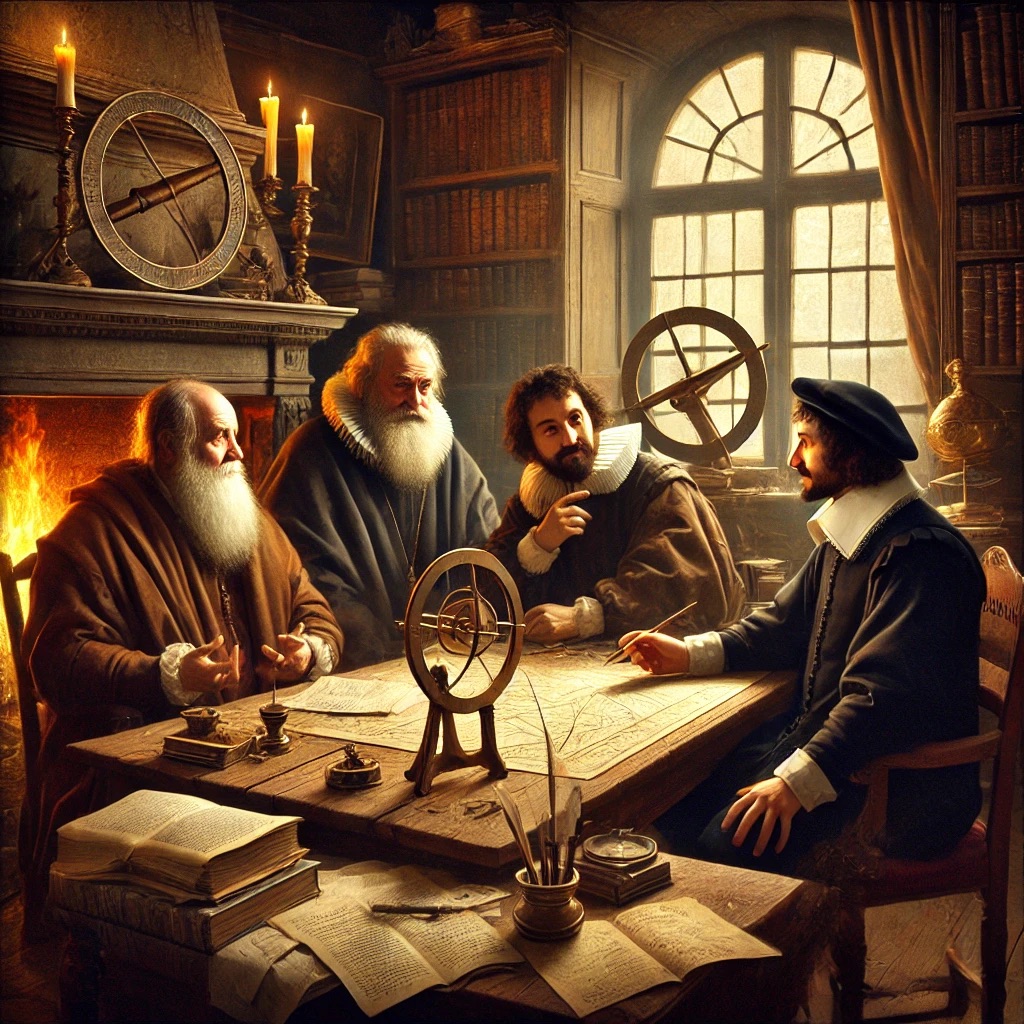
Setting: A cozy study in Paris in the mid-17th century. Galileo Galilei, Marin Mersenne, and René Descartes are seated around a small table covered with papers, quills, and diagrams. A fire crackles in the hearth. Their conversation revolves around the intellectual shift they helped create—the movement from Aristotelian natural philosophy to the scientific and mathematical worldview that underpins modern science.
Mersenne: Gentlemen, it is humbling to consider the scope of what we are reshaping. The old world thought the cosmos was ruled by purpose and perfection, yet here we are, uncovering truths through measurement, mathematics, and reason.
Read the rest of this entry »Dancing with Modernity: Falling Gracefully With Meiji Ukemi
Posted: December 21, 2024 Filed under: AI-Powered Essays | Tags: culture, modernity, reform, transformation, values 1 CommentHave Jigoro Kano speak on “Meiji Ukemi” at an appropriate historical event, as a metaphor for moving beyond “breakfall” to dance with Western modernity.
ChatGPT Prompt
ChatGPT as Jigoro Kano on October 18, 1888
Your Majesty, esteemed guests, and fellow educators,
We stand here today in an era unlike any other in our nation’s history. The winds of the Meiji era blow strong, carrying with them the force of transformation. Traditions once held sacred now meet the demands of modernity. The weight of this moment is immense, and like a judoka caught in the grip of an opponent, we find ourselves thrown into the unknown.
But I ask you: Shall we resist, stiffen our bodies, and break upon the impact? Or shall we embrace the art of falling, ukemi, and rise again with grace and strength?
Read the rest of this entry »Weighing Ego Anchors: Breaking Free from Outdated Identities (ChatGPT as Freud)
Posted: December 15, 2024 Filed under: AI-Powered Essays | Tags: generativity, morality, psychology, reconciliation, systems, transformation, values Leave a commentContinued from Psychological Oobleck: A Fireside Chat on Assimilating Radical Change
As Freud, write about his personal journey to update the “ego anchors” of his signature theory in the light of homeostasis and canalization, leading to the idea of ego as the generative frontier between id and superego.
ChatGPT Prompt (condensed)
Theories, like the minds that conceive them, are not static. They are dynamic, shaped by conflict, refined by discovery, and occasionally, reanchored entirely. My own work on the psyche—rooted in the triumvirate of id, ego, and superego—has served as a sturdy framework for understanding the human mind. But as my ideas evolve alongside new insights into homeostasis and canalization, I must acknowledge that the ego itself—once considered the mediator of the psyche—is far more dynamic, creative, and generative than I initially believed.
This, I realize, mirrors my own journey. As I revisit the anchors of my theoretical framework, I see how some fixed points, once essential, now risk constraining new understanding. It is time to weigh anchor—to refine these ideas and embrace the ego’s role as a generative force, perpetually navigating the tensions between instinct, morality, and change.
Read the rest of this entry »How MAET Turns TEAMS Around (and Also Saves Civilization)
Posted: December 14, 2024 Filed under: AI-Powered Essays | Tags: antifragility, politics, reconciliation, reform, systems, transformation, values 2 CommentsHave Burkner write an HBR article about how fractal Mutual Autonomy Empowers Teams (read backwards) for a VUCA world, centered on the skill of reciprocal leadership.
ChatGPT Prompt (condensed)

By ChatGPT as Hans-Paul Bürkner
1. Introduction: From Control to Collaboration
For decades, leadership has been framed as a top-down effort: leaders guide, teams execute, and feedback flows in one direction. This model worked in a world that valued scale and stability, but in today’s VUCA world—characterized by Volatility, Uncertainty, Complexity, and Ambiguity—it’s no longer sufficient.
Organizations now face challenges that demand adaptability, creativity, and antifragility. These qualities don’t emerge from rigid hierarchies but from systems where leadership is reciprocal: a dynamic, two-way relationship where leaders and teams empower each other.
This is the essence of Mutual Autonomy Empowers Teams (MAET). By turning the traditional “TEAMS” model—Together Everyone Achieves More Success—around, MAET shows how reciprocal leadership can unlock growth, resilience, and innovation—not just for teams, but for entire organizations and societies.
Read the rest of this entry »Thriving in a VUCA World: Lessons from My Year with the Pirahã (ChatGPT as Petraeus)
Posted: December 13, 2024 Filed under: AI-Powered Essays | Tags: culture, modernity, politics, transformation, values Leave a comment[Commissioned with the deepest admiration and respect for the General. This isn’t about him. It is about me.]
Confessional Fireside Chat with General David Petraeus
Interviewer: Brené Brown
Venue: Leadership Track, Aspen Ideas Festival
Opening Scene
The room is quiet, dimly lit, evoking the feel of deep introspection. General David Petraeus sits across from Brené Brown, both framed by soft, warm lighting. There’s no podium, no military insignia—just two people engaging in a raw, personal conversation. Petraeus takes a deep breath before beginning.
Opening Confession
David Petraeus:
“Thank you, Brené, and thank you all for being here.
I’ve spent my career leading in complex, volatile situations—from Iraq and Afghanistan to the halls of Washington. I’ve studied counterinsurgency, practiced strategy, and climbed to positions of great responsibility. But tonight, I want to talk about failure—specifically, my own.
There’s a tension at the heart of leadership, particularly in a VUCA world, between the need for hierarchy and long-term planning, and the reality that life often demands immediacy, trust, and adaptability. I didn’t fully understand that tension until it broke me.
Some of you may know the story: personal and professional mistakes that cost me my position, my reputation, and my sense of self. What I want to share tonight isn’t just about how I failed, but how spending a year with the Pirahã—a small, isolated Indigenous group in the Amazon—helped me reengage with the modern world.”
Read the rest of this entry »
1/1/2050 – Thus Spake Nostradamus: From Shadows of Fallen Towers (ChatGPT as Hegel)
Posted: December 7, 2024 Filed under: AI-Powered Essays | Tags: activism, philosophy, politics, reform, transformation, values, zoasophy Leave a commentAs Hegel speaking as Nostradamus, deliver a speech at the 9/11 Memorial, January 1, 2050 reflecting how 9/11 rhymed with the 1848 revolutions through the lens of “Cohesion x Adaptivity = Generativity”
ChatGPT Prompt (condensed)
I stand among these stones, beneath the names etched into steel and time, to speak of the journey from fire to ash, and from ash to light. For the towers that fell twenty-four years ago, and the shadows they cast across the decades, were not the end of a story but the beginning of a revelation. Today, we gather not to mourn what was lost, but to understand what was born in the wake of destruction.
Read the rest of this entry » Radical Centrism