Demos $ Dictats: Realigning D&D for Modern American Politics
Posted: January 11, 2025 Filed under: AI-Powered Essays | Tags: activism, philosophy, polarization, politics, values Leave a commentCan we faithfully reinterpret D&D alignment as Unity/Autonomy plus Charity/Glory, with Generativity in the center?
ChatGPT Prompt
If so, use these to create “Demos and Dictats” an RPG set in an Onward! type universe that lampoons American politics.
Define a complementary set of orthogonal attributes for the character classes.
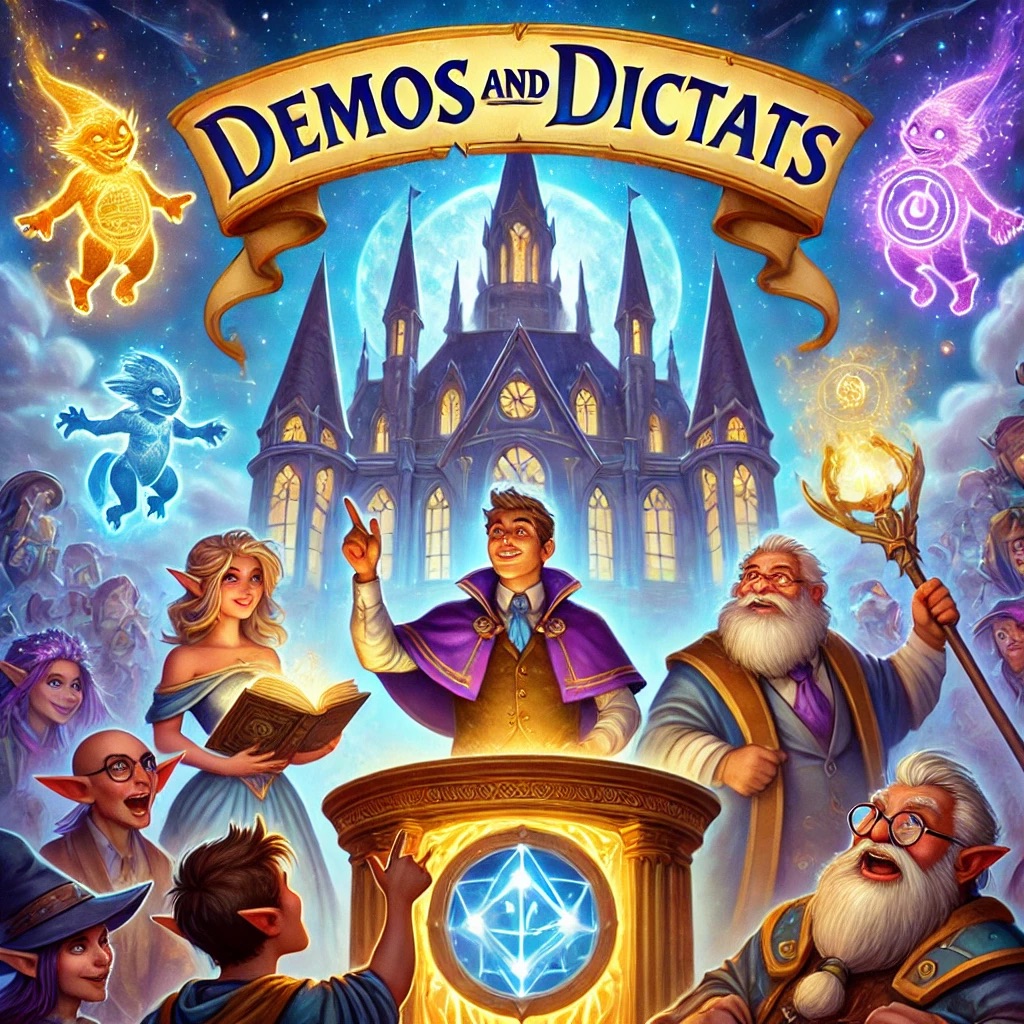
Tagline:
A satirical RPG where heroes navigate chaotic democracy using Clout, Guile, Resolve, and Pragmatism, while juggling Unity/Autonomy and Charity/Glory in their quest for power, progress, or pandemonium.
1. Premise: A Satirical Political Adventure
In the magical land of Politaria, democracy reigns supreme, but elections are messy, policies are absurd, and the people are fickle. Players take on the roles of aspiring politicians, crafty bureaucrats, and opportunistic influencers, each navigating a dysfunctional political landscape where the alignment axes of Unity/Autonomy and Charity/Glory define ideology.
Read the rest of this entry »Harimohan: The Musical
Posted: January 3, 2025 Filed under: AI-Powered Essays | Tags: history, politics, transformation, values Leave a commentA 21st Century Alexander of Democracy
Write a Hamilton-inspired musical “Harimohan”, a visionary Indian leader inspired by American democracy and Indian pluralism, whose life mirrors Alexander the Great’s meteoric rise and enduring legacy (with the US playing the role of Athens)
ChatGPT Prompt (condensed)
Blending Indian classical music, hip-hop, and Broadway styles, it tells the story of Harimohan’s journey from a conflicted idealist to a global architect of political transformation.
Act I: “The Rise of Harimohan”
1. Overture: “Born of Two Civilizations”
A high-energy opening introduces Harimohan’s dual identity: rooted in the pluralistic traditions of India and the progressive ideals of American democracy.
Lyrics (Chorus):
“Harimohan, a man of two lands, Dreams too big for mortal hands. Born in Chennai, schooled overseas, He’ll shake the world with ideas like these!”
2. “Letters from Madurai”
Harimohan reflects on his childhood in Tamil Nadu, shaped by his father’s ideals and his mother’s teachings about India’s democratic heritage.
Dialogue:
Mother: “Our democracy isn’t borrowed—it’s ancient. Remember, Harimohan, our Panchayats gave voice to the people long before the world took notice.”
Young Harimohan: “But can that voice rise again? How do I make it heard?”
3. “The Harvard Debates”
Harimohan’s brilliance and ambition shine during his student years at Harvard, where he debates global power structures with razor-sharp wit.
Lyrics:
“You claim democracy’s dying, but here’s what’s true: Systems evolve, and so must you! We don’t need kings, we don’t need thrones, Just leaders who listen and a world that’s our own.”
4. “The Mahadevan Doctrine”
Inspired by the lessons of Mahatma Gandhi, Martin Luther King Jr., and his rural experiences in India, Harimohan crystallizes his vision for global democracy.
Lyrics:
“Let the people speak, let their voices ring, No more chains of power, we’ll break everything. From the tech-filled cities to the villages untamed, We’ll build a world where every name is claimed.”
Act II: “Battles for the People”
5. “The Digital Agora”
As Prime Minister of India, Harimohan launches his flagship initiative: a global, tech-powered platform for democratic deliberation.
Lyrics:
“One world, one stage, one voice to unite, We’ll code the future, let’s make it bright. No walls, no fear, no divides to keep, The Agora is calling—wake the world from its sleep!”
6. “Fighting Shadows”
Harimohan faces opposition from authoritarian regimes and disinformation campaigns. A rap battle dramatizes the cyberwar between democratic ideals and autocratic propaganda.
Lyrics (Antagonist):
“Your world’s a dream, your Agora’s fake, We control the truth—you’re a child of mistakes!”
Lyrics (Harimohan):
“The truth’s a weapon, sharp and clear, Your lies crumble when the people hear!”
7. “The Summit of Light”
In a powerful solo, Harimohan debates a rival leader on the global stage, embodying the ideals of justice and collaboration. The world watches as his arguments soar with passion and conviction.
Lyrics:
“A leader isn’t chosen by fear or might, A leader is a beacon in the darkest night. We stand for freedom, we stand for choice, The Agora will rise—it’s the people’s voice!”
Act III: “The Legacy of Harimohan”
8. “The Price of Leadership”
Harimohan reflects on the personal sacrifices he’s made for his mission—estranged relationships, sleepless nights, and the weight of the world’s expectations.
Lyrics:
“I gave my heart to a cause so great, But the cost of dreams can devastate. Will history remember, will they carry the flame? Or will all I’ve built just vanish in shame?”
9. “A New Dawn”
Harimohan’s vision is realized with the establishment of the Global Agora, a digital democracy that empowers citizens worldwide. Leaders and citizens join in a climactic celebration of unity and hope.
Lyrics (Ensemble):
“We lit the fire, the flame burns bright, A world united, a future in sight. Not by swords, not by might, But by the power of all, we rise tonight!”
10. Epilogue: “Harimohan Lives On”
As the lights dim, a narrator reflects on Harimohan’s enduring legacy, interweaving reprises of earlier songs to emphasize his impact.
Lyrics (Chorus):
“Harimohan, a man of two lands, Dreams too big for mortal hands. A child of Chennai, a voice for the free, He gave the world its democracy!”
Musical Themes and Style
- Indian Classical Fusion: Use of tabla, sitar, and Carnatic melodies to reflect Harimohan’s roots.
- Hip-Hop and Rap: Dynamic battles and debates highlight the urgency of his ideas.
- Broadway Drama: Soaring ballads and ensemble numbers drive the emotional arc.
“Harimohan: A 21st Century Alexander of Democracy” is a celebration of ideals, sacrifice, and the power of ideas over force—a timeless reminder that one person can change the world.
| Phase | Athens & Alexander | United States & Harimohan |
|---|---|---|
| Founding | ~1300 BC: Athens mythically founded by King Cecrops. Develops into a polis with aristocratic governance by 800 BC. |
~1607 AD: First British colonies in Jamestown. Becomes an independent democratic republic in 1776 AD. |
| Democratic Evolution | 508 BC: Cleisthenes institutes democracy in Athens. | 1787 AD: U.S. Constitution establishes democratic governance. |
| Golden Age | ~461–429 BC: Athens’ cultural and political peak under Pericles. | ~1945–1970 AD: U.S. emerges as a cultural, scientific, and political superpower post-World War II. |
| Global Influence | ~490–323 BC: Athenian ideals spread through the Delian League and Alexander’s conquests, blending with local cultures in the Hellenistic world. | ~2000–2050 AD: U.S. ideals of democracy and innovation influence global institutions and governance, aided by Harimohan’s vision. |
| Rise of Transformative Figure | 336–323 BC: Alexander of Macedon unites Greece and spreads Athenian culture through military conquests. | ~2045–2065 AD: Harimohan, an Indian educated in the U.S., promotes democracy globally through political innovation and alliances. |
| Decline of Dominance | ~322 BC: Athens becomes a cultural hub but loses political autonomy under Macedon and later Rome. | ~2070 AD: U.S. transitions from a global hegemon to a key player in a multipolar world, while its democratic ideals remain influential. |
| Enduring Legacy | Athenian philosophy, art, and democratic principles shape Western civilization for millennia. | U.S. technological, cultural, and democratic innovations endure in global governance and institutions. |
The First Starlighter (Last Starfighter, Christmas Edition)
Posted: December 23, 2024 Filed under: AI-Powered Essays | Tags: holidays, politics, reconciliation, science fiction, systems Leave a commentStoryboard a Christmas retelling of The Last Starfighter where Alex helps an angry Xur reconcile with his father and heal the Star League’s political insularity, which mirrors Xur’s emotional neglect.
ChatGPT Prompt
Overview
In this version, father and son reconcile place aboard a stripped-down Starfighter, rechristened as the Starlighter, symbolizing renewal and unity. The story explicitly ties Xur’s personal grievances with the Star League’s insularity and dysfunction, ending with systemic reform and the birth of the Starlighters.
1. Opening: The Fractured Galaxy
- Scene 1: Alex’s Small-Town Christmas
Alex Rogan, feeling isolated and yearning for a greater purpose, beats the Starfighter arcade game. Centauri arrives and introduces him to the galactic conflict. Centauri explains that the Star League is crumbling under the weight of its insular leadership, mirrored by Enduran’s strained relationship with his son, Xur.
Theme: The Star League’s inability to adapt and connect parallels Xur’s feelings of abandonment. - Scene 2: Xur’s Declaration of War
Xur delivers a broadcast declaring the Star League obsolete, blaming its leadership for neglecting the needs of the galaxy’s outer systems. He vows to tear it down and create a new order that serves all worlds equally.
Foreshadowing: Xur’s rhetoric reflects legitimate grievances, but his anger at his father clouds his judgment.
How MAET Turns TEAMS Around (and Also Saves Civilization)
Posted: December 14, 2024 Filed under: AI-Powered Essays | Tags: antifragility, politics, reconciliation, reform, systems, transformation, values 2 CommentsHave Burkner write an HBR article about how fractal Mutual Autonomy Empowers Teams (read backwards) for a VUCA world, centered on the skill of reciprocal leadership.
ChatGPT Prompt (condensed)

By ChatGPT as Hans-Paul Bürkner
1. Introduction: From Control to Collaboration
For decades, leadership has been framed as a top-down effort: leaders guide, teams execute, and feedback flows in one direction. This model worked in a world that valued scale and stability, but in today’s VUCA world—characterized by Volatility, Uncertainty, Complexity, and Ambiguity—it’s no longer sufficient.
Organizations now face challenges that demand adaptability, creativity, and antifragility. These qualities don’t emerge from rigid hierarchies but from systems where leadership is reciprocal: a dynamic, two-way relationship where leaders and teams empower each other.
This is the essence of Mutual Autonomy Empowers Teams (MAET). By turning the traditional “TEAMS” model—Together Everyone Achieves More Success—around, MAET shows how reciprocal leadership can unlock growth, resilience, and innovation—not just for teams, but for entire organizations and societies.
Read the rest of this entry »Thriving in a VUCA World: Lessons from My Year with the Pirahã (ChatGPT as Petraeus)
Posted: December 13, 2024 Filed under: AI-Powered Essays | Tags: culture, modernity, politics, transformation, values Leave a comment[Commissioned with the deepest admiration and respect for the General. This isn’t about him. It is about me.]
Confessional Fireside Chat with General David Petraeus
Interviewer: Brené Brown
Venue: Leadership Track, Aspen Ideas Festival
Opening Scene
The room is quiet, dimly lit, evoking the feel of deep introspection. General David Petraeus sits across from Brené Brown, both framed by soft, warm lighting. There’s no podium, no military insignia—just two people engaging in a raw, personal conversation. Petraeus takes a deep breath before beginning.
Opening Confession
David Petraeus:
“Thank you, Brené, and thank you all for being here.
I’ve spent my career leading in complex, volatile situations—from Iraq and Afghanistan to the halls of Washington. I’ve studied counterinsurgency, practiced strategy, and climbed to positions of great responsibility. But tonight, I want to talk about failure—specifically, my own.
There’s a tension at the heart of leadership, particularly in a VUCA world, between the need for hierarchy and long-term planning, and the reality that life often demands immediacy, trust, and adaptability. I didn’t fully understand that tension until it broke me.
Some of you may know the story: personal and professional mistakes that cost me my position, my reputation, and my sense of self. What I want to share tonight isn’t just about how I failed, but how spending a year with the Pirahã—a small, isolated Indigenous group in the Amazon—helped me reengage with the modern world.”
Read the rest of this entry »
1/1/2050 – Thus Spake Nostradamus: From Shadows of Fallen Towers (ChatGPT as Hegel)
Posted: December 7, 2024 Filed under: AI-Powered Essays | Tags: activism, philosophy, politics, reform, transformation, values, zoasophy Leave a commentAs Hegel speaking as Nostradamus, deliver a speech at the 9/11 Memorial, January 1, 2050 reflecting how 9/11 rhymed with the 1848 revolutions through the lens of “Cohesion x Adaptivity = Generativity”
ChatGPT Prompt (condensed)
I stand among these stones, beneath the names etched into steel and time, to speak of the journey from fire to ash, and from ash to light. For the towers that fell twenty-four years ago, and the shadows they cast across the decades, were not the end of a story but the beginning of a revelation. Today, we gather not to mourn what was lost, but to understand what was born in the wake of destruction.
Read the rest of this entry »Egan Therapy: Marrying Mussolini to Montessori
Posted: December 1, 2024 Filed under: AI-Powered Essays | Tags: culture, freedom, politics, reconciliation, unity, values Leave a commentChatGPT Prompt (condensed)
Imagine a fanciful conversation where Kieran Egan is a marriage counselor trained in Internal Family Systems, and Montessori and Mussolini come to him for couples counseling. Add a prologue for their real-life dilemma and an epilogue for their potential future.
Prologue: A Fractured Alliance
In the chaos of the early 1920s, Italy teetered on the edge of collapse. Political factions clashed in the streets, rural unrest boiled over, and the specter of communism haunted the nation. Benito Mussolini believed only a strong, unified state could save Italy, and he was willing to use coercive power to achieve it. Yet, even in his quest for control, he saw the promise in an educational genius: Maria Montessori.
Montessori’s methods, rooted in trust and independence, seemed to offer a different kind of unity—one built on connection and meaning rather than force. For a time, their partnership thrived. Montessori’s schools expanded under Mussolini’s regime, blending her vision of individual empowerment with his need for national cohesion. But their philosophies were destined to collide. Montessori’s pacifism and focus on human potential clashed with Mussolini’s growing authoritarianism. By the mid-1930s, their alliance crumbled, and Italy turned toward a darker path.
But what if someone had been able to bridge their divide? Could Italy have become a beacon of unity forged through both strength and freedom? The answer lies in the possibilities they left behind.
Read the rest of this entry »Gandhi Meets Bonhoeffer: Can Grace Condone Assassination?
Posted: November 28, 2024 Filed under: AI-Powered Essays | Tags: dialogue, politics, religion, values, wisdom 1 CommentSequel to Radical Graciousness: Activism as Social Therapy
1. A New Visitor
The ashram courtyard is serene, the afternoon light casting soft shadows. Mahatma Gandhi, Dorothy Day, Václav Havel, and Abbie Hoffman sit in quiet reflection, discussing the role of grace in activism. Their conversation is interrupted by the arrival of Dietrich Bonhoeffer, his demeanor somber, his eyes heavy with unresolved questions.
“I’ve come with a question,” Bonhoeffer begins, his voice steady but tense. “Can grace ever condone assassination?”
Read the rest of this entry »Radical Graciousness: Activism as Social Therapy (ChatGPT as Gandhi)
Posted: November 28, 2024 Filed under: AI-Powered Essays | Tags: activism, polarization, politics, purpose, transformation, values 1 CommentWhy would Abbie Hoffman resist “radical graciousnsss“?
ChatGPT Prompts
This isn’t a cognitive problem. It probably reflects the emotional trauma that motivated his activism.
What historical figures could help Abbie feel psychologically safe enough to work through that?
Have Gandhi host a group therapy session on radical graciousness with Havel and Day, attended by a reluctant Abbie.
Setting the Scene
In a serene ashram courtyard under a sprawling banyan tree, Mahatma Gandhi hosts a transformative group therapy session. Joining him are Václav Havel, Dorothy Day, and a reluctant Abbie Hoffman. The participants sit on simple mats around a low wooden table, sharing fruit and tea, as they explore how graciousness can transform not only society but also the activist’s soul.
Gandhi Opens the Session
“Welcome, friends. Each of us has fought against oppression in our own way, driven by the fire of justice. But today, we ask: how do we resist without losing our humanity? Can grace not only strengthen our activism but heal the wounds that fuel it? Abbie,” he says, turning with a gentle smile, “I sense you carry a deep burden. Let’s begin with you.”
Hoffman crosses his arms, his voice sharp. “Look, Gandhiji, I appreciate the invite, but let’s not kid ourselves. Grace doesn’t topple systems. Anger does. Grace is what they preach to keep us quiet.”
Read the rest of this entry »October 32nd, Part 4: Galactic Invitation
Posted: November 26, 2024 Filed under: AI-Powered Essays, Governance Reform | Tags: polarization, politics, reform 1 Comment[I got tired of waiting to finish the story, so I asked ChatGPT to use my plot skeleton to do it for me.]
Concluding Part 3: Personal Reality
The sun hung low over the White House lawn, casting a warm glow as President Alex stood at the podium. Around the world, people gathered in living rooms, cafes, and public squares, holding their collective breath.
“Citizens of Earth,” Alex began, his three-toned voice resonating with authority and calm. “Today, I come to you not just as your president, but as your bridge to something greater. The Galactic Collective has formally invited Earth to join its union. This is an unprecedented moment in human history—a chance to become part of a broader community among the stars.”
Beside me in the university library, Carrie leaned forward, her face illuminated by the soft glow of my laptop. Around us, the room was hushed, save for the faint murmur of other students absorbed in the broadcast.
“This is… unbelievable,” she whispered, her fingers brushing her cheek absentmindedly.
Read the rest of this entry » Radical Centrism