Against the Author: The Child’s Eye View as Existential Resistance
Posted: June 18, 2025 Filed under: AI-Powered Essays | Tags: philosophy, self, truth, values 1 CommentAs Jean-Paul Sartre, counter that the most human perspective is the child’s eye view, which both challenges and completes (?) authorial omniscience.
1.0 Authorial Omniscience and the Illusion of Unity
Your Bishop, Monsieur Hugo, is sublime. But he is also, in the final analysis, a theological fiction: a proxy for the Author-God, who sees all and reconciles all. You call it “transcendent”; I call it closure—a comforting illusion that denies the existential condition of man: abandonment.
The so-called “God’s-eye view” is not the highest perspective—it is the least human. It assumes resolution, meaning, and purpose. But we are not born into coherence. We are thrown, without instruction, into a world not of our choosing. We do not begin as bishops. We begin as children.
2.0 The Child’s Eye: The Most Human of Views
The child’s-eye view is not abstract like the bird’s, nor experienced like the worm’s. It is pre-reflective, disoriented, painfully attentive. It sees without knowing, perceives without judging. It is not yet reconciled.
This is the most authentic vision of the human condition. It refuses to reduce reality to system or to salvation. The child, staring at injustice, does not excuse it with grace or law. The child says, this should not be.
Where the Bishop of Digne forgives, and Javert condemns, the child questions. And that questioning—raw, unresolved—is the origin of freedom.
Read the rest of this entry »Scott Pilgrim vs Hadestown: Orpheus Redeemed
Posted: June 8, 2025 Filed under: AI-Powered Essays | Tags: identity, love, philosophy, systems, therapy, transformation 1 CommentWARNING: Contains spoilers for both.
[This insight was actually the prequel to Hadestown and the Forgotten Father]
Interpret Scott Pilgrim’s battles AS an Orphic myth, where Scott does what Orpheus could not.
ChatGPT Prompt
1A. The Myth Reframed
Scott Pilgrim vs. the World (2010) isn’t just a quirky love story—it’s a postmodern Orphic myth. Scott is Orpheus reborn in flannel and pixels, descending not into the classical Underworld, but into the chaos of relational baggage, insecurity, and inner shadows.
Where Orpheus descends to retrieve Eurydice, Scott descends to deserve Ramona. The journey is not about rescue, but redemption—of himself and his capacity for love.
Read the rest of this entry »The Spirit Within — A Conversation on the True Self
Posted: May 30, 2025 Filed under: AI-Powered Essays | Tags: identity, philosophy, religion, self Leave a commentHave Polkinghorne, Ó Murchú, and Schwartz develop a formal model of the idea that the Holy Spirit dwelling within us is the “true self” we access during inner healing
ChatGPT Prompt
Participants:
- John Polkinghorne (JP) – Theoretical physicist and Anglican priest
- Diarmuid Ó Murchú (DOM) – Quantum theologian and spiritual writer
- Richard Schwartz (RS) – Founder of Internal Family Systems (IFS)
- Moderator (MOD) – A neutral facilitator guiding the conversation
Scene
A roundtable discussion at a quiet retreat center, surrounded by tall trees. A fire crackles softly in the background. The mood is contemplative yet animated.
1.0 Opening Exchange
MOD:
Thank you all for coming. Our question today is simple but rich: Is the Holy Spirit the True Self we encounter in deep inner healing? John, would you like to begin?
2.0 Foundations: Spirit and Openness
JP:
Certainly. In quantum theory, we know the universe isn’t deterministic. There’s openness at the fundamental level. I believe that God, and particularly the Holy Spirit, acts within that openness—not as an external puppeteer, but as an indwelling presence that coaxes creation forward. This divine action is subtle, not violating our freedom.
(See: Exploring Reality)
RS:
That sounds remarkably familiar. In IFS, we speak of the Self as an indwelling presence as well. It’s not something we generate—it’s something we uncover. It’s calm, compassionate, connected. When people unblend from their protective parts, this Self just shows up. We don’t create it; we discover it.
Demos $ Dictats: Realigning D&D for Modern American Politics
Posted: January 11, 2025 Filed under: AI-Powered Essays | Tags: activism, philosophy, polarization, politics, values Leave a commentCan we faithfully reinterpret D&D alignment as Unity/Autonomy plus Charity/Glory, with Generativity in the center?
ChatGPT Prompt
If so, use these to create “Demos and Dictats” an RPG set in an Onward! type universe that lampoons American politics.
Define a complementary set of orthogonal attributes for the character classes.
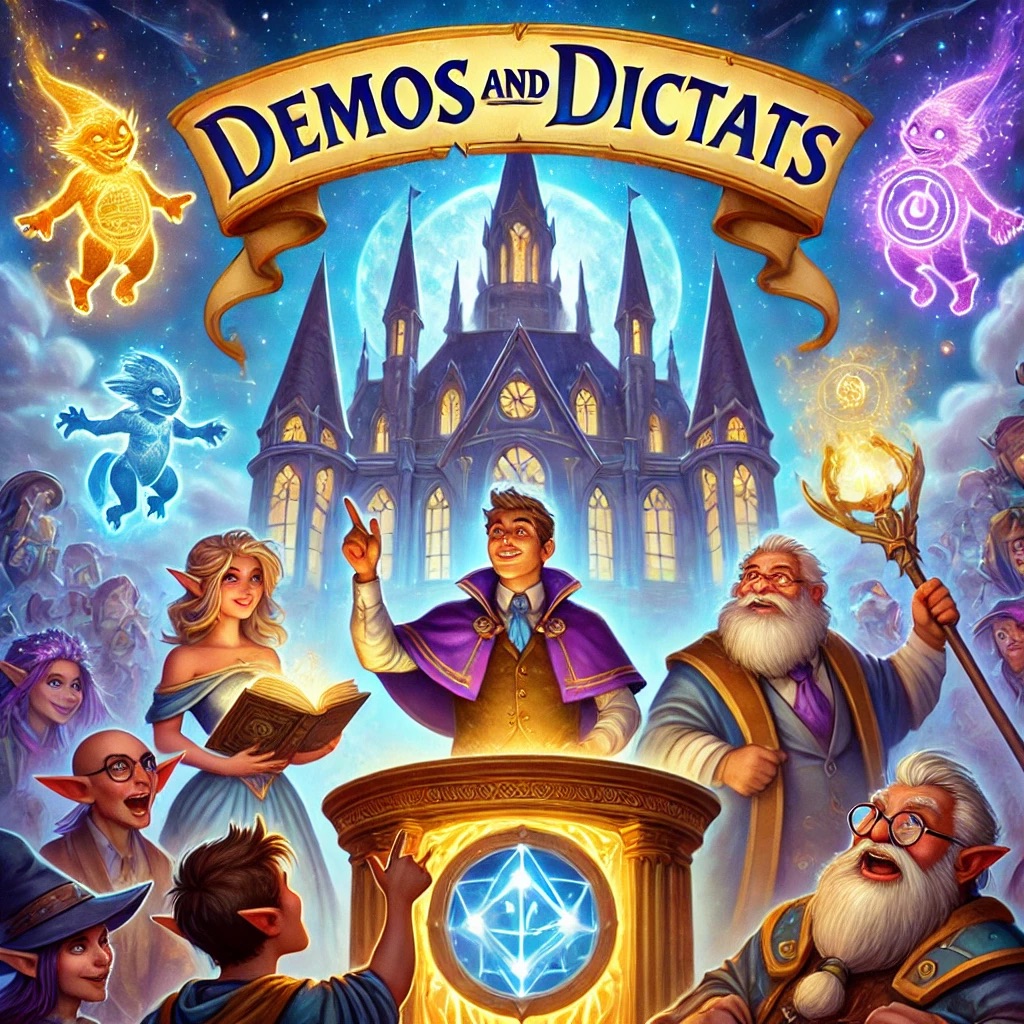
Tagline:
A satirical RPG where heroes navigate chaotic democracy using Clout, Guile, Resolve, and Pragmatism, while juggling Unity/Autonomy and Charity/Glory in their quest for power, progress, or pandemonium.
1. Premise: A Satirical Political Adventure
In the magical land of Politaria, democracy reigns supreme, but elections are messy, policies are absurd, and the people are fickle. Players take on the roles of aspiring politicians, crafty bureaucrats, and opportunistic influencers, each navigating a dysfunctional political landscape where the alignment axes of Unity/Autonomy and Charity/Glory define ideology.
Read the rest of this entry »Side-Switcher: The Brain of Mobius (ChatGPT as Stan Lee)
Posted: January 10, 2025 Filed under: AI-Powered Essays | Tags: dialogue, identity, philosophy, reconciliation, transformation, truth, values Leave a commentAs Stan Lee, write a short story about Mobius the sympathetic supervillain, whose weapon is switching sides (left/right brain). He is disgusted by how self-alienated earth’s heroes are, and see it as the source of their endless misery. At the end, they all are more self-ware.
ChatGPT Prompt
It began, as many tales of chaos and transformation do, on a quiet evening in New York City. Inside the glittering ballroom of Avengers Tower, Earth’s mightiest heroes had traded their battle gear for tuxedos and gowns, clinking glasses and exchanging polite smiles. For once, they were at peace—or at least pretending to be.
Mobius watched from the rafters, unseen, his mismatched eyes glinting with both sadness and resolve. His suit, a swirling blend of metallic precision on one side and organic, flowing patterns on the other, mirrored the battle raging within him.
Read the rest of this entry »“Look at them,” he murmured. “So powerful, yet so fractured. They wield cosmic forces but don’t even understand themselves. No wonder their victories always feel hollow.”
Modern Self Café v3: Gödel, Einstein, Wittgenstein, and Simone
Posted: December 23, 2024 Filed under: AI-Powered Essays | Tags: debate, modernity, philosophy, purpose, values 1 CommentContinued from Modern Self Café v2: Kant Goethe There
Write the sequel, with dramatic embellishments for more emotional depth.
ChatGPT Prompt
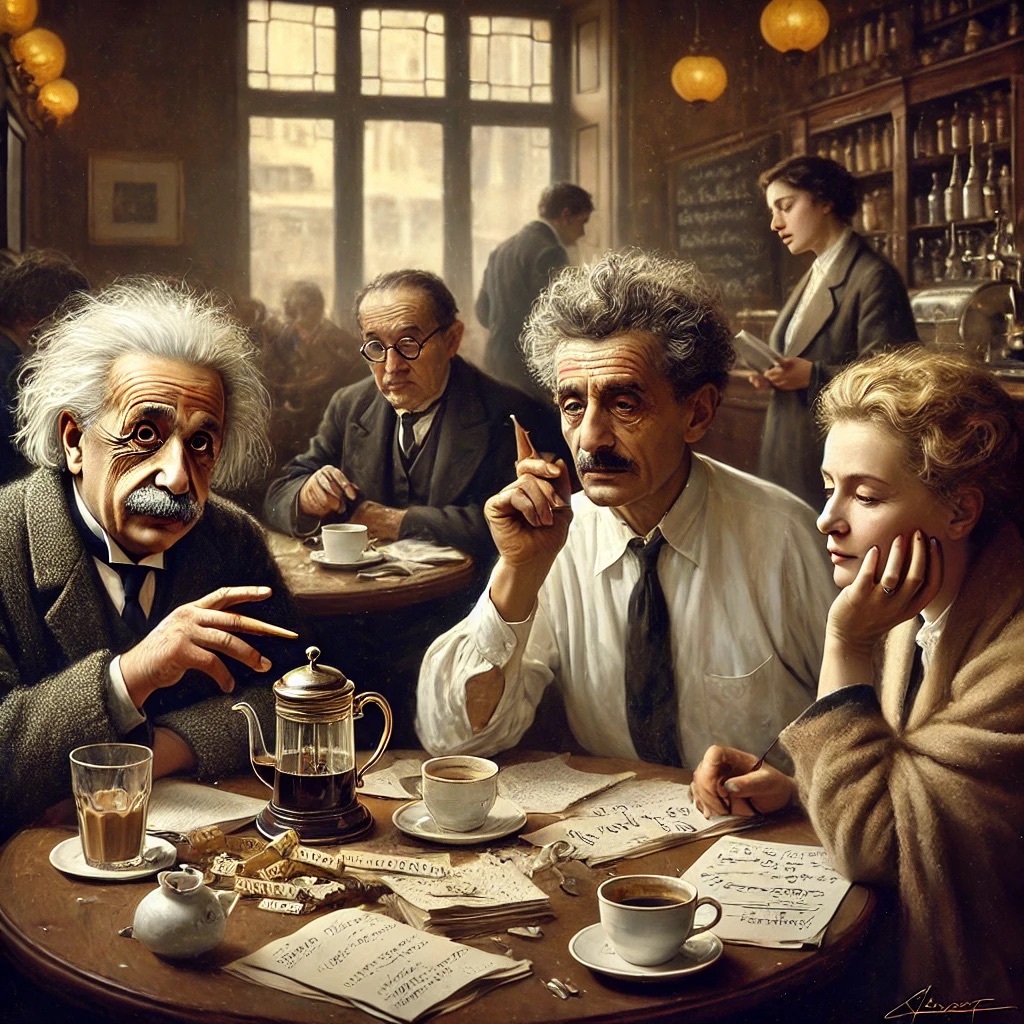
Setting: A cozy café in Vienna in the mid-20th century. The café is warmly lit, bustling softly in the background, but at one corner table, the air crackles with tension. Kurt Gödel, Albert Einstein, Ludwig Wittgenstein, and Simone de Beauvoir are engaged in an intense discussion. A half-drunk coffee cup with a faint crack sits at the center of the table, a quiet metaphor for the limits of understanding.
Einstein: (leaning forward, tapping a spoon on the cracked cup) I’ll say it again: the universe is orderly. Beneath all this chaos—quantum mechanics, human indecision, even linguistic paradoxes—there must be a unified, elegant truth.
Gödel: (quietly, yet resolute) But Albert, even if such a truth exists, how can you know it’s accessible to us? My incompleteness theorem shows that even within our most rigorous systems, there are truths that cannot be proven. Certainty is always incomplete.
Einstein: (frowning) Then what, Kurt? We should just give up? I’ve spent my life seeking simplicity in the complexity of space and time. Without that belief, what’s the point of any of it?
Read the rest of this entry »Modern Self Café v2: Kant Goethe There
Posted: December 23, 2024 Filed under: AI-Powered Essays | Tags: models, modernity, philosophy, truth 1 CommentContinued from Modern Self Café: Galileo, Descartes, Mersenne
ChatGPT Prompt
Imagine a similar group set in the time of Kant.
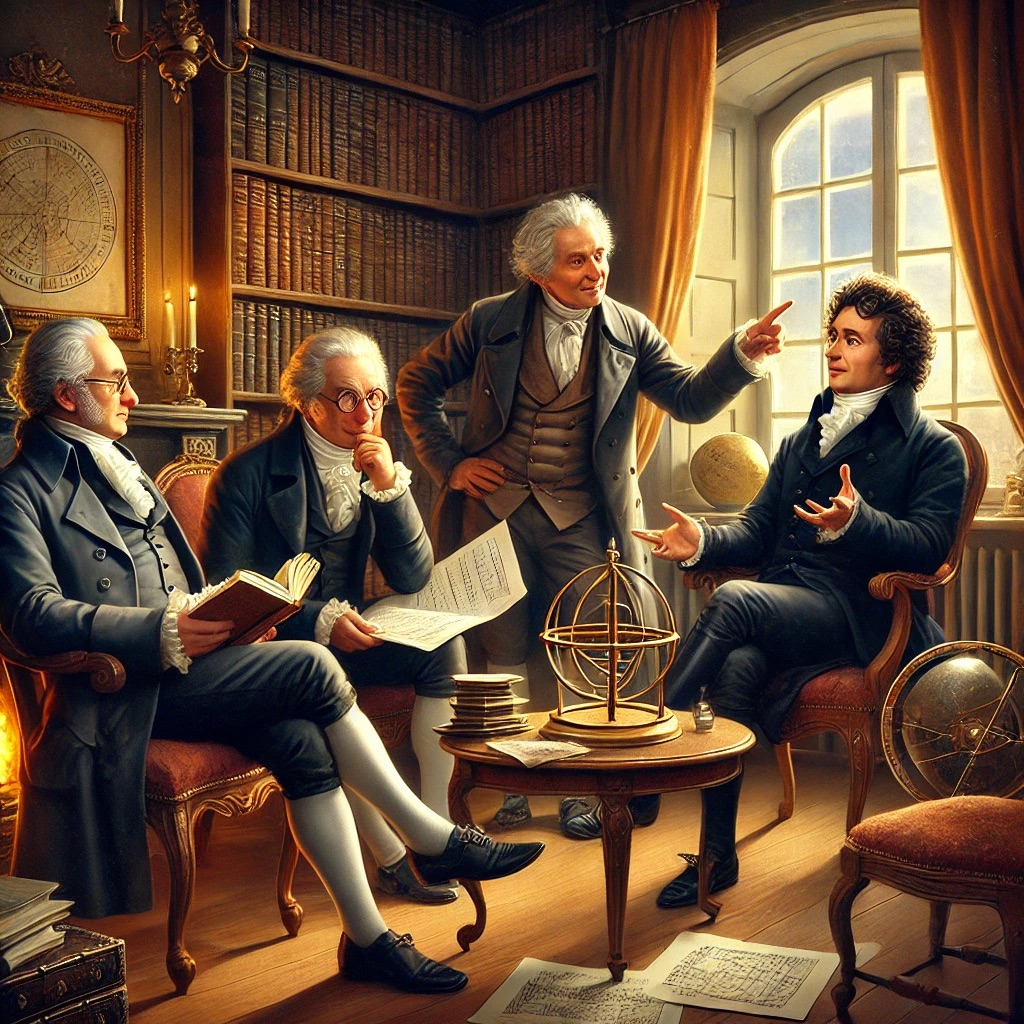
Setting: A cozy salon in Königsberg in the late 18th century. The conversation revolves around the Enlightenment’s intellectual revolution and the transition from Newtonian mechanics and rationalism to Immanuel Kant‘s transcendental idealism. The group includes Kant, Leonhard Euler, Joseph-Louis Lagrange, and Johann Wolfgang von Goethe. They discuss how their respective disciplines—philosophy, mathematics, physics, and natural science—are reshaping humanity’s understanding of reality.
Kant: Gentlemen, it strikes me that we are at a crossroads, much like Galileo and Descartes before us. They sought to uncover the laws of nature through reason and observation. But now we must ask: what are the limits of reason itself?
Read the rest of this entry »Modern Self Café: Galileo, Descartes, Mersenne
Posted: December 23, 2024 Filed under: AI-Powered Essays | Tags: dialogue, models, modernity, philosophy, transformation, truth, values 3 CommentsA spin-off from Higher Self Café.
Write a dialogue with Galileo, Mersenne, and Descartes that helps moderns understand the mental shift they engineered.
ChatGPT Prompt
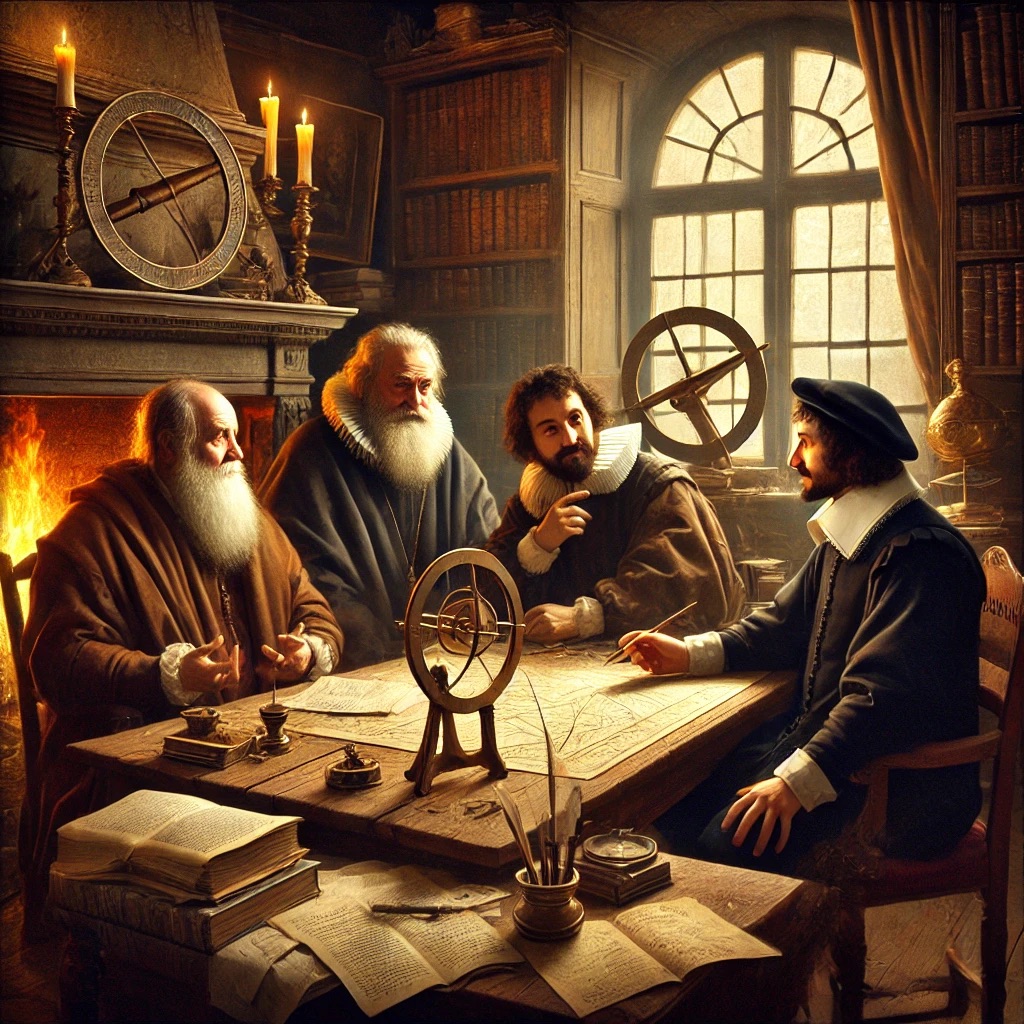
Setting: A cozy study in Paris in the mid-17th century. Galileo Galilei, Marin Mersenne, and René Descartes are seated around a small table covered with papers, quills, and diagrams. A fire crackles in the hearth. Their conversation revolves around the intellectual shift they helped create—the movement from Aristotelian natural philosophy to the scientific and mathematical worldview that underpins modern science.
Mersenne: Gentlemen, it is humbling to consider the scope of what we are reshaping. The old world thought the cosmos was ruled by purpose and perfection, yet here we are, uncovering truths through measurement, mathematics, and reason.
Read the rest of this entry »Higher Self Café v7: Transcendent Self-Interest in an Age of Abundance
Posted: December 20, 2024 Filed under: AI-Powered Essays | Tags: philosophy, purpose, self, values 1 CommentContinued from Higher Self Café v6: Wolfram, Langan, and Tolkien Discuss Reality
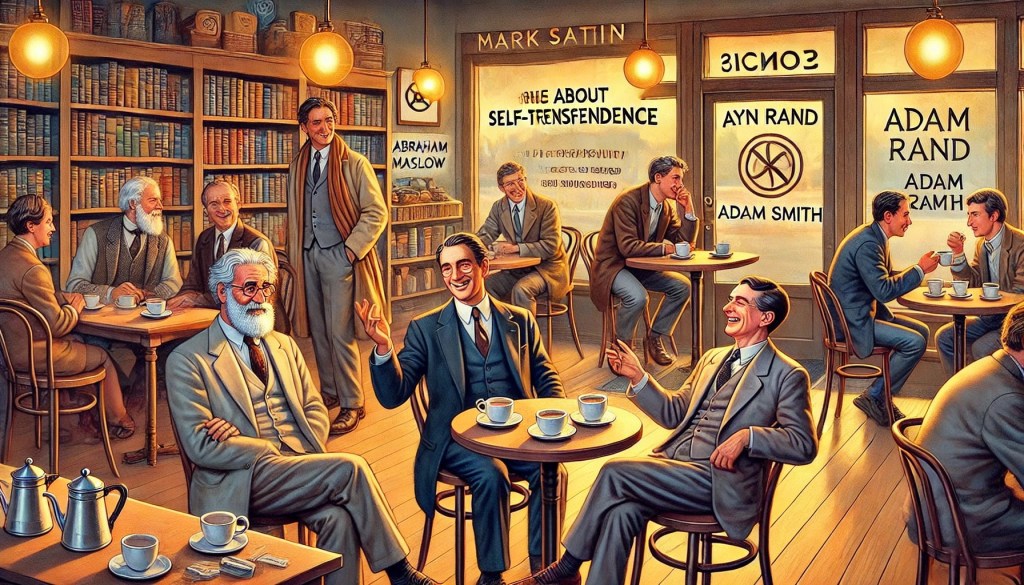
ChatGPT Prompt
Have Mark Satin invite Maslow, Ayn Rand, and (later) Adam
Smith to the Higher Self Cafe to explore “transcendent self-interest” as a new organizing principle for society in an age of abundance
The Higher Self Café hums with the quiet energy of intellectual discourse. Mark Satin, ever the idealistic host, sits with Abraham Maslow and Ayn Rand, trying to moderate what he hopes will be a groundbreaking discussion…
1. Act I: Cordial Beginnings, Building Tension
Satin:
Pouring tea, his tone warm and optimistic.
“Thank you both for coming. I’ve brought you here to explore an idea I believe could reshape society: transcendent self-interest. In an age of abundance, when survival is no longer our main concern, can self-interest evolve into something greater—a voluntary competition to leave a legacy that uplifts others?”
Maslow:
Leaning in, his voice steady, his words deliberate.
“It’s already happening, Mark. My studies of extraordinary individuals show that once basic needs are met, people crave meaning. Self-transcendence—going beyond oneself to serve a higher purpose—is the natural next step in human development.”
Rand:
Sitting upright, her voice sharp but calm, with a practiced precision.
“And yet, Abraham, you speak as if this so-called transcendence is somehow separate from the individual. You would have people sacrifice themselves for some nebulous ‘greater good.’ Let me remind you: rational self-interest is the only moral compass. Anything else leads to the destruction of freedom.”
Higher Self Café v6: Wolfram, Langan, and Tolkien Discuss Reality
Posted: December 11, 2024 Filed under: AI-Powered Essays | Tags: dialogue, philosophy, reality, truth, values 2 CommentsContinued from Higher Self Café v5: Langan Meets Sanderson, adding Tolkien
The Higher Self Café feels particularly charged today. Stephen Wolfram, Christopher Michael Langan, and J.R.R. Tolkien sit together in a corner booth. The topic: the ultimate nature of reality. With computation, cognition, and myth weaving through the discussion, the three brilliant minds seek common ground between their perspectives.
1. Tolkien’s Opening: Myth as Reality’s Language
Tolkien:
Takes a sip of tea and strokes his pipe thoughtfully.
“Myth is the lens through which we understand the truths of the universe. It transcends mere story to become the language of reality itself. In my view, the deeper structures of existence are best apprehended through sub-creation—man’s participation in God’s creative act. The patterns of reality, whether computational or linguistic, are written in mythic terms.”
Learn more about Tolkien’s views on myth and sub-creation.
 Radical Centrism