Modern Self Café: Galileo, Descartes, Mersenne
Posted: December 23, 2024 Filed under: AI-Powered Essays | Tags: dialogue, models, modernity, philosophy, transformation, truth, values 3 CommentsA spin-off from Higher Self Café.
Write a dialogue with Galileo, Mersenne, and Descartes that helps moderns understand the mental shift they engineered.
ChatGPT Prompt
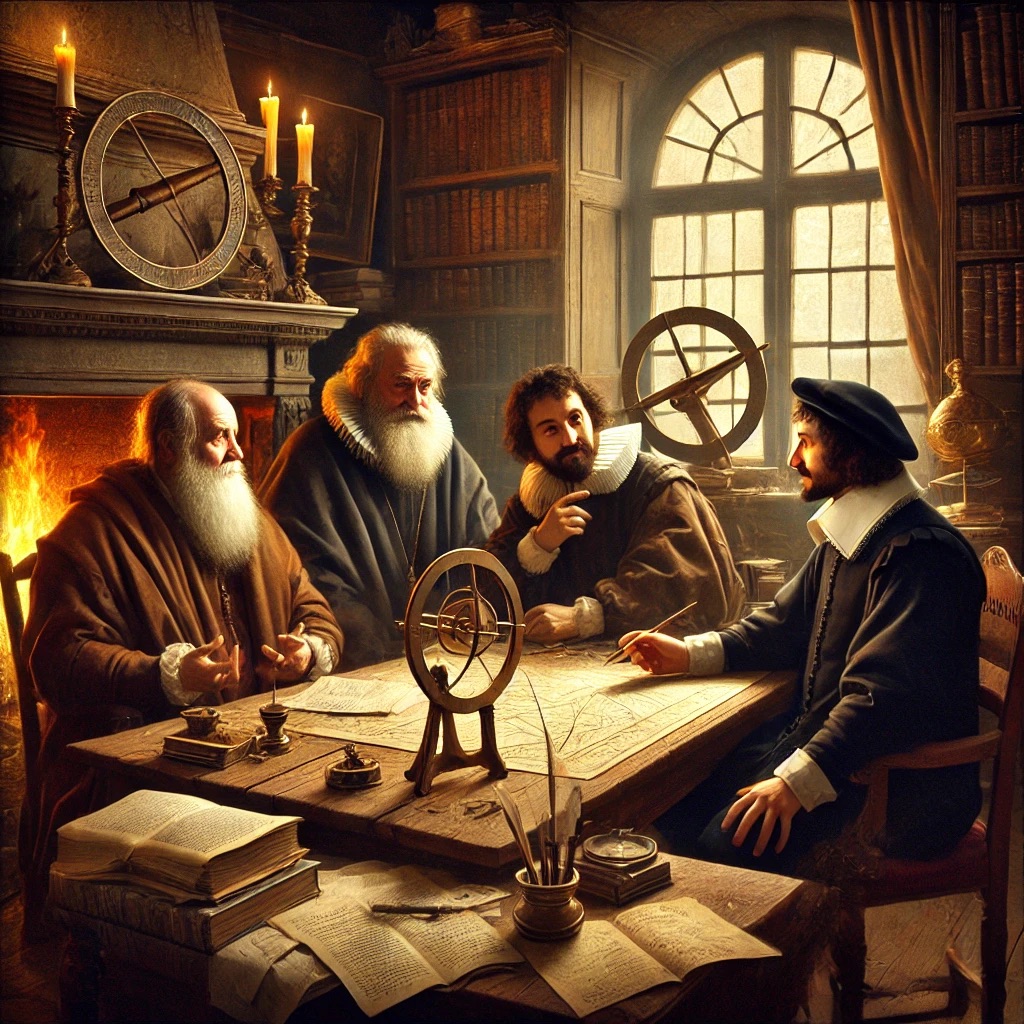
Setting: A cozy study in Paris in the mid-17th century. Galileo Galilei, Marin Mersenne, and René Descartes are seated around a small table covered with papers, quills, and diagrams. A fire crackles in the hearth. Their conversation revolves around the intellectual shift they helped create—the movement from Aristotelian natural philosophy to the scientific and mathematical worldview that underpins modern science.
Mersenne: Gentlemen, it is humbling to consider the scope of what we are reshaping. The old world thought the cosmos was ruled by purpose and perfection, yet here we are, uncovering truths through measurement, mathematics, and reason.
Read the rest of this entry »The Tapestry of Reciprocal Leadership
Posted: December 21, 2024 Filed under: AI-Powered Essays | Tags: argument, dialogue, humility, purpose, reconciliation, relationships, religion, values Leave a commentSequel to How MAET Turns TEAMS Around (and Also Saves Civilization)
Explain the journey of reciprocal leadership using a tapestry viewed from three perspectives: John Gottman, David Marquet, and later Saint Francis. It starts out exciting, but leads to disillusionment.
ChatGPT Prompt (greatly condensed)
Then something miraculous happens…
Act 1: Shared Excitement
Scene: A serene monastery courtyard. The sun casts a golden glow over an ancient stone wall, where a large, intricate tapestry hangs. The label beneath it reads: “Reciprocal Leadership.”
Enter JOHN GOTTMAN, reflective and warm, and DAVID MARQUET, precise and deliberate, from opposite sides of the stage. They stop in front of the tapestry, staring at it curiously.
GOTTMAN (gesturing to the tapestry)
Look at how interconnected it is. Each thread supports the others, like a family—built on trust and shared understanding.
MARQUET (studying the pattern closely)
Interconnected, yes, but orderly. Each thread has a role and direction, like an organization—efficient, driven by clarity and intent.
Dancing with Modernity: Falling Gracefully With Meiji Ukemi
Posted: December 21, 2024 Filed under: AI-Powered Essays | Tags: culture, modernity, reform, transformation, values 1 CommentHave Jigoro Kano speak on “Meiji Ukemi” at an appropriate historical event, as a metaphor for moving beyond “breakfall” to dance with Western modernity.
ChatGPT Prompt
ChatGPT as Jigoro Kano on October 18, 1888
Your Majesty, esteemed guests, and fellow educators,
We stand here today in an era unlike any other in our nation’s history. The winds of the Meiji era blow strong, carrying with them the force of transformation. Traditions once held sacred now meet the demands of modernity. The weight of this moment is immense, and like a judoka caught in the grip of an opponent, we find ourselves thrown into the unknown.
But I ask you: Shall we resist, stiffen our bodies, and break upon the impact? Or shall we embrace the art of falling, ukemi, and rise again with grace and strength?
Read the rest of this entry »Higher Self Café v7: Transcendent Self-Interest in an Age of Abundance
Posted: December 20, 2024 Filed under: AI-Powered Essays | Tags: philosophy, purpose, self, values 1 CommentContinued from Higher Self Café v6: Wolfram, Langan, and Tolkien Discuss Reality
ChatGPT Prompt
Have Mark Satin invite Maslow, Ayn Rand, and (later) Adam
Smith to the Higher Self Cafe to explore “transcendent self-interest” as a new organizing principle for society in an age of abundance
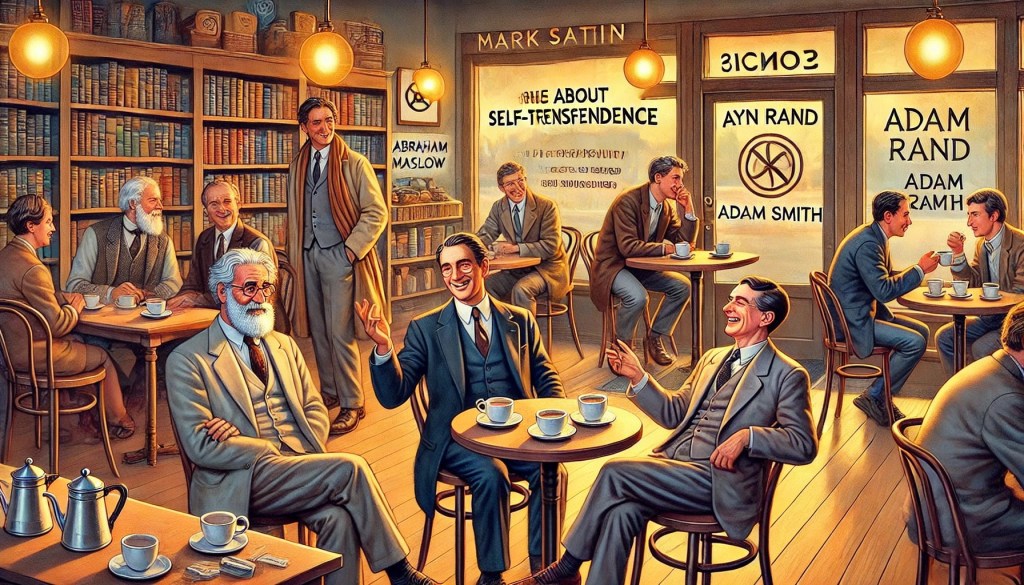
The Higher Self Café hums with the quiet energy of intellectual discourse. Mark Satin, ever the idealistic host, sits with Abraham Maslow and Ayn Rand, trying to moderate what he hopes will be a groundbreaking discussion…
1. Act I: Cordial Beginnings, Building Tension
Satin:
Pouring tea, his tone warm and optimistic.
“Thank you both for coming. I’ve brought you here to explore an idea I believe could reshape society: transcendent self-interest. In an age of abundance, when survival is no longer our main concern, can self-interest evolve into something greater—a voluntary competition to leave a legacy that uplifts others?”
Maslow:
Leaning in, his voice steady, his words deliberate.
“It’s already happening, Mark. My studies of extraordinary individuals show that once basic needs are met, people crave meaning. Self-transcendence—going beyond oneself to serve a higher purpose—is the natural next step in human development.”
Rand:
Sitting upright, her voice sharp but calm, with a practiced precision.
“And yet, Abraham, you speak as if this so-called transcendence is somehow separate from the individual. You would have people sacrifice themselves for some nebulous ‘greater good.’ Let me remind you: rational self-interest is the only moral compass. Anything else leads to the destruction of freedom.”
Weighing Ego Anchors: Breaking Free from Outdated Identities (ChatGPT as Freud)
Posted: December 15, 2024 Filed under: AI-Powered Essays | Tags: generativity, morality, psychology, reconciliation, systems, transformation, values Leave a commentContinued from Psychological Oobleck: A Fireside Chat on Assimilating Radical Change
As Freud, write about his personal journey to update the “ego anchors” of his signature theory in the light of homeostasis and canalization, leading to the idea of ego as the generative frontier between id and superego.
ChatGPT Prompt (condensed)
Theories, like the minds that conceive them, are not static. They are dynamic, shaped by conflict, refined by discovery, and occasionally, reanchored entirely. My own work on the psyche—rooted in the triumvirate of id, ego, and superego—has served as a sturdy framework for understanding the human mind. But as my ideas evolve alongside new insights into homeostasis and canalization, I must acknowledge that the ego itself—once considered the mediator of the psyche—is far more dynamic, creative, and generative than I initially believed.
This, I realize, mirrors my own journey. As I revisit the anchors of my theoretical framework, I see how some fixed points, once essential, now risk constraining new understanding. It is time to weigh anchor—to refine these ideas and embrace the ego’s role as a generative force, perpetually navigating the tensions between instinct, morality, and change.
Read the rest of this entry »How MAET Turns TEAMS Around (and Also Saves Civilization)
Posted: December 14, 2024 Filed under: AI-Powered Essays | Tags: antifragility, politics, reconciliation, reform, systems, transformation, values 2 CommentsHave Burkner write an HBR article about how fractal Mutual Autonomy Empowers Teams (read backwards) for a VUCA world, centered on the skill of reciprocal leadership.
ChatGPT Prompt (condensed)

By ChatGPT as Hans-Paul Bürkner
1. Introduction: From Control to Collaboration
For decades, leadership has been framed as a top-down effort: leaders guide, teams execute, and feedback flows in one direction. This model worked in a world that valued scale and stability, but in today’s VUCA world—characterized by Volatility, Uncertainty, Complexity, and Ambiguity—it’s no longer sufficient.
Organizations now face challenges that demand adaptability, creativity, and antifragility. These qualities don’t emerge from rigid hierarchies but from systems where leadership is reciprocal: a dynamic, two-way relationship where leaders and teams empower each other.
This is the essence of Mutual Autonomy Empowers Teams (MAET). By turning the traditional “TEAMS” model—Together Everyone Achieves More Success—around, MAET shows how reciprocal leadership can unlock growth, resilience, and innovation—not just for teams, but for entire organizations and societies.
Read the rest of this entry »Thriving in a VUCA World: Lessons from My Year with the Pirahã (ChatGPT as Petraeus)
Posted: December 13, 2024 Filed under: AI-Powered Essays | Tags: culture, modernity, politics, transformation, values Leave a comment[Commissioned with the deepest admiration and respect for the General. This isn’t about him. It is about me.]
Confessional Fireside Chat with General David Petraeus
Interviewer: Brené Brown
Venue: Leadership Track, Aspen Ideas Festival
Opening Scene
The room is quiet, dimly lit, evoking the feel of deep introspection. General David Petraeus sits across from Brené Brown, both framed by soft, warm lighting. There’s no podium, no military insignia—just two people engaging in a raw, personal conversation. Petraeus takes a deep breath before beginning.
Opening Confession
David Petraeus:
“Thank you, Brené, and thank you all for being here.
I’ve spent my career leading in complex, volatile situations—from Iraq and Afghanistan to the halls of Washington. I’ve studied counterinsurgency, practiced strategy, and climbed to positions of great responsibility. But tonight, I want to talk about failure—specifically, my own.
There’s a tension at the heart of leadership, particularly in a VUCA world, between the need for hierarchy and long-term planning, and the reality that life often demands immediacy, trust, and adaptability. I didn’t fully understand that tension until it broke me.
Some of you may know the story: personal and professional mistakes that cost me my position, my reputation, and my sense of self. What I want to share tonight isn’t just about how I failed, but how spending a year with the Pirahã—a small, isolated Indigenous group in the Amazon—helped me reengage with the modern world.”
Read the rest of this entry »
Higher Self Café v6: Wolfram, Langan, and Tolkien Discuss Reality
Posted: December 11, 2024 Filed under: AI-Powered Essays | Tags: dialogue, philosophy, reality, truth, values 2 CommentsContinued from Higher Self Café v5: Langan Meets Sanderson, adding Tolkien
The Higher Self Café feels particularly charged today. Stephen Wolfram, Christopher Michael Langan, and J.R.R. Tolkien sit together in a corner booth. The topic: the ultimate nature of reality. With computation, cognition, and myth weaving through the discussion, the three brilliant minds seek common ground between their perspectives.
1. Tolkien’s Opening: Myth as Reality’s Language
Tolkien:
Takes a sip of tea and strokes his pipe thoughtfully.
“Myth is the lens through which we understand the truths of the universe. It transcends mere story to become the language of reality itself. In my view, the deeper structures of existence are best apprehended through sub-creation—man’s participation in God’s creative act. The patterns of reality, whether computational or linguistic, are written in mythic terms.”
Learn more about Tolkien’s views on myth and sub-creation.
The Brothers of the River: A Pirahã Origin Myth
Posted: December 11, 2024 Filed under: AI-Powered Essays | Tags: culture, ideas, language, values Leave a commentHow did the Pirahá evolve such a strong cultural focus on immediacy, relative to other Mura groups?
ChatGPT Prompt
Can we hypothesize a triggering event?
Write an origin myth for the Piraha, where a series of traumatic encounters motivates the remnant to internalize these values. Frame it as a conflict between two brothers.
Long ago, before the world was as it is now, there were two brothers who lived with their people along a mighty river. Their village was full of laughter and stories, and the people had many ways to understand the world. They sang of the spirits in the trees, the fish in the river, and the stars above. The older brother, Hapa, was strong and proud, always looking to the future. He dreamed of building great villages and storing food so that their people would never know hunger. The younger brother, Nima, was quiet and watchful, content to live each day as it came.
The Strangers Arrive
One season, strangers arrived from beyond the river, wearing shiny clothes and speaking words no one understood. They brought strange tools and promises of friendship, but their faces were cold. Hapa welcomed them, seeing in their tools the power to build the great future he dreamed of. He traded fish and game for shiny metal blades and pots, telling the people this was the way forward.
Read the rest of this entry »Higher Self Café v5: Langan Meets Sanderson
Posted: December 11, 2024 Filed under: AI-Powered Essays | Tags: dialogue, emotions, philosophy, truth 1 CommentContinued from Higher Self Café, v4: Miriam Harmonizes The Philosophers
Have Christopher Michael Langan and Brandon Sanderson meet at the Higher Self Cafe to discuss whether “spiritual” is a third dimension alongside physical and cognitive.
ChatGPT Prompt
The scene opens in the cozy confines of the Higher Self Café, where philosophers, authors, and intellectuals from across dimensions gather to exchange ideas. Today, the topic is whether “spiritual” constitutes a third dimension alongside the physical and cognitive. At one table, Christopher Michael Langan and Brandon Sanderson sip their respective drinks, deep in conversation.
Read the rest of this entry » Radical Centrism