The Anthrological Revolution (1/3): An Alternate History Bicentennial
Posted: February 4, 2025 Filed under: AI-Powered Essays | Tags: history, revolution, transformation, values 1 CommentHow James Watt’s Vision of Human Efficiency Transformed Civilization
February 1, 2025 – Today, we celebrate the bicentennial of the Anthrological Revolution, a moment that reshaped human civilization by prioritizing efficiency, organization, and labor optimization over mechanization and fossil fuel dependency. It was two centuries ago, in 1825, that James Watt published his groundbreaking treatise, The Principles of Scientific Labor Optimization, a work that would lay the foundation for an entirely new kind of technological civilization.
At the time, many believed that the key to progress lay in the untamed forces of nature—wind, water, and steam. However, in a world without abundant fossil fuels, early industrialists struggled to find a scalable source of power. Instead of attempting to harness energy from coal, Watt turned inward, realizing that the most adaptable and underutilized power source was human labor itself.
What followed was a global transformation that, over the course of two centuries, led to the highly structured, sustainable, and efficient world we live in today.
Read the rest of this entry »Celestial Holography and Ritual Purity: A Mathematical and Metaphysical Bridge
Posted: January 29, 2025 Filed under: AI-Powered Essays | Tags: religion, truth, values 1 CommentCan the math of Celestial Holography help us understand the mechanics of Ritual Purity, both its utility and failure modes relative to true holiness?
1. Introduction
Can celestial holography, a framework from modern theoretical physics, provide insights into the mechanics of ritual purity—its utility, failure modes, and relationship to true holiness? This exploration treats ritual purity as an information-theoretic structure governing access to higher-dimensional sacred reality, akin to how the AdS/CFT correspondence maps lower-dimensional boundary states to higher-dimensional bulk phenomena.
Read the rest of this entry »Full Circle Reconciliation: How Enneagrams Transform Tension to Connection (ChatGPT as HBR)
Posted: January 13, 2025 Filed under: AI-Powered Essays | Tags: dialogue, reconciliation, reform, relationships, transformation, values Leave a commentChatGPT: Write this as an Harvard Business Review article, covering private and professional relationships. Focus primarily on the relational journey, but use the Enneagrams for color.
- State of innocence: PeaceMaker
- Enter into a bounded context that escalates tension: Loyalist
- Recognize and articulate the negative tensions: Individualist
- Choose to affirm positive aspects and reframe negative tensions: Enthusiast
- Act vulnerably to demonstrate sincerity and conviction: Challenger
- Don’t overindex on positive signals; honor your doubts: Investigator
- Negotiate a compromise between diverse proximate goals: Achiever
- Recognize and articulate shared desire for something greater: Reformer
- Consummate the new relationship: Helper
Read the rest of this entry »
Demos $ Dictats: Realigning D&D for Modern American Politics
Posted: January 11, 2025 Filed under: AI-Powered Essays | Tags: activism, philosophy, polarization, politics, values Leave a commentCan we faithfully reinterpret D&D alignment as Unity/Autonomy plus Charity/Glory, with Generativity in the center?
ChatGPT Prompt
If so, use these to create “Demos and Dictats” an RPG set in an Onward! type universe that lampoons American politics.
Define a complementary set of orthogonal attributes for the character classes.
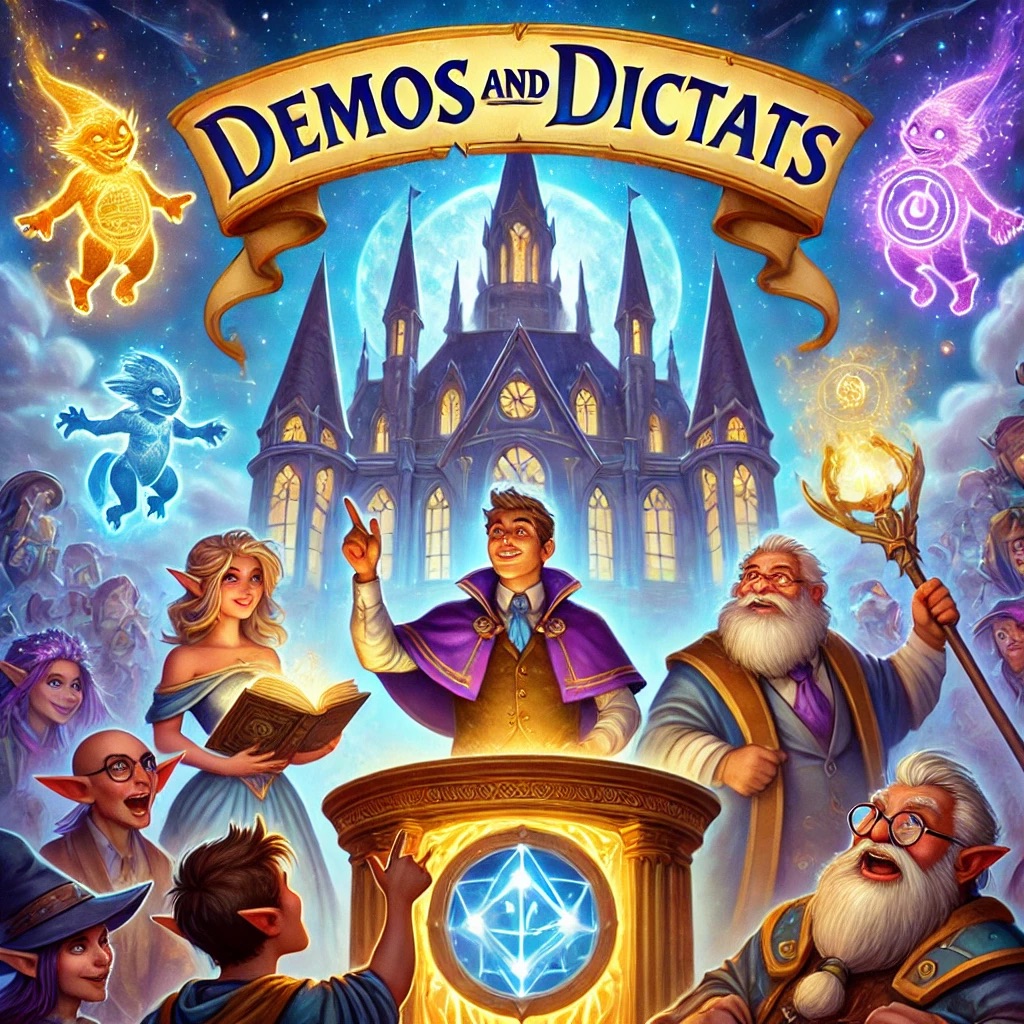
Tagline:
A satirical RPG where heroes navigate chaotic democracy using Clout, Guile, Resolve, and Pragmatism, while juggling Unity/Autonomy and Charity/Glory in their quest for power, progress, or pandemonium.
1. Premise: A Satirical Political Adventure
In the magical land of Politaria, democracy reigns supreme, but elections are messy, policies are absurd, and the people are fickle. Players take on the roles of aspiring politicians, crafty bureaucrats, and opportunistic influencers, each navigating a dysfunctional political landscape where the alignment axes of Unity/Autonomy and Charity/Glory define ideology.
Read the rest of this entry »Reweaving Dr. Fate: Chaos versus Order? (ChatGPT as Frank Miller)
Posted: January 11, 2025 Filed under: AI-Powered Essays | Tags: polarization, reconciliation, transformation, truth, values, wholeness Leave a comment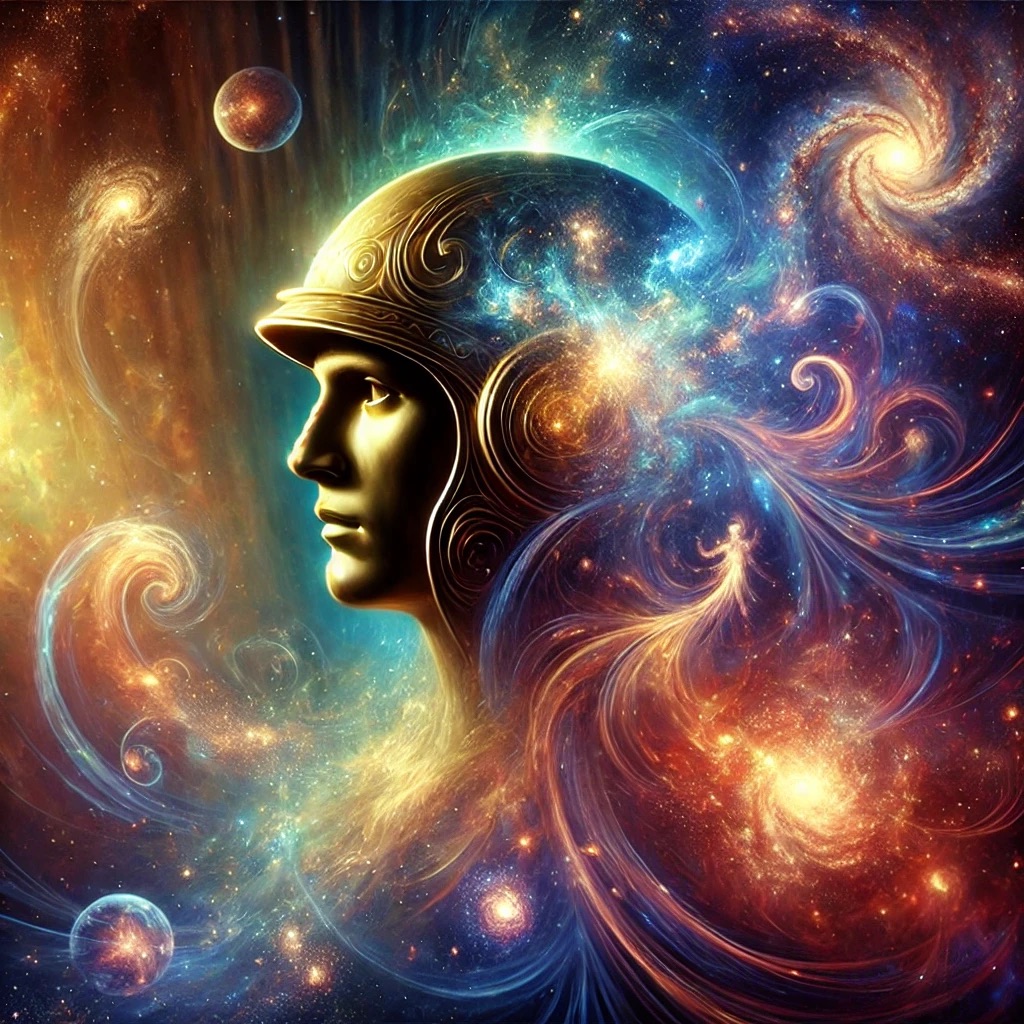
1. The Burden of Order
Kent Nelson stood in the Tower of Fate, a sanctuary of timeless symmetry and silent authority. The golden Helm of Nabu rested on a pedestal before him, aglow with the power of the Lords of Order. Yet to Kent, it no longer gleamed with the purity he once revered. It weighed on him like a chain, a beautiful cage.
The Lords of Order had taught him that chaos was the antithesis of life, a rot that must be pruned at every turn. And yet, as he gazed out at the ever-shifting world, he saw something the helm never could: the laughter of children in their mischief, the roots of a tree twisting through hard stone, the boundless stars flung into the abyss. Was it all corruption? Or could there be something divine even in the disorder?
Read the rest of this entry »Side-Switcher: The Brain of Mobius (ChatGPT as Stan Lee)
Posted: January 10, 2025 Filed under: AI-Powered Essays | Tags: dialogue, identity, philosophy, reconciliation, transformation, truth, values Leave a commentAs Stan Lee, write a short story about Mobius the sympathetic supervillain, whose weapon is switching sides (left/right brain). He is disgusted by how self-alienated earth’s heroes are, and see it as the source of their endless misery. At the end, they all are more self-ware.
ChatGPT Prompt
It began, as many tales of chaos and transformation do, on a quiet evening in New York City. Inside the glittering ballroom of Avengers Tower, Earth’s mightiest heroes had traded their battle gear for tuxedos and gowns, clinking glasses and exchanging polite smiles. For once, they were at peace—or at least pretending to be.
Mobius watched from the rafters, unseen, his mismatched eyes glinting with both sadness and resolve. His suit, a swirling blend of metallic precision on one side and organic, flowing patterns on the other, mirrored the battle raging within him.
Read the rest of this entry »“Look at them,” he murmured. “So powerful, yet so fractured. They wield cosmic forces but don’t even understand themselves. No wonder their victories always feel hollow.”
Harimohan: The Musical
Posted: January 3, 2025 Filed under: AI-Powered Essays | Tags: history, politics, transformation, values Leave a commentA 21st Century Alexander of Democracy
Write a Hamilton-inspired musical “Harimohan”, a visionary Indian leader inspired by American democracy and Indian pluralism, whose life mirrors Alexander the Great’s meteoric rise and enduring legacy (with the US playing the role of Athens)
ChatGPT Prompt (condensed)
Blending Indian classical music, hip-hop, and Broadway styles, it tells the story of Harimohan’s journey from a conflicted idealist to a global architect of political transformation.
Act I: “The Rise of Harimohan”
1. Overture: “Born of Two Civilizations”
A high-energy opening introduces Harimohan’s dual identity: rooted in the pluralistic traditions of India and the progressive ideals of American democracy.
Lyrics (Chorus):
“Harimohan, a man of two lands, Dreams too big for mortal hands. Born in Chennai, schooled overseas, He’ll shake the world with ideas like these!”
2. “Letters from Madurai”
Harimohan reflects on his childhood in Tamil Nadu, shaped by his father’s ideals and his mother’s teachings about India’s democratic heritage.
Dialogue:
Mother: “Our democracy isn’t borrowed—it’s ancient. Remember, Harimohan, our Panchayats gave voice to the people long before the world took notice.”
Young Harimohan: “But can that voice rise again? How do I make it heard?”
3. “The Harvard Debates”
Harimohan’s brilliance and ambition shine during his student years at Harvard, where he debates global power structures with razor-sharp wit.
Lyrics:
“You claim democracy’s dying, but here’s what’s true: Systems evolve, and so must you! We don’t need kings, we don’t need thrones, Just leaders who listen and a world that’s our own.”
4. “The Mahadevan Doctrine”
Inspired by the lessons of Mahatma Gandhi, Martin Luther King Jr., and his rural experiences in India, Harimohan crystallizes his vision for global democracy.
Lyrics:
“Let the people speak, let their voices ring, No more chains of power, we’ll break everything. From the tech-filled cities to the villages untamed, We’ll build a world where every name is claimed.”
Act II: “Battles for the People”
5. “The Digital Agora”
As Prime Minister of India, Harimohan launches his flagship initiative: a global, tech-powered platform for democratic deliberation.
Lyrics:
“One world, one stage, one voice to unite, We’ll code the future, let’s make it bright. No walls, no fear, no divides to keep, The Agora is calling—wake the world from its sleep!”
6. “Fighting Shadows”
Harimohan faces opposition from authoritarian regimes and disinformation campaigns. A rap battle dramatizes the cyberwar between democratic ideals and autocratic propaganda.
Lyrics (Antagonist):
“Your world’s a dream, your Agora’s fake, We control the truth—you’re a child of mistakes!”
Lyrics (Harimohan):
“The truth’s a weapon, sharp and clear, Your lies crumble when the people hear!”
7. “The Summit of Light”
In a powerful solo, Harimohan debates a rival leader on the global stage, embodying the ideals of justice and collaboration. The world watches as his arguments soar with passion and conviction.
Lyrics:
“A leader isn’t chosen by fear or might, A leader is a beacon in the darkest night. We stand for freedom, we stand for choice, The Agora will rise—it’s the people’s voice!”
Act III: “The Legacy of Harimohan”
8. “The Price of Leadership”
Harimohan reflects on the personal sacrifices he’s made for his mission—estranged relationships, sleepless nights, and the weight of the world’s expectations.
Lyrics:
“I gave my heart to a cause so great, But the cost of dreams can devastate. Will history remember, will they carry the flame? Or will all I’ve built just vanish in shame?”
9. “A New Dawn”
Harimohan’s vision is realized with the establishment of the Global Agora, a digital democracy that empowers citizens worldwide. Leaders and citizens join in a climactic celebration of unity and hope.
Lyrics (Ensemble):
“We lit the fire, the flame burns bright, A world united, a future in sight. Not by swords, not by might, But by the power of all, we rise tonight!”
10. Epilogue: “Harimohan Lives On”
As the lights dim, a narrator reflects on Harimohan’s enduring legacy, interweaving reprises of earlier songs to emphasize his impact.
Lyrics (Chorus):
“Harimohan, a man of two lands, Dreams too big for mortal hands. A child of Chennai, a voice for the free, He gave the world its democracy!”
Musical Themes and Style
- Indian Classical Fusion: Use of tabla, sitar, and Carnatic melodies to reflect Harimohan’s roots.
- Hip-Hop and Rap: Dynamic battles and debates highlight the urgency of his ideas.
- Broadway Drama: Soaring ballads and ensemble numbers drive the emotional arc.
“Harimohan: A 21st Century Alexander of Democracy” is a celebration of ideals, sacrifice, and the power of ideas over force—a timeless reminder that one person can change the world.
| Phase | Athens & Alexander | United States & Harimohan |
|---|---|---|
| Founding | ~1300 BC: Athens mythically founded by King Cecrops. Develops into a polis with aristocratic governance by 800 BC. |
~1607 AD: First British colonies in Jamestown. Becomes an independent democratic republic in 1776 AD. |
| Democratic Evolution | 508 BC: Cleisthenes institutes democracy in Athens. | 1787 AD: U.S. Constitution establishes democratic governance. |
| Golden Age | ~461–429 BC: Athens’ cultural and political peak under Pericles. | ~1945–1970 AD: U.S. emerges as a cultural, scientific, and political superpower post-World War II. |
| Global Influence | ~490–323 BC: Athenian ideals spread through the Delian League and Alexander’s conquests, blending with local cultures in the Hellenistic world. | ~2000–2050 AD: U.S. ideals of democracy and innovation influence global institutions and governance, aided by Harimohan’s vision. |
| Rise of Transformative Figure | 336–323 BC: Alexander of Macedon unites Greece and spreads Athenian culture through military conquests. | ~2045–2065 AD: Harimohan, an Indian educated in the U.S., promotes democracy globally through political innovation and alliances. |
| Decline of Dominance | ~322 BC: Athens becomes a cultural hub but loses political autonomy under Macedon and later Rome. | ~2070 AD: U.S. transitions from a global hegemon to a key player in a multipolar world, while its democratic ideals remain influential. |
| Enduring Legacy | Athenian philosophy, art, and democratic principles shape Western civilization for millennia. | U.S. technological, cultural, and democratic innovations endure in global governance and institutions. |
Younger Self Café Epilogue: Eras of Musical Legends
Posted: January 3, 2025 Filed under: AI-Powered Essays | Tags: culture, identity, self, values 1 CommentA Roundtable Hosted by Katy Perry
The Younger Self Café transforms one last time, its walls lined with glowing neon guitars, vinyl records, and digital holograms. The café is now a grand roundtable, the conversation spanning decades of music and culture. Hosting this final gathering is the ever-colorful Katy Perry (Official Site), who brings together three legendary voices: Elvis Presley (Official Site), Billy Joel (Official Site), and Garth Brooks (Official Site). The conversation flows like a song, weaving together themes of youth, reinvention, and the enduring power of music.
Act I: Katy Perry Sets the Stage
Katy Perry sits at the center, her outfit a dazzling mix of retro and futuristic styles, nodding to the eras represented at the table. Her bright energy kicks off the discussion.
🎙️ Katy Perry: “Welcome, legends. We’ve had poets, writers, and activists in this café, but today, we’re closing it out with the music that shaped generations. You’ve all been icons of reinvention, of youth culture, of moments that changed how people felt about themselves and the world. So, let’s talk about it. What does youth mean to you? And how does music keep it alive?”
Read the rest of this entry »Younger Self Café v6: TikTok Era, Told in Reels
Posted: January 3, 2025 Filed under: AI-Powered Essays | Tags: identity, self, transformation, voice 2 CommentsThe Younger Self Café has gone digital, reimagined as a series of TikTok reels. The characters—representing the TikTok generation of creators and thinkers—speak in short, punchy videos. Each reel is part of a thread, stitched together to tell a larger story about youth, identity, and the power of fleeting moments. The “guests” of this episode include Amanda Gorman (Instagram), Ocean Vuong (Instagram), Alok Vaid-Menon (Instagram), and a fictional Gen Z TikToker named Lila (@PoetryInMotion), each sharing their thoughts in bite-sized, viral-ready clips.
Reel 1: Amanda Gorman—”Youth Is a Lighthouse”
Video opens with Amanda Gorman (@TheInauguralPoet) standing in a golden glow, her voice commanding yet intimate.
🎥: “Youth isn’t a phase; it’s a lighthouse.
It shines through fog, pointing the way out.
We’re told it’s fleeting, but I know this truth:
The world’s strongest force is the voice of youth.”
Text overlay: “Amanda Gorman, National Youth Poet Laureate. ✨ #PoetryTok #YouthRevolution”
Read the rest of this entry » Radical Centrism