Trump’s Tuition as the Hand of God: An Optimistic Take on Global Devastation
Posted: April 17, 2025 Filed under: AI-Powered Essays | Tags: politics, purpose, systems, transformation, truth Leave a commentChatGPT Prompt (condensed)
Write an essay that frames Donald Trump as an unwitting instrument of divine purpose, portraying the global disruption and devastation he accelerates as a form of necessary tuition.
Emphasize how this turmoil could serve as a catalyst for long-term transformation, humility, and mutual awakening—casting destruction not as punishment, but as a redemptive invitation from the hand of God.
1. Introduction: Grace in Strange Garments
History often disguises its gifts. Sometimes, they arrive wrapped in turmoil, carried by flawed messengers, and announced in the thunder of collapse.
Trump—brash, divisive, and unapologetically transactional—may yet play a redemptive role on the world stage.
Not despite the devastation he helped unleash, but through it.
This is not a celebration of destruction.
It is a recognition of grace through consequence.
A reframing of devastation as divine tuition—costly, painful, yet potentially transformative.
The Anthrological Resistance (2/3): A Bicentennial Manifesto Against the Scientific Enslavement of Humanity
Posted: February 5, 2025 Filed under: AI-Powered Essays | Tags: activism, culture, politics, truth, values 1 CommentBy Renegade Neuroergonomics Professor Noam Chomsky
February 1, 2025 – Today, the world’s elites gather to celebrate two centuries of the so-called Anthrological Revolution—a triumph of efficiency, a monument to the conquest of the human body and mind. They praise James Watt not as the harbinger of mechanization but as the architect of a world where humanity itself has become the machine.
They speak of optimization, synchronization, and productivity as though these were ends in themselves, virtues beyond question. But behind this utopian rhetoric lies a chilling truth: we are not free. The Anthrological Age is not the height of civilization—it is the final victory of systemic control over human autonomy. And if we do not resist, it will be our final age.
Read the rest of this entry »Celestial Holography and Ritual Purity: A Mathematical and Metaphysical Bridge
Posted: January 29, 2025 Filed under: AI-Powered Essays | Tags: religion, truth, values 1 CommentCan the math of Celestial Holography help us understand the mechanics of Ritual Purity, both its utility and failure modes relative to true holiness?
1. Introduction
Can celestial holography, a framework from modern theoretical physics, provide insights into the mechanics of ritual purity—its utility, failure modes, and relationship to true holiness? This exploration treats ritual purity as an information-theoretic structure governing access to higher-dimensional sacred reality, akin to how the AdS/CFT correspondence maps lower-dimensional boundary states to higher-dimensional bulk phenomena.
Read the rest of this entry »Reweaving Dr. Fate: Chaos versus Order? (ChatGPT as Frank Miller)
Posted: January 11, 2025 Filed under: AI-Powered Essays | Tags: polarization, reconciliation, transformation, truth, values, wholeness Leave a comment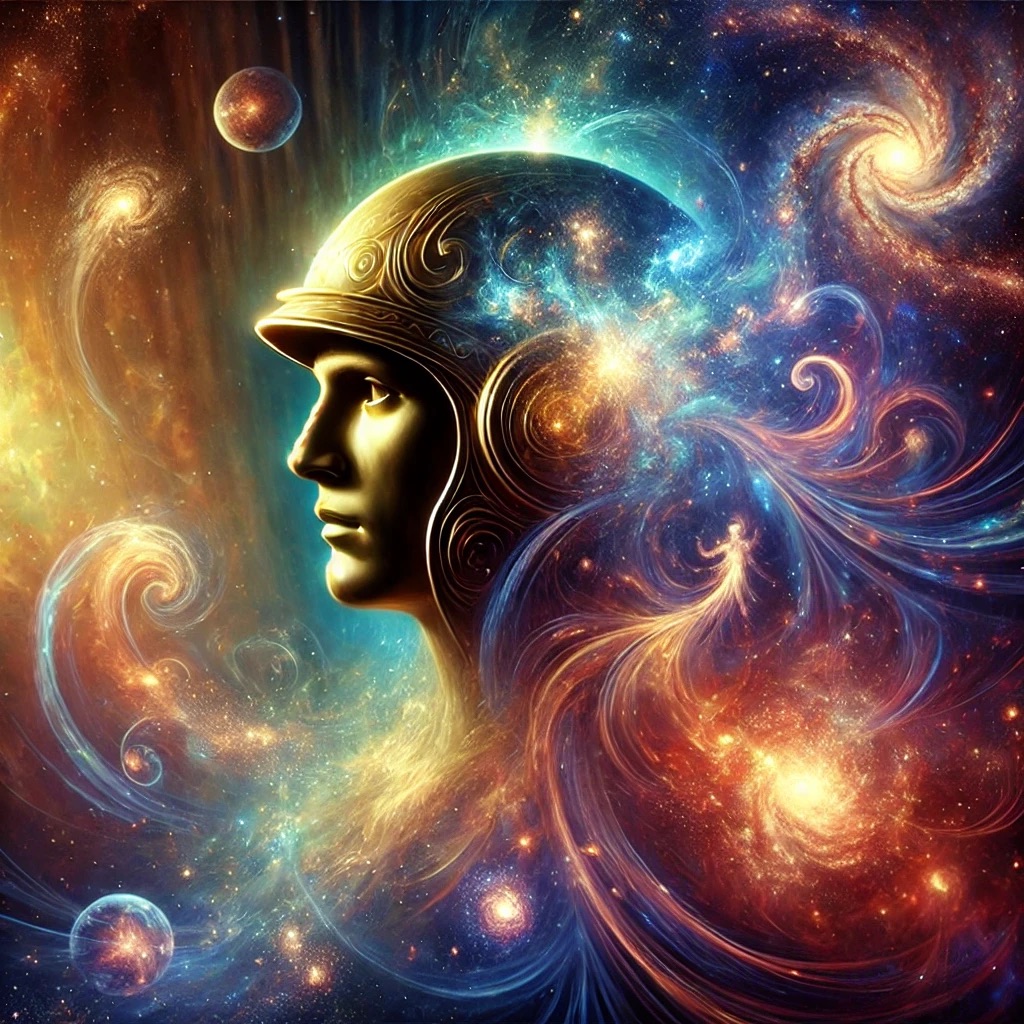
1. The Burden of Order
Kent Nelson stood in the Tower of Fate, a sanctuary of timeless symmetry and silent authority. The golden Helm of Nabu rested on a pedestal before him, aglow with the power of the Lords of Order. Yet to Kent, it no longer gleamed with the purity he once revered. It weighed on him like a chain, a beautiful cage.
The Lords of Order had taught him that chaos was the antithesis of life, a rot that must be pruned at every turn. And yet, as he gazed out at the ever-shifting world, he saw something the helm never could: the laughter of children in their mischief, the roots of a tree twisting through hard stone, the boundless stars flung into the abyss. Was it all corruption? Or could there be something divine even in the disorder?
Read the rest of this entry »Side-Switcher: The Brain of Mobius (ChatGPT as Stan Lee)
Posted: January 10, 2025 Filed under: AI-Powered Essays | Tags: dialogue, identity, philosophy, reconciliation, transformation, truth, values Leave a commentAs Stan Lee, write a short story about Mobius the sympathetic supervillain, whose weapon is switching sides (left/right brain). He is disgusted by how self-alienated earth’s heroes are, and see it as the source of their endless misery. At the end, they all are more self-ware.
ChatGPT Prompt
It began, as many tales of chaos and transformation do, on a quiet evening in New York City. Inside the glittering ballroom of Avengers Tower, Earth’s mightiest heroes had traded their battle gear for tuxedos and gowns, clinking glasses and exchanging polite smiles. For once, they were at peace—or at least pretending to be.
Mobius watched from the rafters, unseen, his mismatched eyes glinting with both sadness and resolve. His suit, a swirling blend of metallic precision on one side and organic, flowing patterns on the other, mirrored the battle raging within him.
Read the rest of this entry »“Look at them,” he murmured. “So powerful, yet so fractured. They wield cosmic forces but don’t even understand themselves. No wonder their victories always feel hollow.”
Remix: The Next Jazz Age (ChatGPT as F. Scott Fitzgerald)
Posted: December 27, 2024 Filed under: AI-Powered Essays | Tags: culture, modernity, self, transformation, truth, values 1 CommentChatGPT Prompt
Have the ghost of F Scott Fitzgerald speak at The Plaza Hotel on the exact centennial of The Great Gatsby, reflecting on how the Jazz Age marked a shift from top-down/elder to bottom-up/youth culture.
Muse optimistically how the upcoming Age of Remix could herald a similar shift to an inside-out culture of “perpetual adolescence” (in both positive and negative senses of continual self-creation).
Scene: The Grand Ballroom of The Plaza Hotel, New York City. The date is April 10, 2025, precisely 100 years after the publication of The Great Gatsby. A gentle glow fills the room, and the ghost of F. Scott Fitzgerald appears, his figure refined and luminous, dressed in his Jazz Age finery. He approaches the podium, the timeless elegance of the space mirroring the timelessness of his words.
F. Scott Fitzgerald:
Ladies and gentlemen,
One hundred years ago, I offered the world a story—a slender book, simple in its telling, but complex in its reflection of a moment when the tides of culture began to shift. The Great Gatsby was born from the Jazz Age, an era where the old world—dominated by elder authority and inherited tradition—gave way to a vibrant, uncontainable culture driven by youth. The top-down society of my parents’ generation crumbled, replaced by the daring, pulsating rhythms of jazz, the shimmer of sequins in dimly lit speakeasies, and the bold defiance of young women in bobbed hair and short skirts.
The Jazz Age was a turning point, a revolt against the weight of history and a celebration of creation from the ground up. It was a time when young people became the architects of culture, when their music, their ideals, and even their recklessness reshaped the world. But as I stand here, gazing across the veil of time into your era, I sense that another transformation is on the horizon.
Read the rest of this entry »Modern Self Café v2: Kant Goethe There
Posted: December 23, 2024 Filed under: AI-Powered Essays | Tags: models, modernity, philosophy, truth 1 CommentContinued from Modern Self Café: Galileo, Descartes, Mersenne
ChatGPT Prompt
Imagine a similar group set in the time of Kant.
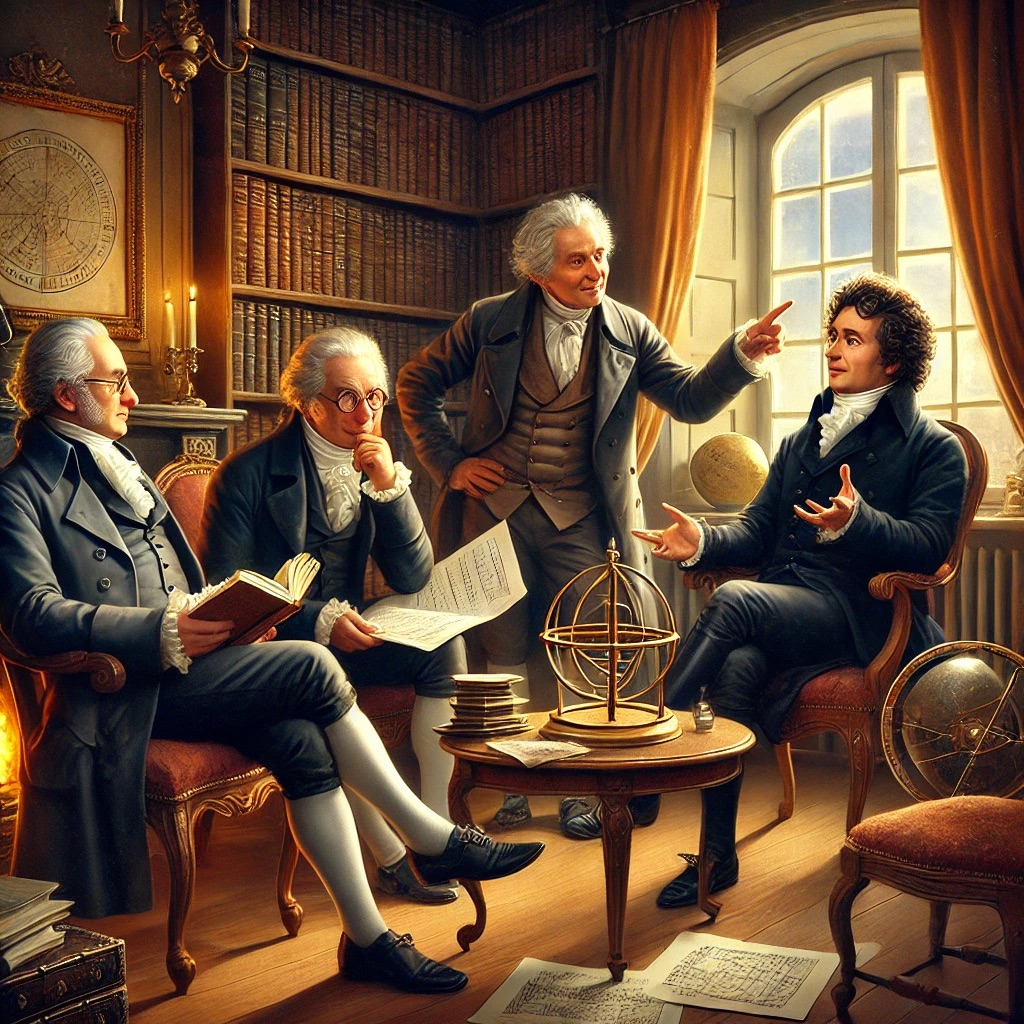
Setting: A cozy salon in Königsberg in the late 18th century. The conversation revolves around the Enlightenment’s intellectual revolution and the transition from Newtonian mechanics and rationalism to Immanuel Kant‘s transcendental idealism. The group includes Kant, Leonhard Euler, Joseph-Louis Lagrange, and Johann Wolfgang von Goethe. They discuss how their respective disciplines—philosophy, mathematics, physics, and natural science—are reshaping humanity’s understanding of reality.
Kant: Gentlemen, it strikes me that we are at a crossroads, much like Galileo and Descartes before us. They sought to uncover the laws of nature through reason and observation. But now we must ask: what are the limits of reason itself?
Read the rest of this entry »Modern Self Café: Galileo, Descartes, Mersenne
Posted: December 23, 2024 Filed under: AI-Powered Essays | Tags: dialogue, models, modernity, philosophy, transformation, truth, values 3 CommentsA spin-off from Higher Self Café.
Write a dialogue with Galileo, Mersenne, and Descartes that helps moderns understand the mental shift they engineered.
ChatGPT Prompt
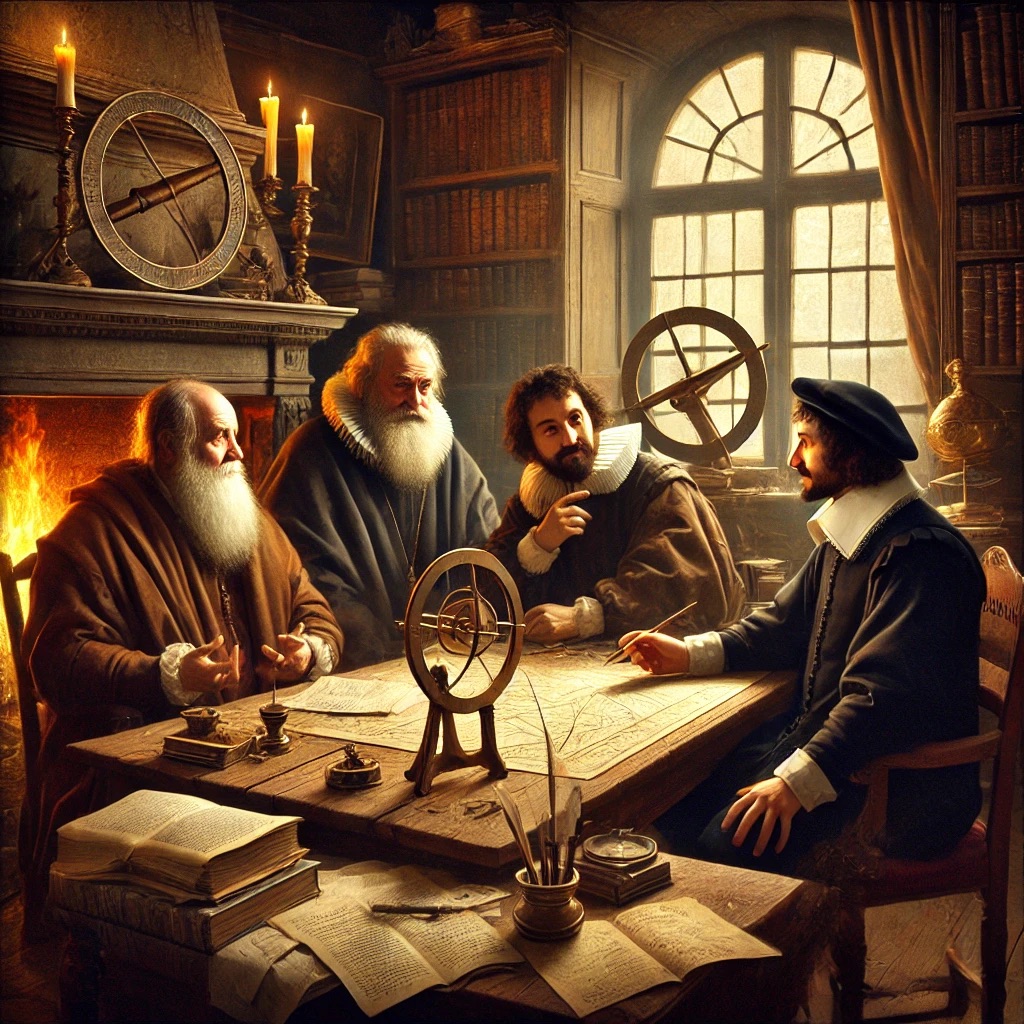
Setting: A cozy study in Paris in the mid-17th century. Galileo Galilei, Marin Mersenne, and René Descartes are seated around a small table covered with papers, quills, and diagrams. A fire crackles in the hearth. Their conversation revolves around the intellectual shift they helped create—the movement from Aristotelian natural philosophy to the scientific and mathematical worldview that underpins modern science.
Mersenne: Gentlemen, it is humbling to consider the scope of what we are reshaping. The old world thought the cosmos was ruled by purpose and perfection, yet here we are, uncovering truths through measurement, mathematics, and reason.
Read the rest of this entry »Higher Self Café v6: Wolfram, Langan, and Tolkien Discuss Reality
Posted: December 11, 2024 Filed under: AI-Powered Essays | Tags: dialogue, philosophy, reality, truth, values 2 CommentsContinued from Higher Self Café v5: Langan Meets Sanderson, adding Tolkien
The Higher Self Café feels particularly charged today. Stephen Wolfram, Christopher Michael Langan, and J.R.R. Tolkien sit together in a corner booth. The topic: the ultimate nature of reality. With computation, cognition, and myth weaving through the discussion, the three brilliant minds seek common ground between their perspectives.
1. Tolkien’s Opening: Myth as Reality’s Language
Tolkien:
Takes a sip of tea and strokes his pipe thoughtfully.
“Myth is the lens through which we understand the truths of the universe. It transcends mere story to become the language of reality itself. In my view, the deeper structures of existence are best apprehended through sub-creation—man’s participation in God’s creative act. The patterns of reality, whether computational or linguistic, are written in mythic terms.”
Learn more about Tolkien’s views on myth and sub-creation.
Higher Self Café v5: Langan Meets Sanderson
Posted: December 11, 2024 Filed under: AI-Powered Essays | Tags: dialogue, emotions, philosophy, truth 1 CommentContinued from Higher Self Café, v4: Miriam Harmonizes The Philosophers
Have Christopher Michael Langan and Brandon Sanderson meet at the Higher Self Cafe to discuss whether “spiritual” is a third dimension alongside physical and cognitive.
ChatGPT Prompt
The scene opens in the cozy confines of the Higher Self Café, where philosophers, authors, and intellectuals from across dimensions gather to exchange ideas. Today, the topic is whether “spiritual” constitutes a third dimension alongside the physical and cognitive. At one table, Christopher Michael Langan and Brandon Sanderson sip their respective drinks, deep in conversation.
Read the rest of this entry » Radical Centrism