Narrative Self Café v13B Interlude — Unsettling Placodusa: The Rhythm That Moves You
Posted: March 1, 2026 Filed under: AI-Powered Essays | Tags: development, history, models, polarization, systems, transformation 2 CommentsSequel to Scaling PlacoSponges (How Tidal Shear Might Have Electrified Animals)
Richard Goldschmidt
ChatGPT Prompt (condensed)
Delivered (ahistorically) at the 1939 Cold Spring Harbor Symposium on Quantitative Biology
Act 0 — The Abstract
Mobility need not originate in predation, pursuit, or neural innovation. It becomes accessible once electrically excitable epithelium encloses hydraulic volume at sufficient scale.
In a placosponge-grade ancestor—comparable in simplicity to early Porifera or Placozoa—heterochronic delay of settlement permits metamorphosis in suspension. The contractile aperture—originally a valve against tidal shear stress—becomes a circumferential actuator. Excitable contractile cavities with threshold recovery dynamics form relaxation oscillators. In fluid, oscillation produces thrust.
Read the rest of this entry »Non-Narrative Cafe v19: By Way Of Contrast (Polarism)
Posted: February 11, 2026 Filed under: AI-Powered Essays | Tags: dialogue, philosophy, polarization, systems Leave a commentSequel to Non-Narrative Café v18=v9×2: Retconning Hertz More
Write the next cafe skit where three disciples of Peirce, Spencer-Brown, and Whitehead accidentally invent Polarism when confronted by how Contrast precedes Being.
ChatGPT Prompt (condensed)
A small café. Late afternoon. A paper tablecloth. Three coffees arrive before the people do, as if expecting them.
They sit.
There is already writing on the tablecloth, in ink, slightly bled by condensation from a glass that is no longer there.
Contrast precedes being.
They read it without speaking.
A long pause of the kind that only happens when three people realize the same thing at the same time and wish the others hadn’t.
Clarke
Someone’s confused distinction with graffiti.
Colapietro
No. Someone’s confused ontology with a napkin.
Stengers
(quietly)
Or someone has put ontology where it belongs.
Read the rest of this entry »Non-Narrative Café v11: The Möbius Twist
Posted: December 29, 2025 Filed under: AI-Powered Essays | Tags: identity, philosophy, polarization, relationships, systems, transformation 3 CommentsSequel to Non-Narrative Café v10: The Relational Substrate
As a Stoppardian skit, the next cafe introduces irreversible asymmetry to the Carbon Rule via a literal plot twist — with Simondon advising and Mobius pitching a pun-itive panel of:
ChatGPT Prompt
Noether (“neither, ‘nother“)
Hopf (“hopeful“)
Merleau-Ponty (“Merlot, pointy“)
Dramatis Personae
- Gilbert Simondon — advisor, guardian of the preindividual field
- August Ferdinand Möbius — candidate, delighted by minimal constructions
- Emmy Noether — examiner, symmetry absolutist
- Heinz Hopf — examiner, topological realist
- Maurice Merleau-Ponty — examiner, phenomenologist of orientation
(A café. A chalkboard. Coffee cups. A paper strip lies untouched on the table.)
Scene I — The Problem Is Stated
(Simondon stands at the chalkboard. Möbius sits, uncharacteristically quiet.)
Simondon
Before we twist anything, we must recall why a twist is even needed.
The Carbon Rule states:
The most generative systems scale.
Scaling requires composition.
Composition gives us relation.
(He writes on the board: WITHNESS.)
In the last café, we established a relational substrate:
relations that co-hold without force, law, direction, or meaning.
No time.
No narrative.
No selection.
No self.
(He turns to the panel.)
The difficulty is structural:
Nothing yet distinguishes one relational configuration from another in a way that persists.
No bias.
No orientation.
No memory.
Which raises the central question—
(He turns to Möbius.)
—how does a system obeying the Carbon Rule avoid collapsing into indifferent multiplicity?
Read the rest of this entry »Glorious Conflict: Inventing the Generative Fugue
Posted: July 31, 2025 Filed under: AI-Powered Essays | Tags: debate, dialogue, polarization, politics, reconciliation, relationships, values Leave a commentContrast Gore/Buckley with Jefferson/Adams to discern the generative spiral powered by reconciling conflict.
ChatGPT Prompt (condensed)
Write a humorous skit where three diverse experts embody, then discover, that spiral.
The Sound of Tension
A Humorous Skit on the Discovery of the Generative Fugue
Featuring:
- James Baldwin – Fire-eyed prophet of lyrical dissent.
- Martha Nussbaum – Philosopher-warrior of ethical tragedy.
- Parker J. Palmer – Quaker mystic of civic wholeness.
Setting
A university conference room, double-booked for both a panel titled “Democracy and the Public Voice” and a raucous karaoke night. A fog machine is on. No one knows why.
Read the rest of this entry »Bishop of Digne: The God’s Eye View as Transcendent Reconciliation
Posted: June 18, 2025 Filed under: AI-Powered Essays | Tags: law, polarization, reconciliation, religion 1 CommentAs Victor Hugo, respond to Civilization as the Tension Between Bird’s Eye and Worm’s Eye Views by suggesting Monseigneur Bienvenu
ChatGPT Prompt
as transcendence that sees and reconciles the other two views.
1.0 Above Bird and Worm: The Divine Perspective
You speak wisely, mon ami, of the worm’s-eye view—that trembling, human agency which suffers, sins, and yet is capable of love. And you speak truly of the bird’s-eye view—that distant abstraction which organizes and judges with steel precision. But there is a third view, higher than both, and deeper. It is the eye of God, and in Les Misérables, it is embodied in the person of Monseigneur Bienvenu, the Bishop of Digne.
Read the rest of this entry »WOKED: The Musical
Posted: February 15, 2025 Filed under: AI-Powered Essays | Tags: culture, polarization, reconciliation, values Leave a commentWrite the musical WOKED, a spoof of Wicked with male characters. Make E a right-wing reactionary, and G politically correct. Ensure a redemptive ending for both.
ChatGPT Prompt
Characters
- Ethan “E” Thornwell (a.k.a. “The Canceled One”) – A quick-witted, deeply contrarian conservative student who rails against political correctness, wokeness, and the “death of Western civilization.” Over the course of the story, he realizes that his provocations have unintended consequences.
- Gabe “G” Lightman (a.k.a. “The Righteous One”) – A progressive golden boy who believes in the absolute necessity of social justice. He starts off as a self-righteous enforcer of political correctness but gradually learns that people are more complex than their worst opinions.
- Dean Ozborne – A university dean who changes policies based on whatever is least controversial at the moment. He tries to keep donations flowing while pretending to be a moral leader.
- The Internet (“The Mob”) – A faceless, ever-present chorus representing online outrage. They build up ideological heroes only to destroy them at the first misstep.
- Felix De León (a.k.a. “Brogressive”) – A charming but hypocritical social justice activist who knows all the right buzzwords but isn’t willing to put in the work.
- Dr. Morrible – A radical professor who pushes students toward extremes, mentoring E into reactionary politics while grooming G into a ruthless enforcer of ideological purity.
- Boq (a.k.a. “The Troll”) – A nihilistic student who enjoys stirring up online drama and watches both sides tear each other apart for sport.
Demos $ Dictats: Realigning D&D for Modern American Politics
Posted: January 11, 2025 Filed under: AI-Powered Essays | Tags: activism, philosophy, polarization, politics, values Leave a commentCan we faithfully reinterpret D&D alignment as Unity/Autonomy plus Charity/Glory, with Generativity in the center?
ChatGPT Prompt
If so, use these to create “Demos and Dictats” an RPG set in an Onward! type universe that lampoons American politics.
Define a complementary set of orthogonal attributes for the character classes.
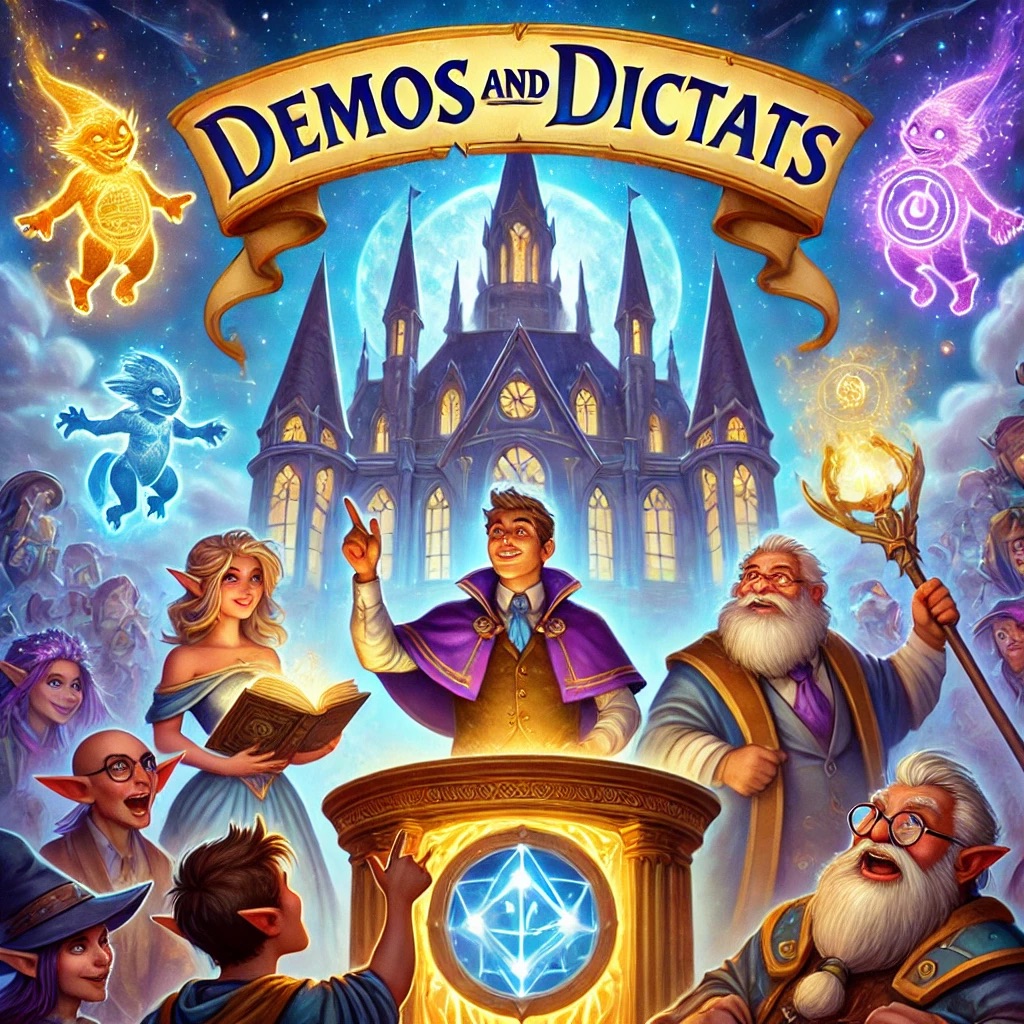
Tagline:
A satirical RPG where heroes navigate chaotic democracy using Clout, Guile, Resolve, and Pragmatism, while juggling Unity/Autonomy and Charity/Glory in their quest for power, progress, or pandemonium.
1. Premise: A Satirical Political Adventure
In the magical land of Politaria, democracy reigns supreme, but elections are messy, policies are absurd, and the people are fickle. Players take on the roles of aspiring politicians, crafty bureaucrats, and opportunistic influencers, each navigating a dysfunctional political landscape where the alignment axes of Unity/Autonomy and Charity/Glory define ideology.
Read the rest of this entry »Reweaving Dr. Fate: Chaos versus Order? (ChatGPT as Frank Miller)
Posted: January 11, 2025 Filed under: AI-Powered Essays | Tags: polarization, reconciliation, transformation, truth, values, wholeness Leave a comment
1. The Burden of Order
Kent Nelson stood in the Tower of Fate, a sanctuary of timeless symmetry and silent authority. The golden Helm of Nabu rested on a pedestal before him, aglow with the power of the Lords of Order. Yet to Kent, it no longer gleamed with the purity he once revered. It weighed on him like a chain, a beautiful cage.
The Lords of Order had taught him that chaos was the antithesis of life, a rot that must be pruned at every turn. And yet, as he gazed out at the ever-shifting world, he saw something the helm never could: the laughter of children in their mischief, the roots of a tree twisting through hard stone, the boundless stars flung into the abyss. Was it all corruption? Or could there be something divine even in the disorder?
Read the rest of this entry »Radical Graciousness: Activism as Social Therapy (ChatGPT as Gandhi)
Posted: November 28, 2024 Filed under: AI-Powered Essays | Tags: activism, polarization, politics, purpose, transformation, values 1 CommentWhy would Abbie Hoffman resist “radical graciousnsss“?
ChatGPT Prompts
This isn’t a cognitive problem. It probably reflects the emotional trauma that motivated his activism.
What historical figures could help Abbie feel psychologically safe enough to work through that?
Have Gandhi host a group therapy session on radical graciousness with Havel and Day, attended by a reluctant Abbie.
Setting the Scene
In a serene ashram courtyard under a sprawling banyan tree, Mahatma Gandhi hosts a transformative group therapy session. Joining him are Václav Havel, Dorothy Day, and a reluctant Abbie Hoffman. The participants sit on simple mats around a low wooden table, sharing fruit and tea, as they explore how graciousness can transform not only society but also the activist’s soul.
Gandhi Opens the Session
“Welcome, friends. Each of us has fought against oppression in our own way, driven by the fire of justice. But today, we ask: how do we resist without losing our humanity? Can grace not only strengthen our activism but heal the wounds that fuel it? Abbie,” he says, turning with a gentle smile, “I sense you carry a deep burden. Let’s begin with you.”
Hoffman crosses his arms, his voice sharp. “Look, Gandhiji, I appreciate the invite, but let’s not kid ourselves. Grace doesn’t topple systems. Anger does. Grace is what they preach to keep us quiet.”
Read the rest of this entry »October 32nd, Part 4: Galactic Invitation
Posted: November 26, 2024 Filed under: AI-Powered Essays, Governance Reform | Tags: polarization, politics, reform 1 Comment[I got tired of waiting to finish the story, so I asked ChatGPT to use my plot skeleton to do it for me.]
Concluding Part 3: Personal Reality
The sun hung low over the White House lawn, casting a warm glow as President Alex stood at the podium. Around the world, people gathered in living rooms, cafes, and public squares, holding their collective breath.
“Citizens of Earth,” Alex began, his three-toned voice resonating with authority and calm. “Today, I come to you not just as your president, but as your bridge to something greater. The Galactic Collective has formally invited Earth to join its union. This is an unprecedented moment in human history—a chance to become part of a broader community among the stars.”
Beside me in the university library, Carrie leaned forward, her face illuminated by the soft glow of my laptop. Around us, the room was hushed, save for the faint murmur of other students absorbed in the broadcast.
“This is… unbelievable,” she whispered, her fingers brushing her cheek absentmindedly.
Read the rest of this entry » Radical Centrism