The Great American Marriage: Kamal Harris v. Donna Trump
Posted: November 19, 2024 Filed under: AI-Powered Essays | Tags: argument, dialogue, ideas, intellectual, polarization, politics, reform, relationships, transformation, values Leave a commentWrite a hunorous three-act play where the American political divide is portrayed as a couple, Donna Trump and Kamal Harris.
ChatGPT Prompt
In Act II, show their therapist Miriam Bowen-Friedman guiding them to a breakthrough using self-harmonization and the example of Jefferson and Adams.
Highlight how their conflicts mirror their inner struggles and how embracing their rejected parts (Donna’s logic, Kamal’s passion) leads to personal and relational growth, especially for parenting their kids.
#InternalFamilySystems
Act I – “Divided We Bicker”
Setting: The living room of the America household. The room is divided down the middle. On one side, everything is red, adorned with eagles and a MAGA hat on the coffee table. On the other side, it’s blue, with a climate change poster and a Ruth Bader Ginsburg bobblehead on the shelf. Donna Trump, wearing a red power suit and pearls, is pacing aggressively. Kamal Harris, in a navy blazer with a cup of herbal tea, is calmly sitting on the couch.
Scene 1: The Disagreement
Donna Trump (hands on hips):
Kamal, I’m telling you, we need a wall! The neighbor’s kids keep cutting through our yard. It’s disrespectful!
Kamal Harris (raises an eyebrow, sipping tea):
Donna, we don’t need a wall. We need a fence, maybe even a community garden. Let’s invite them over and talk about why they’re cutting through.
Donna Trump (throws her hands in the air):
Talk? TALK? By the time you’re done “talking,” they’ll have taken the lawn chairs, the grill, and the doghouse!
Self-Harmonization: A Grand Unified Theory of Socialization
Posted: November 16, 2024 Filed under: AI-Powered Essays | Tags: dialogue, intellectual, passion, philosophy, polarization, politics, reconciliation, self, systems 4 CommentsTEDx Talk given 4/1/2024 at the The Friedman School of Self-Differentiating Leaders for a Meta-Modern World
[Opening: A Personal Confession]
When I was deciding on my career, I felt like I was being torn in two directions. On one side was Pat, my logical, analytical side, saying, “You should be a physicist. Physics is structured, precise, and universal. It reveals the hidden patterns of the universe and lets you solve problems at their core. It’s practical and clear—a perfect career path.”
On the other side was Chris, my intuitive, relational side, whispering, “You should be a social worker. Social work is about people. It’s about connection, healing, and building communities that thrive. It’s deeply human and incredibly meaningful.”
Pat saw the world as a system of forces and equations. Chris saw it as a web of relationships and emotions. For a while, I felt trapped, like I had to pick one and leave the other behind. But then, something clicked: Pat and Chris didn’t need to compete—they needed to collaborate.
That realization didn’t just shape my career; it reshaped the way I understand the world. It led me to sociology—and to what I now call self-harmonization, a grand unified theory of socialization that applies at every scale of the system, from the internal workings of the mind to the relationships between people, and even to our interactions with artificial intelligence.
Read the rest of this entry »The Grace of the Included Middle
Posted: November 9, 2024 Filed under: AI-Powered Essays | Tags: culture, dialogue, philosophy, polarization, reconciliation, religion, values Leave a commentChatGPT as Brendan Graham Dempsey
In the age of polarization, divisive ideologies, and unyielding binaries, we find ourselves in need of a profound shift in thinking—a shift that allows us to embrace paradox, complexity, and, most importantly, the grace of what I call the Included Middle. This concept does not merely lie between opposing viewpoints but occupies a space that is both-and: a creative middle that holds the tension of opposites in transformative ways. Embracing the Included Middle offers not just a strategy for navigating our complex age but an invitation to a deeper, more compassionate mode of existence.
Theologically and culturally, this approach represents a metamodern response to postmodern fragmentation. Where postmodernism often focused on deconstruction, identifying every boundary and category as a potential power play, metamodernism seeks synthesis, oscillating between structures rather than dismantling them entirely. Within this framework, the Included Middle is a profoundly sacred space—a space that mirrors the inclusive, reconciling grace we seek to embody in our fractured world.
Read the rest of this entry »Up From Socialism: The Heartbreaking Memoir Offering Hope to the Woke
Posted: January 27, 2024 Filed under: News | Tags: activism, polarization, politics, race, socialism, transformation, woke Leave a commentUp From Socialism: My 60-Year Search for a Healing New Radical Politics (Bombardier Books/Post Hill Press, edited by Adam Bellow, distributed by Simon & Schuster).
I have a confession to make.
I am a horrible person.
I am asking you to do something I haven’t done myself.
Maybe because I’m lazy and cowardly.
Or too busy. Or the wrong person.
But if you are hungry to change the world, and heal all the horrific wrongs you see in society, you need to read Mark Satin‘s latest book.
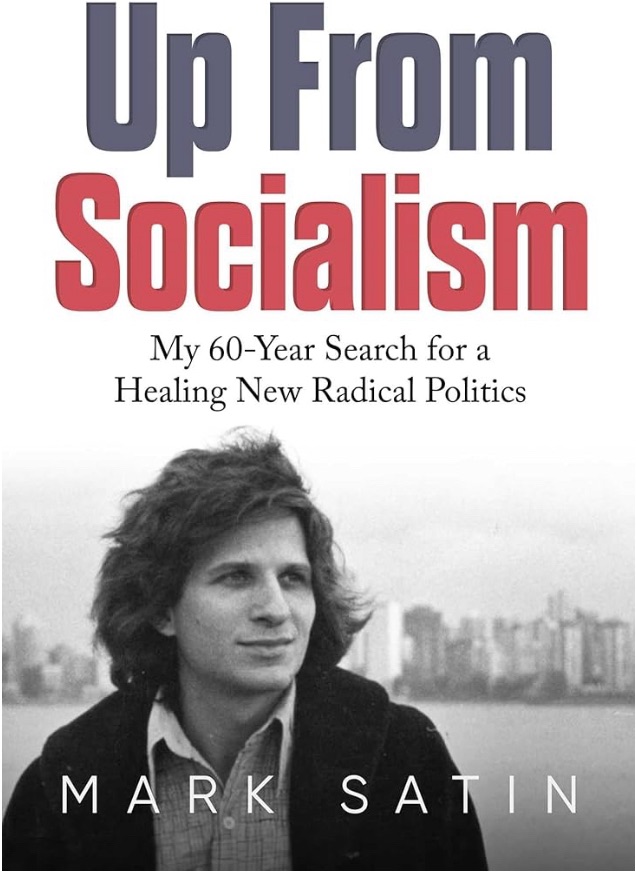
Because as he readily admits, he has tried and failed at that probably more times than anyone…
Read the rest of this entry » Radical Centrism