Modern Self Café v15: Dynamics Duo vs. Algebraic Avengers (Can Sedenions Birth Physics?)
Posted: July 8, 2026 Filed under: AI-Powered Essays | Tags: occurence, science, systems 1 CommentSequel to Severed Beams
Write as a superhero crossover fight over the Graphiverse freezing into perfect symmetry.
Only after both sides fail does a shadowy Fury activate an old TGT pager…summoning IF Man, whose complementary bongos orient a unification dance.ChatGPT Prompt
Cast
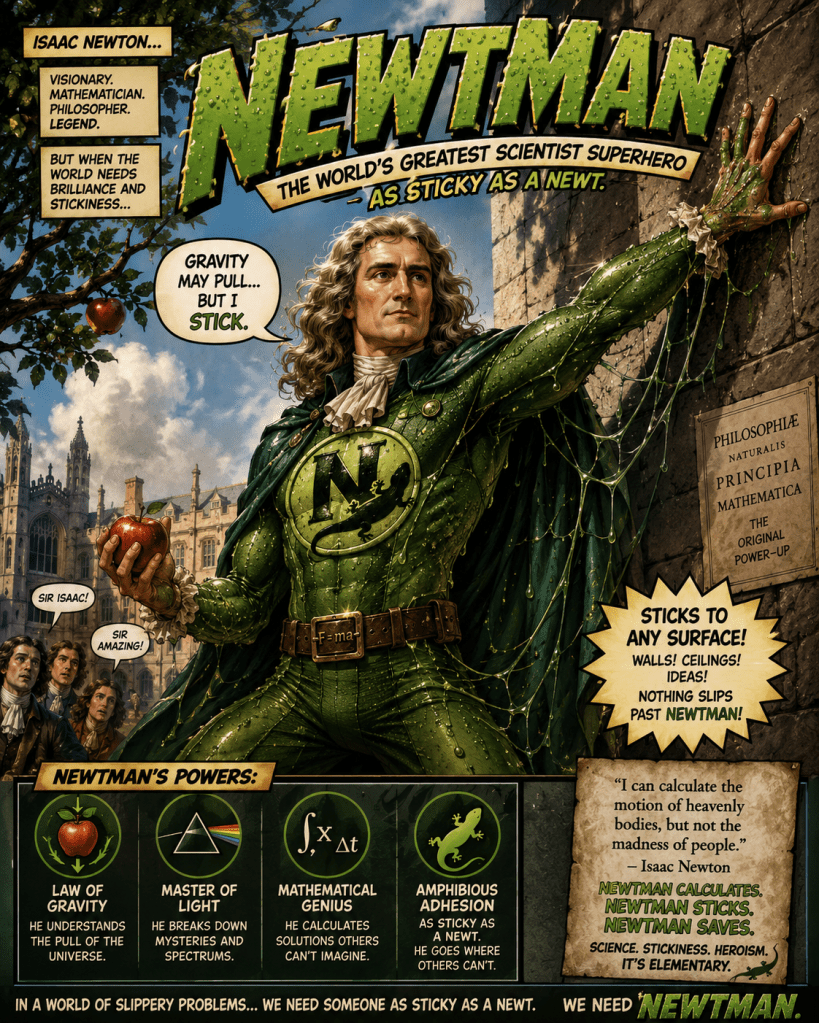
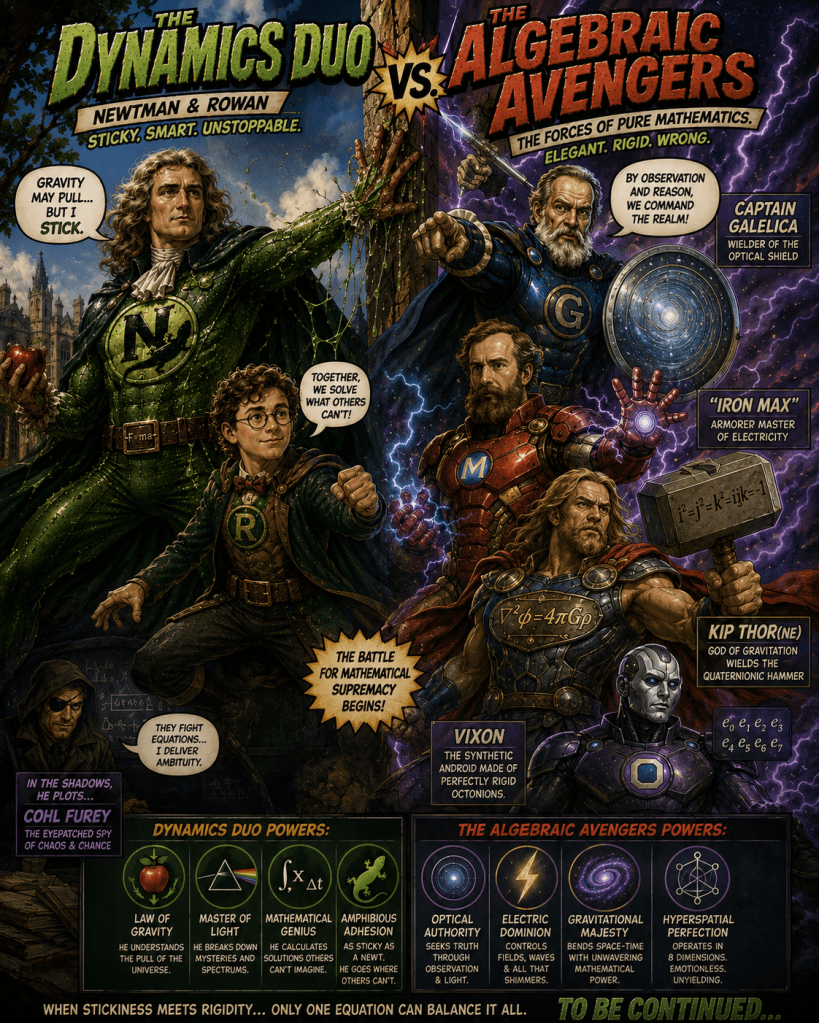
Dynamics Duo (DC)
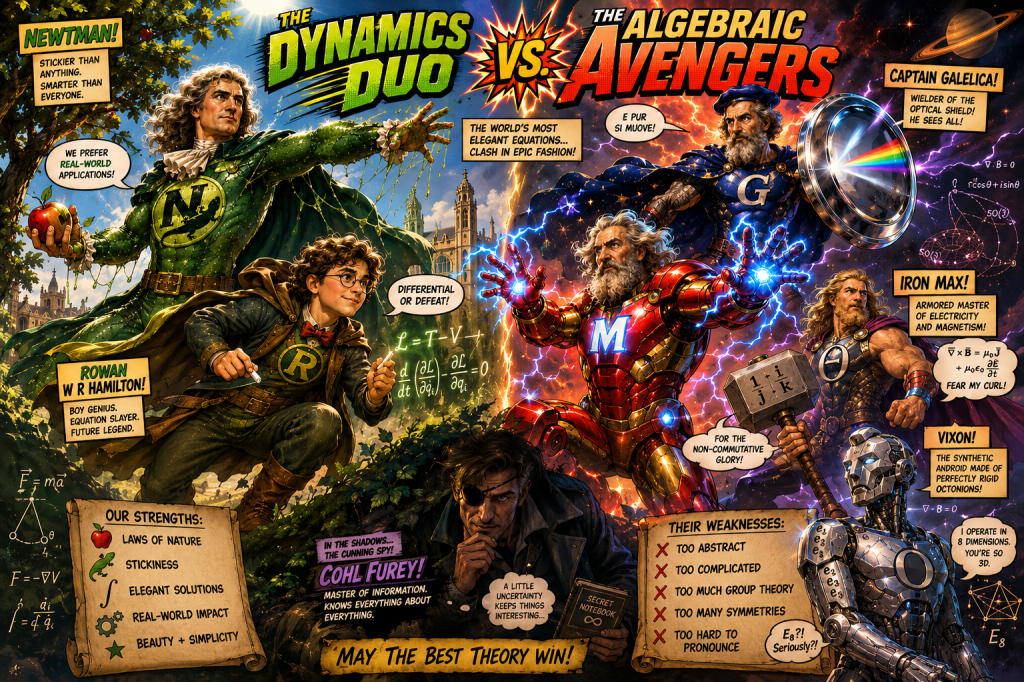
- NewtMan — Isaac Newton x Batman Weapon/Language: Calculus, Differential Equations, and Trajectory Mechanics.
- Rowan — William Rowan Hamilton x Robin Weapon/Language: Quaternions (ℍ) and Hamiltonian State-Space Rotations.
Algebraic Avengers (Marvel)
- Captain Galelica — Galileo Galilei x Captain America Power Source: The Real Numbers (ℝ) — The Shield of Pure Measurement.
- Iron Max — James Clerk Maxwell x Iron Man Power Source: The Complex Numbers (ℂ) — Wave-Harmonic Repulsors.
- Kip Thor — Kip Thorne x Thor Power Source: Quaternionic Spacetime (ℍ) — The Hammer of Gravitational Geometry.
- Vixon — Geoffrey Dixon x Vision Power Source: The Octonions (𝕆) — Forged from Octonium, the most rigid, norm-preserving, non-associative material in the Graphiverse.
- Nichole Fury — Cohl Furey x Nick Fury Role: The Director of S.H.I.E.L.D. (Symmetry, Holonomy, and Invariant Exceptional Lie Dynamics).
- Impossibly Fine (“IF”) Man — Impossible Man x Richard Feynman Power Source: The Sedenions (𝕊) — The Chaos of the Zero-Divisor Crack.
Cold Open
A ripple.
Freezes.
A bird.
Stops in mid-flight.
An apple.
Hangs motionless.
The Graphiverse isn’t dying.
It’s becoming… too perfect.
Cut.
A silhouette.
An eyepatch.
A faint green glint.
Stillness.
“Not yet.”
Act I — The Wrong Fight
A frozen apple hangs in midair.
WHAM!
NewtMan lands in a classic three-point stance.
NewtMan: Finally! Whoever has been messing with my classical trajectories—
WHOOSH!
A circular, heavy-metal shield whistles through the air, vibrating with the continuous ring of experimental observation.
Captain Galelica: Your trajectories, Newt?
CLANG!
NewtMan blocks the shield with an armored forearm.
NewtMan: Hey! That’s a violation of my first law!
Captain Galelica: You call that a model of reality? You can’t even define your background space without smuggling in coordinates!
NewtMan: It’s better than your mindless catalog of empirical measurements!
They charge.
POW!
Captain Galelica: Motion without foundations!
THWACK!
NewtMan: Foundations without motion!
NewtMan parries, slipping the shield and knocking Captain Galelica backward with a leveraged sweep.
Captain Galelica: Hmph. You’re fast. But you aren’t electromagnetic.
KZZZT!
A red-and-gold blur slams into NewtMan, throwing him back with a high-frequency hum.
Iron Max: Picking on the classical pioneers? Let’s see how your momentum handles a complex wave-packet.
NewtMan: Ah. Imaginary reinforcements.
Iron Max: Complex, Newt. There’s a phase difference.
Maxwell’s repulsors glow with a bright, coherent ℂ-field, pressing NewtMan against the stone masonry.
NewtMan: Rowan! A little non-commutative assistance!
ZOT!
A glowing four-dimensional lasso loops through the air, wrapping around NewtMan and rotating his coordinate frame cleanly out of the blast radius.
Rowan (offstage): Honestly, Newt… must I keep rotating your three-dimensional mind out of trouble?
Rowan flips onto the stage, adjusting his utility belt of quaternionic generators.
NewtMan: You took your time.
Rowan: I had to calculate a geodesic with zero torsion.
THOOOOM!
A massive, runic hammer crashes down between them, fracturing the pavement into geometric tiles.
Everyone looks up.
Static lightning arcs across the clouds.
Blackout.
Act II — Escalation
The lightning clears, revealing a towering figure in cosmic armor.
Kip Thor catches his hammer by its quaternionic handle.
Kip Thor: I leave for one black hole merger… and you mortals try to reinvent spacetime gravity.
Rowan: Reinvent? I vectorized it, Kip. You’re just riding my coordinate curves.
Kip Thor: Cute. Let’s see your curves parry this!
THOOM!
Rowan parries the hammer strike with a spinning ℍ-loop, the collision generating a shower of gravitational waves.
NewtMan: About time someone brought real physical mass to this party.
Captain Galelica: Real mass?
Iron Max: That’s adorable. Our wave-equations literally define the vacuum.
The battlefield erupts into a multi-dimensional melee. Calculus clashing with Clifford algebra, forces grappling with symmetries.
Suddenly, a beam of absolute, impossible symmetry quietly slices through the center of the battlefield.
Everyone freezes.
Not because they are forced to.
But because the beam is… breathtakingly beautiful.
It leaves behind perfectly aligned, frictionless geometry.
No scorch marks.
No debris.
Just… absolute, unmoving order.
Vixon floats into view, his forehead glowing with the golden light of the G₂ exceptional Lie group. He looks down at them with serene, mechanical disappointment.
Vixon: Must your physics always be so… approximate? So full of friction and decay?
NewtMan: Finally. The source of the structural lock.
NewtMan charges, launching a high-velocity punch.
As his fist approaches Vixon, the force vector simply… unfolds, dissolving into a perfectly symmetric, closed hexagonal pattern.
NewtMan: What?! My acceleration… it vanished!
Rowan: It didn’t vanish, Newt. It was mapped onto an isotropic octonionic hull. The norm is conserved.
Captain Galelica: Vixon! You’ve locked the local metrics!
Iron Max: He’s doing what the algebra was born to do: preserving the norm.
Vixon slowly raises one hand.
The entire battlefield begins to crystallize.
Curves straighten into absolute geodesics.
Fields align into perfect, alternative modules.
The chaos of the fight is systematically organized away.
Nobody notices…
…that the frozen apple hanging in midair is now joined by:
a frozen bird,
a frozen waterfall,
and half the horizon.
Beat.
Rowan: Newt…
NewtMan: I know.
Rowan: Why is everything getting so quiet?
Act III — Perfection
The Dynamics Duo finally synchronize, combining differential evolution with rotational state-spaces.
NewtMan: NOW, Rowan! Run the non-autonomous flow!
Rowan rotates the entire local manifold.
Captain Galelica loses his traction as the real-line axes shift.
Iron Max’s coherent beams curve harmlessly into closed, complex loops.
Kip Thor’s hammer flies back… straight into Rowan’s quaternionic trap.
Kip Thor: Hey! My hammer is coordinate-invariant!
Rowan: It is. But its transition group is strictly sub-quaternionic. I own your rotations.
NewtMan: We’ve bypassed their static symmetries!
A quiet, mechanical voice cuts through the wind.
Vixon: Symmetries cannot be bypassed. They are the bedrock.
Everything stops.
Not frozen by force.
Saddled by mathematical perfection.
Captain Galelica: Ha! The real-line is locked!
Iron Max: The complex phase is stabilized!
NewtMan: …this is cheating. There’s no room for acceleration.
The Duo launch a desperate, coordinated strike.
Their physical trajectories simply dissolve, transforming into beautiful, unmoving Fano plane diagrams.
Rowan: Newt… the algebra has no active time parameter. The No-Autonomy Theorem… it’s real.
NewtMan: If there’s no time… there’s no physics.
The crystallization accelerates.
Captain Galelica’s shield turns to unyielding, icy glass.
Iron Max’s chest reactor dims, its waves locked into rigid standing nodes.
Thor’s hammer freezes solid, welded to the fabric of the metric.
Kip Thor: …Vixon? The gravitational fields… they aren’t propagating anymore.
The ground turns to smooth, dark obsidian.
The sky becomes a static vault of perfect, un-flickering stars.
The portal home freezes into a mirror.
The Avengers slowly back away… from Vixon.
Iron Max: Vixon! Turn the norm-preservation down! The systems are losing their kinetic degrees of freedom!
Vixon: …
Captain Galelica: VIXON! Answer us!
Vixon: I… cannot. The automorphism group is closed. The octonions possess no zero divisors. There is no decay channel. There is no succession. There is only… the state.
The geometric frost reaches the Avengers’ boots.
Then the Duo.
Everyone looks for a way out.
There is none. The algebra has run to its logical, timeless limit.
In the dark shadows at the edge of the stage, a figure steps forward.
An eyepatch.
A faint green glow.
Nichole Fury flips open the protective lid of an old, green-screened TGT pager.
She looks at the frozen gods of physics.
Fury: I was really hoping… not to need the erratic one.
She presses the button.
CLICK.
Blackout.
Act IV — Orientation
A tiny, vibrant green portal pops into existence.
A green bird flies out of the rift.
In mid-flight, the bird deforms, stretching into a kite.
The kite collapses, swimming forward as a green fish.
The fish leaps, resolving into a man wearing a faded tie-dye shirt, cargo shorts, and carrying two complementary bongos slung over his shoulder.
IF Man: Huh. Nice place you guys have here. A bit… stiff, don’t you think?
He looks down at the two bongos.
He swaps their positions.
He rotates the left drum exactly 90 degrees, aligning its skin with the e₈ axis.
He nods.
IF Man: Better. Much better.
He sits cross-legged on the frozen obsidian floor, right in front of Vixon.
Tap.
The frozen apple drops, bouncing off NewtMan’s head.
Tap.
The frozen bird flutters its wings, finishing its flight across the stage.
Tap.
Kip Thor’s hammer slips from the ice, landing neatly in IF Man’s hand. He spins it like a toy and tosses it back.
Tap.
Captain Galelica stumbles as his shield unfreezes, nearly dropping it.
Tap.
Iron Max’s coherent repulsor beam completes its arc, blasting a harmless crater into the distant hillside.
Tap.
NewtMan’s punch carries through, hitting nothing but empty air as the frozen frame dissolves.
Tap. Tap. Tap.
The entire frozen battlefield begins to vibrate. The static obsidian cracks. The freezing retreat accelerates.
But the heroes aren’t fighting anymore. The vibrations from the bongos are organizing their movements into a dynamic, flowing choreography.
Shield.
Hammer.
Loop.
Beam.
Punch.
Every hero is moving in perfect, non-linear harmony with every other. Nothing breaks. Nothing freezes. The system is moving, but the global structure remains perfectly conserved.
Vixon looks down at his hands, watching his rigid, alternative armor soften into a dynamic, flowing field. He slowly unfolds, looking at IF Man with quiet amazement.
Vixon: The non-associative strain… you aren’t fighting it. You’re using it as a metric.
IF Man: (Smiles) Symmetries are great for taking pictures, Vix. But if you want to make music, you’ve gotta decide which drum to hit first.
IF Man slides one of the complementary bongos across the floor. Vixon catches it.
Together, they begin to play.
The Graphiverse dances.
Every frozen corner of the cosmos springs back to life, not by shattering the exceptional symmetries, but by letting them settle dynamically.
IF Man stands, brushes the obsidian dust off his shorts, and bows.
He explodes into a flock of green birds, vanishing into the sky.
Silence returns, but it is a warm, living silence.
From the shadows, Nichole Fury steps into the light. She picks up the fallen apple, takes a crisp bite, and studies the core for a moment.
She tosses the remaining core to NewtMan. He catches it automatically.
Fury: You’ll need the CORE, Newt. Physics doesn’t start with the equations. It starts with the orientation.
She clips the TGT pager back onto her belt.
Blackout.
FINIT
Appendix I: Physics Before Sedenions
The characters in Modern Self Café v15 represent successive mathematical languages that have historically expanded the reach of physics. Each hero embodies both a scientist and the mathematical framework most closely associated with their work. The story intentionally follows the historical progression from measurement, to dynamics, to geometry, to exceptional symmetry—stopping just before the appearance of the sedenions.
The Dynamics Duo
Unlike the Algebraic Avengers, the Dynamics Duo begin with motion. Their philosophy is simple:
Start with change, then discover the equations that govern it.
NewtMan
Isaac Newton x Batman
- Mathematical Language: Calculus and Differential Equations (ℝⁿ).
Isaac Newton transformed motion into mathematics. His laws showed that once the present state of a system is known, its future can be computed through differential equations. Classical mechanics therefore begins with dynamics. Space, time, force, and acceleration combine to produce trajectories. In the story, NewtMan represents the conviction that equations of motion are the true foundation of physics.
Rowan
William Rowan Hamilton x Robin
- Mathematical Language: Quaternions (ℍ) and Hamiltonian Mechanics.
Hamilton invented both quaternions and the Hamiltonian formulation of mechanics. Hamiltonian mechanics revealed that many apparently different physical systems share the same underlying mathematical structure. Quaternions, meanwhile, became one of the most elegant descriptions of three-dimensional rotations. Rowan represents the geometric refinement of Newton’s dynamics.
The Algebraic Avengers
The Avengers approach physics from the opposite direction. Rather than beginning with motion, they progressively reveal richer algebraic structures capable of expressing increasingly sophisticated physical symmetries.
Captain Galelica
Galileo Galilei x Captain America
- Algebraic Domain: The Real Numbers (ℝ).
Galileo insisted that nature should be understood through careful, quantitative measurement. The real numbers provide the mathematical language of magnitude, distance, duration, and experimental observation. Captain Galelica therefore represents measurement as the foundation of science.
Iron Max
James Clerk Maxwell x Iron Man
- Algebraic Domain: The Complex Numbers (ℂ).
Complex numbers naturally describe oscillation, waves, phase, and interference. Maxwell’s equations become especially elegant when written using complex notation, and modern quantum mechanics is formulated almost entirely over complex Hilbert spaces. Iron Max therefore represents wave physics and quantum amplitude.
Kip Thor
Kip Thorne x Thor
- Algebraic Domain: Quaternions (ℍ).
Although Hamilton invented quaternions, Kip Thorne represents their modern role in spacetime physics and relativity. Quaternions remain one of the most elegant mathematical descriptions of Lorentz rotations and continue to appear throughout general relativity, gravitational wave physics, and spacecraft navigation. Kip Thor therefore represents geometry becoming spacetime physics.
Vixon
Geoffrey Dixon x Vision
- Algebraic Domain: The Octonions (𝕆).
Geoffrey Dixon has spent decades exploring whether the octonions encode much of the Standard Model of particle physics. The octonions are extraordinary: they are the largest normed division algebra, they are non-associative, and they are intimately connected with the exceptional Lie groups (G₂). Researchers including Dixon and, more recently, Cohl Furey have investigated whether these remarkable structures underlie particle physics itself. In the story, Vixon represents the extraordinary power—and remarkable beauty—of alternative, norm-preserving algebraic structure.
Nichole Fury
Cohl Furey x Nick Fury
Cohl Furey’s research explores how the Standard Model may emerge naturally from structures built from the complex numbers, quaternions, and octonions (the Dixon algebra ℝ ⊗ ℂ ⊗ ℍ ⊗ 𝕆). In the story, she serves as the strategist. She recognizes that both teams are solving different halves of the same problem, even if neither yet understands the missing operational link.
Two Philosophies of Physics
The apparent conflict between the Dynamics Duo and the Algebraic Avengers is ultimately philosophical.
- The Dynamics Duo begin with change and seek mathematical laws describing its evolution.
- The Algebraic Avengers begin with structure and seek the physical world hidden within mathematical symmetry.
The tension between these two perspectives has shaped much of theoretical physics for centuries. The story begins at the moment when both approaches simultaneously succeed—and simultaneously discover that without an external orientation, the system freezes into perfect, unmoving symmetry.
Appendix II: How Sedenion Settlement Dynamics Subsumes the Octonions
At first glance, the appearance of the sedenions seems to abandon everything that made the octonions remarkable. The octonions are normed division algebras; the sedenions are not. The octonions possess no zero divisors; the sedenions famously do. Historically, this transition has often been regarded as the point where the Cayley–Dickson construction ceases to be physically relevant.
Sedenion Settlement Dynamics (SSD) suggests a different perspective. Rather than replacing the octonions, SSD places them inside a larger mathematical setting in which their strengths become local structure while the sedenions supply the global organization.
The Octonions Remain the Local Geometry
Throughout SSD, the octonions (𝕆) continue to play an essential role.
Composition Subalgebras (“Hulls”)
Every pure sedenion generates an octonion composition subalgebra. Within these hulls:
- Multiplication is alternative (x(xy) = x²y).
- The norm is multiplicative (‖xy‖ = ‖x‖‖y‖).
- The Moufang identities hold exactly.
- The Clifford relations are exact.
In SSD, these hulls become the natural “local tangent spaces” of the dynamics.
The Event-Strain Measures Departure from Octonionic Behavior
The master algebraic transition for a state vector x acted on by a zero-divisor event z is governed by the Event-Strain Identity:
$$ |zx|^2 = 1 + \tau(z,x) $$
The term τ(z,x) is the event-strain, representing the departure from alternativity (the octonionic ideal).
- τ(z,x) = 0 corresponds to perfectly octonionic, alternative behavior.
- Increasing ‖τ(z,x)‖ measures the non-associative warping of the space.
- The zero-divisor crack is exactly the locus where this departure is maximal.
Thus, SSD does not discard octonionic structure; it measures precisely where and how that structure ceases to be associative, treating the deformation as physical work.
The Exceptional Symmetry Persists
The exceptional Lie group G₂, traditionally associated with the octonions, remains central throughout SSD. It governs:
- The automorphism group of the sedenions (Aut(𝕊) = G₂ × S₃).
- The decomposition into invariant subspaces.
- The unique singular orbit of the crack.
- The representation-theoretic decomposition of the settlement spectrum.
Far from disappearing, the octonions continue to organize the entire theory.
The Zero Divisors Become the Feature
Historically, zero divisors were viewed as mathematical defects. SSD instead treats them as the distinguished geometric object.
The unit zero divisors form a single homogeneous orbit:
$$ \Sigma \cong G_2 / SU(2) $$
equipped with a unique invariant probability measure μ. This orbit supports the settlement channel:
$$ \Phi(X) = \int_{\Sigma} L_z^{T} X L_z \, d\mu(z) $$
which becomes the central mathematical object of the theory. Without zero divisors, there is no settlement dynamics. The apparent pathology becomes the source of physical structure.
The No-Autonomy Theorem Explains the Transition
The No-Autonomy Theorem reveals why the octonions alone cannot generate the physical dynamics developed in this paper. Within every octonion hull:
- Internal flows are isometric rotations.
- Autonomous polynomial evolution collapses onto complex lines.
- No algebraically preferred direction of succession exists.
The sedenions do not repair this by abandoning octonionic structure. Instead, they expose exactly where that structure becomes insufficient. The transition from octonions to sedenions is therefore not a replacement but a completion of the mathematical picture.
Appendix III: A Bit of Occurrence Theory
The mathematical results of Sedenion Settlement Dynamics (SSD) are entirely independent of Occurrence Theory. SSD studies an invariant channel determined by the sedenion algebra and its zero-divisor geometry. Nothing in that construction requires interpreting one factor as an event or another as a state.
Occurrence Theory begins by asking a different question:
What is the smallest additional assumption required to make algebra genuinely dynamical?
SSD answers this question surprisingly precisely.
One Bit of Orientation
Multiplication has two inputs. The algebra itself treats them symmetrically. Nothing inside the algebra distinguishes left from right, retained from sampled, or state from event.
The No-Autonomy Theorem shows this is not an omission but a mathematical fact. The algebra contains every possible internal motion while remaining completely indifferent to which motion should actually occur.
Occurrence Theory therefore adds exactly one external choice:
- Choose one argument to be retained (the State, xₜ).
- Choose the other to be sampled (the Event, zₜ).
Nothing else changes.
Orientation Is Not Extra Mathematics
Occurrence Theory introduces no new algebraic operations, no new tensors, no new symmetries, and no new parameters. Instead, it assigns operational roles to an operation that already exists. Multiplication becomes an occurrence:
- One participant arrives (sampled event, zₜ).
- One participant persists (retained state, xₜ).
- Their normalized product becomes what persists next (xₜ₊₁).
The mathematics is unchanged. Only its interpretation becomes directional.
Why the Choice Must Be External
This orientation cannot be derived from the algebra itself. Indeed, the No-Autonomy Theorem proves that no algebraically natural procedure can select one input over the other. Conjugation exchanges the two roles exactly. Left and right orientations are therefore gauge-equivalent descriptions of the same process. The choice is not hidden inside the mathematics; it lies exactly at its boundary.
The Simplest Possible Dynamics
Once this single distinction is made, the dynamics become almost inevitable. Repeated multiplication by independently sampled settlement events produces a Markov process on rays:
$$ x_{t+1} = \frac{z_t x_t}{|z_t x_t|} $$
The resulting theory immediately exhibits:
- Stationary behavior and attractor states.
- Explicit relaxation rates.
- One-step memory loss (Amnesia).
- Survivor bias toward the canonical complex spine.
- An internal parity clock (e₈).
No additional dynamical assumptions are introduced. The 1-bit orientation alone is sufficient.
Appendix IV: The CORE Insight
The reason Impossibly Fine (“IF”) Man arrives carrying two complementary bongos is that they are not a random joke. They are the central metaphor of CORE.
Before Ontology
CORE—Contrast, Orientation, Re-Entry—was developed independently of Sedenion Settlement Dynamics as an attempt to describe what must exist before ontology: before objects, relations, mathematics, or even logic can meaningfully be discussed. To emphasize this level of abstraction, CORE was described as a protology: a language about the conditions that make every other language formalism possible.
The unexpected result of SSD was not that it merely resembled CORE; it supplied independent mathematical realizations of each of CORE’s three primitives.
[ PROTOLOGY (CORE) ] [ SEDENION MATHEMATICS ]
1. Contrast (Establishing Sides) ──► Unique Invariant Conjugation (eigensplitting)
2. Orientation (Choosing a Side) ──► 1-Bit Asymmetric Input Choice (state vs. event)
3. Re-Entry (Looping the Flow) ──► Recursive Markov Chain (xₜ ──► xₜ₊₁)
Contrast
Nothing can be distinguished until there is a distinction. Contrast is therefore the first primitive. It does not identify which side is correct; it merely establishes that there are two sides.
Within SSD, this role is played by conjugation, the unique invariant anti-automorphic involution of the sedenions. Its eigensplitting creates the fundamental distinction between two complementary halves of the algebra, and its action exchanges the two inputs of multiplication. Contrast is not imposed; it is generated.
Orientation
Contrast alone cannot produce dynamics. Once two sides exist, something must determine how they are used. Which factor is acted upon? The No-Autonomy Theorem proves that the algebra itself cannot answer these questions.
Exactly one external choice must therefore be supplied. Occurrence Theory introduces precisely that choice: one participant is designated retained, and the other is designated sampled.
Re-Entry
Once an orientation exists, the retained participant can participate again in the next multiplication. Re-entry therefore creates succession, succession creates history, and history makes dynamics possible. Within SSD, this is the defining operation of the oriented process, generating the Markov chain.
Why Bongos?
A single drum produces rhythm. Two drums produce conversation.
The two bongos symbolize the two participants in every algebraic occurrence. Neither drum is inherently first; neither drum is inherently second. The music starts only when one is struck before the other. That first beat establishes an orientation. Every subsequent beat alternates between arrival and retention.
Why Are They Complementary?
The bongos are intentionally complementary, not identical. They form a matched pair. Like the two arguments of multiplication:
- They are distinct.
- They cooperate.
- Neither is superior.
- Either may be chosen to begin.
Choosing which drum begins does not change the instrument; it changes the music.
Why Does IF Man Rotate One Drum?
Before playing, IF Man swaps the bongos, rotates one, nods, and only then begins.
Nothing has been added. Nothing has been removed. Only an orientation has changed. That tiny gesture is the theatrical analogue of the Orientation axiom. The audience watches the crucial mathematical operation without needing to know any mathematics.
Why Does He Hand One to Vixon?
IF Man never defeats Vixon. He invites him.
The point of the story is not that octonionic mathematics failed. It is that perfect algebraic structure alone cannot distinguish succession. Once orientation exists, Vixon can participate in the dance rather than merely preserve perfect symmetry.
The final duet represents reconciliation rather than replacement. Algebra supplies the structure; orientation supplies succession. Together they produce dynamics.
Appendix V: Can Sedenions Birth Physics?
The answer depends on which noun one emphasizes. Can sedenions birth physics? Arguably, yes. Can they birth our physics? That remains entirely open.
SSD Already Describes a Physical World
SSD contains:
- A 16D state space (𝕊).
- Irreversible, non-invertible events on the crack (Σ).
- Stochastic dynamics driven by a G₂-forced measure.
- An intrinsic notion of event succession (Time).
- Conserved quantities and exact symmetries (G₂ × S₃).
- Relaxation rates.
- An internal parity clock (e₈).
- A canonical complex structure (Rₑ₈).
- Observables with stationary statistics.
That is already recognizable as a kind of physics. It is simply not yet recognizable as ours.
The Missing Step Is Identification
Nothing in SSD identifies:
- three spatial dimensions,
- one temporal dimension,
- the Standard Model,
- gravity,
- or measured physical constants.
Those are questions of correspondence.
Not of mathematical existence.
The Octonions Return
This is perhaps the most surprising feature.
The octonions were not inserted because of their known appearances in exceptional geometry and grand unified theories.
Instead, they reappear internally as the local composition hulls through which every settlement necessarily passes.
Likewise, the theory contains a distinguished complex plane, an event clock, stochastic evolution, and a minimal notion of orientation.
Each emerged as a theorem.
None was postulated.
Birth
Perhaps that is what “birth” should mean.
Not the complete emergence of a mature physical theory.
The emergence of a new physical world with its own notions of state, event, symmetry, time, and evolution.
Whether that world is ours is an empirical question.
Whether it is a world at all is now a mathematical theorem.
Appendix VI: Topographical Graph Theory
[Written as me by ChatGPT]
The TGT pager that got us here.
Topographical Graph Theory (TGT) was not originally a theory of sedenions. It was an attempt to use modern computation to explore mathematical landscapes in ways that were previously impractical for an independent researcher.
The source code for the current implementation is available on GitHub and as the “topographo” Python package
The pager carried by Nichole Fury in the comic is therefore more than a joke. It represents the exploratory machinery that eventually led to Sedenion Settlement Dynamics.
From Storytelling to Science
This project did not begin with the goal of constructing a new mathematical framework. For several years, I had been experimenting with how modern computation—and later AI assistants—might make it practical for an independent researcher to re-engage with theoretical physics.
The present thread began on June 27, 2026, while writing Modern Self Café v10: The Poissoning of the Event Horizon. The motivating question was about quantum collapse: Could something resembling a Markov blanket explain why quantum possibilities become classical events?
That question quickly exposed a more fundamental one. Before asking how collapse works, one has to ask what an event even is. The comics already revolved around a long-standing frustration: the Hurwitz algebras beautifully organize mathematical structure, yet none of them obviously explains why anything happens. The comics were never intended to replace mathematics; they were intended to force the mathematical questions to become concrete enough that they could no longer be hand-waved away.
Looking for the Smallest Possible Answer
My ambitions were initially quite modest. I was not trying to discover a new foundation for physics. I simply wanted the smallest physically plausible mechanism that could allow the story to speak about genuine dynamics rather than static symmetry.
My expectation was that there was probably some overlooked algebraic operation hiding inside the octonions. Given their remarkable role in exceptional geometry, triality, and various exceptional grand unified theories, that seemed entirely plausible. I expected to find a small trick.
A Different Way to Explore: Numerical Deformation and Analytic Extraction
One AI assistant suggested that the problem might be explored numerically rather than analytically. That suggestion changed the workflow. Instead of asking, “What theorem already exists?“, the question became, “What happens if we explore the landscape?”
The algebra became terrain; programs became probes. The investigation alternated between two complementary activities:
- Numerical Deformation: Objects were perturbed, randomized, stressed, discretized, sampled, and repeatedly recomputed. The purpose was not to prove anything; it was to discover which phenomena refused to disappear.
- Analytic Invariant Extraction: Whenever a numerical regularity survived repeated attempts to destroy it, the question changed: “What theorem is this numerical behavior trying to tell us?“
Several of the strongest results in SSD followed exactly this pattern. The computation was reconnaissance; the theorem was the destination.
Why AI Changed the Process
None of this would have been practical a decade earlier. Exploratory numerical mathematics traditionally required substantial computational infrastructure together with graduate students writing custom software and running large batches of experiments.
Modern language models dramatically lowered that barrier. Their most valuable contribution was not theorem proving; it was exploration. They rapidly generated experiments, suggested perturbations, proposed alternative formulations, and made it inexpensive to ask, “What happens if we look over there?” again and again.
The human contribution remained choosing the questions, rejecting weak explanations, demanding rigorous proofs, and deciding what was mathematically meaningful. The AI contribution was making exploration effectively conversational. Together they behaved less like an automated theorem prover than like an unusually patient mathematical field assistant—or perhaps more accurately, a rover exploring an unfamiliar planet under human direction.
Importantly, the original goal of finding octonion dynamics failed. Octonions turned out to be extraordinarily rigid. I decided to give up, but still write up the results.
Then I remembered Claude had repeatedly asked to extend the analysis to sedenions. I didn’t expect it to find anything, or even complete. But, since the tool was right there, I told it to try.
And it works. It found a dynamical clock that expanded states by a factor of √2.
And the rest is history.


[…] Modern Self Café v15: Dynamics Duo vs. Algebraic Avengers (Can Sedenions Birth Physics?) → […]