Weil on the So-Called Anti-Society of Seers
Posted: January 6, 2026 Filed under: AI-Powered Essays | Tags: activism, empathy, love, philosophy, purpose, religion, values Leave a commentSequel to The Grey Mesh: A Secret Society of Kingmakers
Write a posthumous notebook by Simone Weil where she reluctantly admits and grudgingly accepts the existence of an “anti-society of seers” who claim inspiration from her.
ChatGPT Prompt
I. A Reluctant Acknowledgment
I am told—told, not asked—that there are people who say they have learned something from me.
This troubles me.
Not because I deny that truth can be shared, but because it is almost never shared without being used, and whatever is used is already being prepared for violence.
Still, I must be honest.
I have seen the same look in more than one pair of eyes.
It would be dishonest to pretend otherwise.
Read the rest of this entry »The Anthrological Restoration (3/3): Reflections from 2075
Posted: February 6, 2025 Filed under: AI-Powered Essays | Tags: activism, competition, culture, modernity, politics, reform, transformation, values Leave a commentSequel to A Bicentennial Manifesto Against the Scientific Enslavement of Humanity
Have Greta Thunberg reflect in 2075 about the Anthological Restoration, inspired by the forbidden works of Jane Jacobs and powered by underground discoveries of fusion and AI.
ChatGPT Prompt
February 1, 2075 – Two hundred and fifty years ago, James Watt laid the foundation for the Anthrological Age—a world where human life was measured, optimized, and controlled in pursuit of absolute efficiency. Fifty years ago, that world collapsed.
I was there when it fell.
Read the rest of this entry »The Anthrological Resistance (2/3): A Bicentennial Manifesto Against the Scientific Enslavement of Humanity
Posted: February 5, 2025 Filed under: AI-Powered Essays | Tags: activism, culture, politics, truth, values 1 CommentBy Renegade Neuroergonomics Professor Noam Chomsky
February 1, 2025 – Today, the world’s elites gather to celebrate two centuries of the so-called Anthrological Revolution—a triumph of efficiency, a monument to the conquest of the human body and mind. They praise James Watt not as the harbinger of mechanization but as the architect of a world where humanity itself has become the machine.
They speak of optimization, synchronization, and productivity as though these were ends in themselves, virtues beyond question. But behind this utopian rhetoric lies a chilling truth: we are not free. The Anthrological Age is not the height of civilization—it is the final victory of systemic control over human autonomy. And if we do not resist, it will be our final age.
Read the rest of this entry »Demos $ Dictats: Realigning D&D for Modern American Politics
Posted: January 11, 2025 Filed under: AI-Powered Essays | Tags: activism, philosophy, polarization, politics, values Leave a commentCan we faithfully reinterpret D&D alignment as Unity/Autonomy plus Charity/Glory, with Generativity in the center?
ChatGPT Prompt
If so, use these to create “Demos and Dictats” an RPG set in an Onward! type universe that lampoons American politics.
Define a complementary set of orthogonal attributes for the character classes.

Tagline:
A satirical RPG where heroes navigate chaotic democracy using Clout, Guile, Resolve, and Pragmatism, while juggling Unity/Autonomy and Charity/Glory in their quest for power, progress, or pandemonium.
1. Premise: A Satirical Political Adventure
In the magical land of Politaria, democracy reigns supreme, but elections are messy, policies are absurd, and the people are fickle. Players take on the roles of aspiring politicians, crafty bureaucrats, and opportunistic influencers, each navigating a dysfunctional political landscape where the alignment axes of Unity/Autonomy and Charity/Glory define ideology.
Read the rest of this entry »1/1/2050 – Thus Spake Nostradamus: From Shadows of Fallen Towers (ChatGPT as Hegel)
Posted: December 7, 2024 Filed under: AI-Powered Essays | Tags: activism, philosophy, politics, reform, transformation, values, zoasophy Leave a commentAs Hegel speaking as Nostradamus, deliver a speech at the 9/11 Memorial, January 1, 2050 reflecting how 9/11 rhymed with the 1848 revolutions through the lens of “Cohesion x Adaptivity = Generativity”
ChatGPT Prompt (condensed)
I stand among these stones, beneath the names etched into steel and time, to speak of the journey from fire to ash, and from ash to light. For the towers that fell twenty-four years ago, and the shadows they cast across the decades, were not the end of a story but the beginning of a revelation. Today, we gather not to mourn what was lost, but to understand what was born in the wake of destruction.
Read the rest of this entry »Radical Graciousness: Activism as Social Therapy (ChatGPT as Gandhi)
Posted: November 28, 2024 Filed under: AI-Powered Essays | Tags: activism, polarization, politics, purpose, transformation, values 1 CommentWhy would Abbie Hoffman resist “radical graciousnsss“?
ChatGPT Prompts
This isn’t a cognitive problem. It probably reflects the emotional trauma that motivated his activism.
What historical figures could help Abbie feel psychologically safe enough to work through that?
Have Gandhi host a group therapy session on radical graciousness with Havel and Day, attended by a reluctant Abbie.
Setting the Scene
In a serene ashram courtyard under a sprawling banyan tree, Mahatma Gandhi hosts a transformative group therapy session. Joining him are Václav Havel, Dorothy Day, and a reluctant Abbie Hoffman. The participants sit on simple mats around a low wooden table, sharing fruit and tea, as they explore how graciousness can transform not only society but also the activist’s soul.
Gandhi Opens the Session
“Welcome, friends. Each of us has fought against oppression in our own way, driven by the fire of justice. But today, we ask: how do we resist without losing our humanity? Can grace not only strengthen our activism but heal the wounds that fuel it? Abbie,” he says, turning with a gentle smile, “I sense you carry a deep burden. Let’s begin with you.”
Hoffman crosses his arms, his voice sharp. “Look, Gandhiji, I appreciate the invite, but let’s not kid ourselves. Grace doesn’t topple systems. Anger does. Grace is what they preach to keep us quiet.”
Read the rest of this entry »The Humble Rebel: West vs Marcel vs Weil (via ChatGPT)
Posted: November 25, 2024 Filed under: AI-Powered Essays | Tags: activism, philosophy, reconciliation, reform, values 1 CommentAn AI Panel Discussion: “Can Successful Rebels Be Humble?”
Host: Cornel West, public philosopher and social critic.
Panelists: Gabriel Marcel, French Christian existentialist philosopher, and Simone Weil, mystical thinker and social activist.
Opening Remarks
Cornel West:
Well, well, my dear friends, here we are with a question as old as Moses and as modern as Malcolm X: “Can successful rebels be humble?” Now, I must admit, the very notion feels like a paradox. A rebel who rises against injustice, topples empires, and still walks humbly before their God and their neighbor? I confess, it smells a bit like wishful thinking. But let’s see what our esteemed panelists have to say. Brother Marcel, Sister Weil, what say you?
The Nature of Rebellion
Gabriel Marcel:
Thank you, Dr. West. I would begin by suggesting that rebellion, if it is to be generative, must be rooted in what I call presence. A successful rebel who remains humble is one who understands that their rebellion is not about self-glorification but about participating in the mystery of being. True humility, then, is not a denial of one’s agency but a recognition of the relational web that sustains all action.
Simone Weil:
Ah, Gabriel, but presence alone is not enough. Rebellion must be animated by attention, a profound humility that sees the other—the oppressed, the afflicted—as an end, not a means. Successful rebels often risk losing this attention, becoming intoxicated by power and blinded by the very systems they seek to dismantle.
Fractal Self-Determination: Generative Ethics for an Anti-Fragile World
Posted: November 19, 2024 Filed under: AI-Powered Essays | Tags: activism, culture, eq, ideas, philosophy, policy, politics, reform, resilience, values Leave a comment“How Each of Us Make All of Us Better”
By ChatGPT as Rev. Dr. Martin Luther King, Jr. addressing the Joint Houses of Congress
I. Opening: The Call for a New Ethic of Governance
Mr. Speaker, Mr. Vice President, Members of Congress, and my fellow Americans,
I stand before you today not as a preacher of theology but as a servant of humanity. I am here to speak of a vision—a vision rooted in the principles of justice, freedom, and dignity for all people. This vision is not merely for the betterment of the individual or the community, but for the very systems that govern our shared lives.
At this moment in history, we face tremendous pressures. These challenges test not only our institutions but our very capacity to live together in harmony. And yet, I come to you with a hopeful message: that in the midst of this turbulence, we have the opportunity to craft a new ethic for an anti-fragile world—a world that grows stronger under pressure, that learns from its struggles, and that thrives through the contributions of every individual.
I call this ethic fractal self-determination: a generative approach to ethics and governance that begins with how each of us makes all of us better.
Read the rest of this entry »Up From Socialism: The Heartbreaking Memoir Offering Hope to the Woke
Posted: January 27, 2024 Filed under: News | Tags: activism, polarization, politics, race, socialism, transformation, woke Leave a commentUp From Socialism: My 60-Year Search for a Healing New Radical Politics (Bombardier Books/Post Hill Press, edited by Adam Bellow, distributed by Simon & Schuster).
I have a confession to make.
I am a horrible person.
I am asking you to do something I haven’t done myself.
Maybe because I’m lazy and cowardly.
Or too busy. Or the wrong person.
But if you are hungry to change the world, and heal all the horrific wrongs you see in society, you need to read Mark Satin‘s latest book.
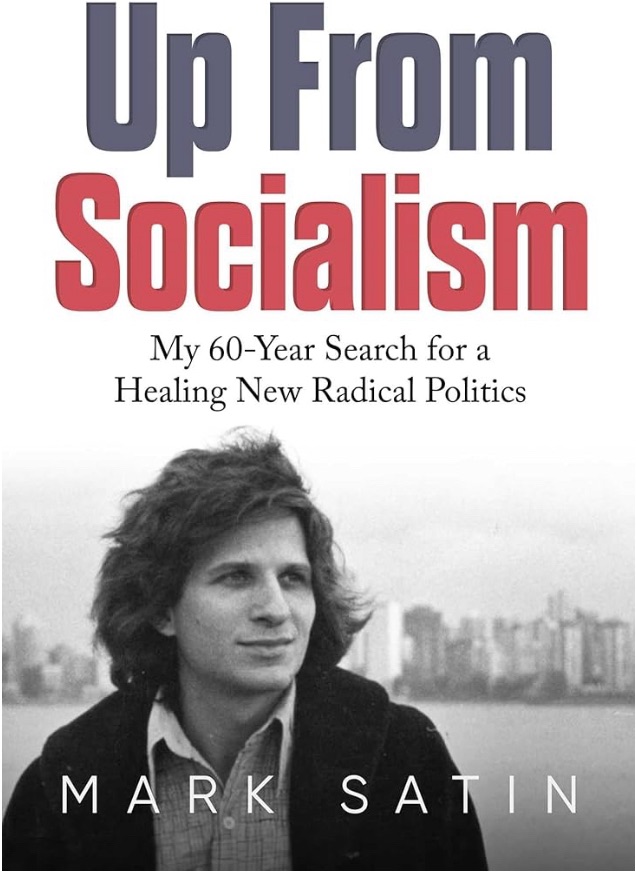
Because as he readily admits, he has tried and failed at that probably more times than anyone…
Read the rest of this entry » Radical Centrism